 Crypto Exchange Software
  White Label Crypto Exchange
  P2P Crypto Exchange
  Crypto Futures Trading
  Forex Trading Software
  Token Launchpad
  Margin Trading
  Liquidity Engine
  Crypto Wallet
  KYC & AML
  Exchange Security
  Crypto Staking Software
  Crypto Lending Software
  Crypto Earn Module
  Exchange Integrations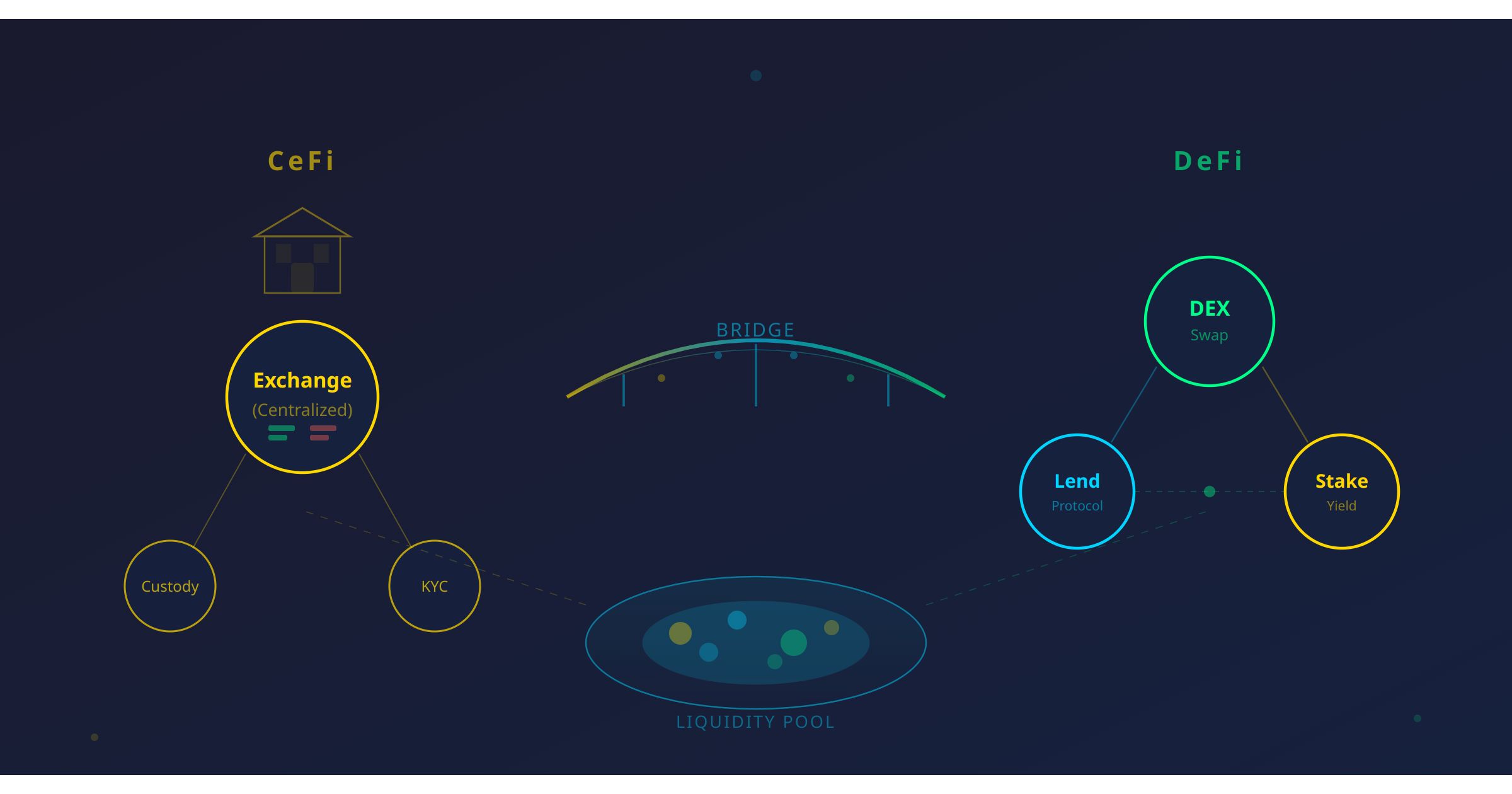
DeFi Integration for Centralized Exchanges: The Best of Both Worlds
Table of Contents
- The Great Convergence: CeFi Meets DeFi
- Why Centralized Exchanges Need DeFi Integration
- The Five DeFi Integrations That Matter Most
- Technical Architecture for DeFi Integration
- The Business Case: Revenue Impact of DeFi Integration
- Implementation Roadmap
- The Competitive Landscape
- Getting Started with DeFi Integration
The Great Convergence: CeFi Meets DeFi
For years, the crypto industry was split into two camps. Centralized exchange (CEX) advocates argued that speed, UX, and compliance made CeFi the only viable path for mass adoption. Decentralized finance (DeFi) enthusiasts countered that trustlessness, transparency, and self-custody were non-negotiable.
In 2026, both camps were right. And wrong.
The market has spoken clearly: users don’t care about the CeFi vs DeFi debate. They care about the best experience. They want the speed and customer support of a centralized exchange with the yield opportunities and transparency of DeFi. They want to trade on a fast order book AND access DeFi lending rates. They want custodial convenience AND the option for self-custody.
The exchanges delivering this hybrid experience — sometimes called “CeDeFi” — are capturing market share from both pure CEX and pure DEX competitors. They’re offering something neither can offer alone: a single platform where users access centralized and decentralized services without switching contexts.
Here’s how to build it.
Why Centralized Exchanges Need DeFi Integration
Before diving into the how, let’s address the why. If you’re running a successful centralized exchange, why bother with DeFi at all?
Reason 1: Your Users Are Already Using DeFi
The data is unambiguous. Cross-chain analytics show that 40-60% of CEX users also interact with DeFi protocols. They deposit stablecoins on your exchange, trade, withdraw to a wallet, and farm yields on Aave or Lido. Then they withdraw yields, deposit back on your exchange, and trade again.
Every time they leave your platform, you lose:
- Potential trading volume (they might trade on a DEX while they’re out)
- Custody of assets (your AUM decreases)
- Data on user behavior (can’t track what happens off-platform)
- Revenue from services DeFi protocols are providing
If you integrate DeFi yields into your exchange, users never need to leave. You capture the entire financial lifecycle: trading, earning, lending, staking — all on your platform.
Reason 2: DeFi Yields Are a Retention Weapon
We discussed in our Valentine’s Day article how earning features keep users engaged. DeFi integration takes this to another level.
Traditional exchange earn modules offer fixed rates set by the exchange. These are funded from the exchange’s own capital or market-making activities. DeFi integration gives you access to market-rate yields from the largest liquidity pools in crypto:
- Aave/Compound lending: Variable rates on stablecoins, ETH, BTC
- Lido/Rocket Pool staking: ETH staking yields (3-5% APY)
- Uniswap/Curve LP positions: Higher yields with impermanent loss risk
- Pendle/Eigenlayer: Points and restaking yields for advanced users
When your exchange offers DeFi-grade yields with CEX-grade simplicity, users have zero incentive to manage their own wallets and DeFi positions.
Reason 3: DEX Liquidity Expands Your Token Selection
Your exchange lists 200 tokens. The DeFi ecosystem has 50,000+. When a token starts trending on social media, your users want to buy it NOW — not after your two-week listing process.
By integrating DEX aggregation (1inch, Jupiter, Paraswap), your exchange can offer instant access to any token with on-chain liquidity. The user experience is smooth: they search for the token, see the price (sourced from DEX liquidity), and buy it — all within your exchange interface.
You capture the spread. The user gets the token instantly. Nobody had to submit a listing application.
Reason 4: Regulatory Positioning
This might seem counterintuitive — DeFi helping with compliance? But here’s the logic: regulators in 2026 are increasingly interested in DeFi oversight. Exchanges that offer DeFi services through a regulated, KYC’d interface are positioned as the “compliant gateway to DeFi.” This narrative is powerful with regulators and institutions alike.
Rather than fighting DeFi, you’re channeling it through a regulated framework. That’s exactly what regulators want.
The Five DeFi Integrations That Matter Most
Not every DeFi protocol is worth integrating. Focus on the five that deliver the most user value and revenue.
Integration 1: DeFi Yield Aggregation
What it is: Automatically deploy user funds into the highest-yielding DeFi strategies, accessible through your exchange’s interface.
How it works:
- User deposits USDT into “DeFi Earn” on your exchange
- Your platform routes funds to the optimal DeFi protocol (Aave, Compound, or Morpho based on current rates)
- Yields accrue daily and display in the user’s account
- User withdraws anytime — your platform handles the DeFi withdrawal automatically
Revenue model: Take a 10-20% performance fee on yields. If the protocol pays 8% APY, the user receives 6.4-7.2% after your fee. This is standard in the industry and users accept it because of the convenience.
Risk management — critical:
- Only integrate audited, blue-chip protocols (Aave, Compound, Lido, Maker)
- Implement automatic withdrawal triggers if protocol risk parameters change
- Set per-protocol and per-chain exposure limits
- Clearly communicate to users that DeFi yields carry smart contract risk
- Consider offering both “Protected” (lower yield, insured) and “Enhanced” (higher yield, risk-exposed) tiers
User experience: The user should not need to understand DeFi at all. They see “Earn 6.5% APY on USDT” and click “Start Earning.” Your staking platform and earn module infrastructure handles the complexity.
Integration 2: DEX Aggregation for Extended Token Access
What it is: Route trades to DEX liquidity when the token isn’t listed on your centralized order book.
How it works:
- User searches for a token (e.g., a new meme coin) on your exchange
- Token isn’t in your spot trading order book
- Your platform queries DEX aggregators (1inch on Ethereum, Jupiter on Solana, PancakeSwap on BSC)
- Best price is displayed with “DEX” label and clear fee disclosure
- User buys. Your platform executes the on-chain swap and credits the token to the user’s custodial account
Revenue model: Add 0.5-1.5% spread on DEX-routed trades. This is higher than your CEX fees but lower than users would pay navigating DEXs themselves (gas fees, slippage, MEV). Users happily pay the convenience premium.
Key UX decision: Should DEX-routed tokens appear alongside CEX-listed tokens, or in a separate section?
Best practice: Same search, different badge. When users search for a token, show all results — CEX-listed tokens and DEX-available tokens in the same list. CEX tokens show normal trading interface. DEX tokens show a “Swap” interface with DEX routing details. The user doesn’t need to know the infrastructure difference unless they care.
Integration 3: Cross-Chain Bridge
What it is: Let users move assets between blockchains directly within your exchange interface.
How it works:
- User has ETH on Ethereum in their account
- User wants ETH on Polygon (cheaper transactions, access to Polygon DeFi)
- User selects “Bridge” → Ethereum to Polygon → Amount
- Your platform executes the bridge (via Wormhole, LayerZero, or Stargate)
- Bridged ETH appears in user’s Polygon balance within minutes
Why this matters: Multi-chain is the reality. We covered this in our trends article — users expect smooth multi-chain support. Bridging is the most friction-filled experience in crypto for normal users. Gas estimation, approval transactions, waiting for finality, bridge interfaces that feel like they were designed by committee — it’s painful.
Your exchange can make this painless. One button, clear fee display, fast execution. You handle the complexity of bridge selection, gas optimization, and transaction monitoring.
Revenue model: Bridge fee (0.1-0.3% of bridged amount) plus gas fee markup.
Integration 4: Liquid Staking
What it is: Allow users to stake PoS tokens (ETH, SOL, MATIC) and receive liquid staking tokens (stETH, mSOL, stMATIC) that can be traded or used in DeFi while staking rewards accrue.
How it works:
- User deposits ETH and selects “Stake”
- Your platform stakes ETH via Lido, Rocket Pool, or a native staking mechanism
- User receives stETH (liquid staking derivative) credited to their account
- Staking rewards accrue to the stETH balance automatically
- User can trade stETH, use it as collateral, or unstake back to ETH
Why liquid staking through a CEX wins: Direct staking through protocols requires managing wallets, understanding unstaking queues, and navigating complex interfaces. Your exchange makes it “click Stake, earn rewards, trade anytime.” The conversion rate on this is extraordinary — users who would never navigate to Lido.fi directly will happily stake through your interface.
Revenue model: Take 5-10% of staking rewards as a commission. Lido already takes 10%, so you can either share their fee or layer your own on top (clearly disclosed).
Integration 5: DeFi Lending and Borrowing
What it is: Allow users to lend their assets for yield or borrow against their holdings without selling.
How it works for lending:
- User has 10,000 USDT idle in their account
- User selects “Lend USDT” → sees current lending rate (e.g., 7.2% APY sourced from Aave)
- One-click to start lending
- Interest accrues daily, visible in account
How it works for borrowing:
- User has 1 BTC and needs USDT without selling their Bitcoin
- User selects “Borrow against BTC” → sees loan-to-value ratio, interest rate, liquidation price
- Deposits BTC as collateral → receives USDT loan
- User repays loan + interest when ready → gets BTC back
Why integrated lending matters: Crypto holders don’t want to sell their long-term positions to fund short-term needs. Borrowing against holdings is a killer feature for:
- Traders who want to leverage without using futures
- Long-term holders who need fiat for expenses without triggering taxable events
- Miners/stakers who earn crypto but have fiat-denominated operating costs
Your lending software infrastructure provides the framework. DeFi integration provides the capital efficiency of decentralized lending pools.
Technical Architecture for DeFi Integration
The Middleware Layer
DeFi integration requires a middleware layer between your exchange platform and on-chain protocols. This middleware handles:
Transaction construction: Building and signing blockchain transactions for DeFi interactions (deposits, withdrawals, swaps, stakes).
Gas management: Maintaining gas token balances across all supported chains, estimating gas costs, and optimizing transaction timing for lower fees.
Position tracking: Monitoring all DeFi positions across protocols and chains. Recording accrued yields, health factors (for loans), and position values in real time.
Risk monitoring: Watching protocol health metrics, smart contract events, and oracle prices. Auto-withdrawing if risk parameters are breached.
Smart Contract Risk Management
This is the elephant in the room. DeFi protocols carry smart contract risk. Exploits happen. Bridges get hacked. Lending protocols face bad debt events.
How responsible exchanges handle DeFi risk:
-
Protocol whitelisting: Only integrate audited, battle-tested protocols. For lending: Aave, Compound, Maker. For staking: Lido, Rocket Pool. For DEXs: Uniswap, Curve, PancakeSwap. New protocols with unaudited contracts are excluded regardless of APY.
-
Exposure limits: Cap total exposure to any single protocol at 20-30% of DeFi AUM. Cap exposure to any single chain at 40%. Diversification reduces impact of any single failure.
-
Insurance integration: Protocols like Nexus Mutual and InsurAce offer smart contract cover. Factor insurance cost into yield calculations. Offer “insured” and “uninsured” tiers to users.
-
Clear disclosure: Users must understand they’re exposed to smart contract risk. This isn’t optional — it’s ethical and legal. But disclosure doesn’t need to be scary. “Your funds are deployed to Aave, a protocol managing $15B with no exploits in 4 years” is honest and reassuring.
-
Emergency procedures: Automated withdrawal from protocols if: contract upgrade is detected, TVL drops more than 30% in 24 hours, or oracle deviations exceed thresholds. Better to exit early at a small cost than lose funds in an exploit.
Multi-Chain Complexity
DeFi exists across many chains. Effective integration means supporting DeFi protocols on at least:
- Ethereum — largest DeFi ecosystem by TVL
- BNB Chain — second largest, lower fees
- Solana — fastest growing, unique DeFi ecosystem
- Polygon — low-cost Ethereum-compatible DeFi
- Avalanche — growing institutional DeFi presence
Each chain has different: gas token, transaction format, confirmation time, RPC infrastructure, and DeFi protocols. Your wallet infrastructure needs to handle all of them smoothly.
The Business Case: Revenue Impact of DeFi Integration
Let’s run the numbers on a mid-sized exchange with $50M in user deposits:
| DeFi Feature | Estimated Adoption | Revenue Model | Annual Revenue |
|---|---|---|---|
| Yield Aggregation | 30% of deposits ($15M) | 15% of yields (at 6% APY) | $135,000 |
| DEX Token Access | 5% of daily volume | 1% spread on swaps | $180,000+ |
| Cross-Chain Bridge | 10% of deposits/month | 0.2% bridge fee | $120,000 |
| Liquid Staking | 20% of ETH/SOL ($10M) | 8% of staking rewards | $40,000 |
| DeFi Lending | 15% of stablecoins ($7.5M) | 10% of lending yields | $52,500 |
| Total | $527,500+ |
That’s over half a million in additional annual revenue from an exchange with just $50M in deposits. For larger exchanges, these numbers scale linearly. A $500M exchange could see $5M+ in additional DeFi-related revenue annually.
And this doesn’t account for the retention benefit. Users who earn yields and access DeFi through your exchange have dramatically higher switching costs than users who only trade spot.
Implementation Roadmap
Phase 1: Foundation (Weeks 1-4)
- Deploy yield aggregation for stablecoins (USDT, USDC) via Aave on Ethereum
- Create “DeFi Earn” section in exchange UI
- Implement risk monitoring and automated withdrawal triggers
- Clear user disclosure and opt-in flow
Phase 2: Expansion (Weeks 5-8)
- Add liquid staking for ETH (via Lido) and SOL
- Integrate DEX aggregation for extended token access
- Expand yield options to BNB Chain and Polygon
- Implement per-protocol exposure limits
Phase 3: Advanced (Weeks 9-12)
- Launch DeFi lending/borrowing against crypto collateral
- Add cross-chain bridge functionality
- Implement insured vs uninsured yield tiers
- Create DeFi portfolio dashboard with yield tracking
Phase 4: Optimization (Ongoing)
- Add new protocols as they prove themselves
- Optimize yield routing for maximum returns
- Build automated DeFi strategy suggestions based on user holdings
- Launch DeFi educational content to drive adoption
The Competitive Landscape
The exchanges that have already integrated DeFi services are pulling ahead. Binance has Earn, Launchpool, and Liquid Swap. OKX has their Web3 wallet with DeFi access. Bybit offers yield products powered by DeFi protocols.
Smaller exchanges can’t match these products feature-for-feature. But they can:
- Move faster — large exchanges have months-long compliance reviews for new DeFi integrations. You can ship in weeks.
- Specialize — focus DeFi integration on a specific chain ecosystem where you have expertise and community.
- Be more transparent — clearly show which protocols underpin each yield product. Users increasingly demand this transparency that large exchanges don’t always provide.
- Offer higher yields — smaller overhead means you can take a smaller fee cut, passing more yield to users.
Getting Started with DeFi Integration
The technology gap between wanting to offer DeFi services and actually offering them is real. Building DeFi middleware, managing multi-chain infrastructure, monitoring smart contract risk, and creating a smooth UX is a significant engineering challenge.
Codono’s exchange platform provides the foundation: multi-chain wallet infrastructure, earn module architecture, staking platform, and the API layer that DeFi integration builds upon. The modular architecture means DeFi features plug into your existing exchange without rebuilding core infrastructure.
The CeDeFi future is here. The question isn’t whether to integrate DeFi — it’s how fast you can do it.
Ready to explore DeFi integration for your exchange? Request a demo or view our pricing to learn how Codono can help.
The Codono Team has been building crypto exchange infrastructure since 2017. We’ve watched the CeDeFi convergence from the inside, helping exchange operators bridge the gap between centralized and decentralized finance.
Codono Team
Codono builds enterprise-grade crypto exchange software deployed by 250+ operators across 30+ countries. Our team writes from production experience running spot, derivatives, custody, and compliance at scale.
View all posts by Codono Team →