 Crypto Exchange Software
  White Label Crypto Exchange
  P2P Crypto Exchange
  Crypto Futures Trading
  Forex Trading Software
  Token Launchpad
  Margin Trading
  Liquidity Engine
  Crypto Wallet
  KYC & AML
  Exchange Security
  Crypto Staking Software
  Crypto Lending Software
  Crypto Earn Module
  Exchange Integrations
 White Label Crypto Exchange Software
Launch a fully branded cryptocurrency exchange under your own domain, your own logo, and your own fee structure. Codono's white label platform gives you a production-ready trading infrastructure that deploys in 14 days, not 14 months. Full source code. One-time payment. No revenue sharing.
Reviewed by the Codono engineering team ·
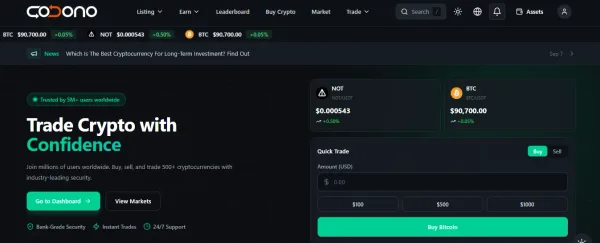
What Is White Label Crypto Exchange Software?
White label crypto exchange software is a complete, pre-built trading platform that you license, rebrand, and deploy as your own exchange. Instead of hiring a team of blockchain developers, security engineers, and frontend designers to build an exchange from scratch, you start with a battle-tested platform that already handles order matching, wallet management, user authentication, KYC verification, and every other component a live exchange requires. The same model is often called a white label CEX — a white label centralized exchange — because the operator runs a custodial, order-book venue under their own brand without building the matching engine, wallets, or compliance stack from scratch.
The term "white label" means the software ships without branding. You apply your company name, logo, color palette, domain, and visual identity. When users visit your exchange, they see your brand, not the software provider's. The underlying technology is invisible to your users, the same way a restaurant's kitchen equipment supplier is invisible to diners.
What makes white label different from SaaS exchange platforms is ownership. With Codono, you receive the full source code. You host it on your servers. You control the data, the infrastructure, and the codebase. There are no monthly licensing fees, no revenue sharing agreements, and no dependency on a third party to keep your exchange running. If you want to modify the matching engine, add a custom trading feature, or integrate a specific payment provider, your team has complete access to do so.
This is how the majority of successful exchange operators launch. The technology is proven across hundreds of deployments. The operator focuses on what actually differentiates their business: market positioning, regulatory licensing, user acquisition, and liquidity development.
Codono's white-label package is built on the same crypto exchange software used by licensed operators worldwide. If your priority is source-code access and custom engineering, see the crypto exchange script option.
White Label vs Custom Build
Complete Feature Stack Included
Every component you need to run a professional exchange, ready on day one
Trading Engine
In-memory order matching with price-time priority. Supports limit, market, stop-loss, and stop-limit orders. Handles thousands of concurrent orders per second. The spot trading engine processes trades with sub-millisecond latency and emits real-time events via WebSocket for instant UI updates.
Wallet Infrastructure
Multi-chain wallet system with automated hot and cold storage management. Supports 50+ blockchains including Bitcoin, Ethereum, Solana, Tron, and all EVM networks. Configurable hot wallet thresholds, automated sweeps, and multi-signature security for cold storage transactions.
KYC & Compliance
Built-in KYC/AML system with tiered verification levels. Integrates with providers like SumSub for automated identity verification. Sanctions screening, transaction monitoring, and suspicious activity reporting support MiCA, FinCEN, and VARA compliance requirements.
Admin Dashboard
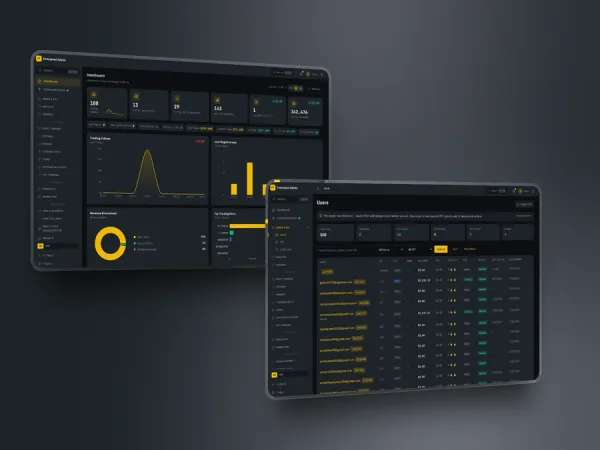
Complete exchange admin panel for managing every aspect of your exchange. User management, KYC approvals, trading pair configuration, fee settings, wallet monitoring, system health metrics, and financial reporting. Role-based access control lets you delegate tasks to support and compliance teams.
Mobile Applications
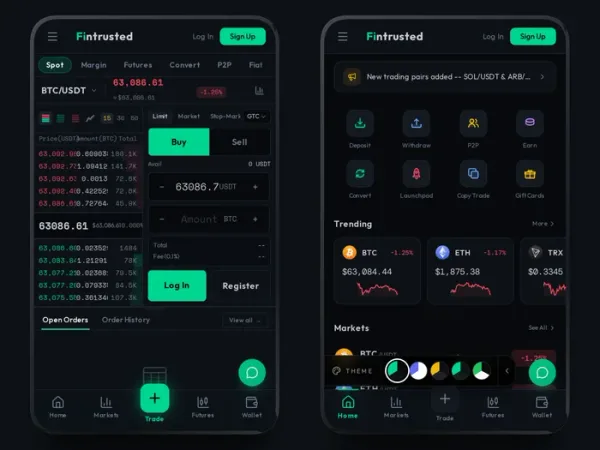
Native mobile apps for iOS and Android with real-time price feeds, order placement, portfolio tracking, push notifications, and biometric authentication. The mobile experience mirrors the web platform with full trading functionality. Your branding applied across every screen.
TradingView Charts
Professional-grade TradingView charting with 100+ technical indicators, drawing tools, and multiple timeframes. Candlestick, line, bar, and Heikin-Ashi chart types. Real-time data streaming. The charting library that professional traders expect as standard.
API & WebSocket
Full REST API and WebSocket infrastructure for algorithmic trading, market data streaming, and third-party integrations. Versioned endpoints, complete documentation, rate limiting, and API key management. Supports trading bots, portfolio trackers, and data aggregators.
Liquidity Engine
Built-in liquidity aggregation that connects to external exchanges and market makers. Your order book shows competitive spreads from launch day without waiting for organic volume. Configurable aggregation rules and spread markup for revenue optimization.
Security Architecture
Enterprise-grade security with AES-256 encryption at rest, TLS 1.3 in transit, TOTP-based two-factor authentication, anti-phishing codes, device fingerprinting, IP whitelisting, withdrawal address whitelisting, and real-time anomaly detection. DDoS protection and rate limiting built in.
Expand Beyond Spot Trading
Add revenue-generating modules as your exchange grows
Margin Trading
Cross and isolated margin with configurable leverage up to 10x. Automated liquidation engine, margin call alerts, and risk management controls.
Futures & Perpetuals
Perpetual contracts with funding rates, insurance fund, and position management. 100x leverage on major pairs. The highest-revenue trading product per user.
P2P Trading
Peer-to-peer marketplace with escrow, dispute resolution, and 300+ payment methods. Direct fiat-to-crypto trading without exchange-held fiat reserves.
Forex Trading
50+ currency pairs and precious metals with leverage up to 1:500. Real-time price feeds from institutional LPs. Transform your crypto exchange into a multi-asset platform.
Staking Platform
Flexible and locked staking products with configurable APY. Support for proof-of-stake tokens. A passive revenue stream that increases user retention and deposits.
Token Launchpad
IEO and IDO platform for hosting token sales. KYC-gated participation, vesting schedules, and allocation management. Listing fee revenue plus new user acquisition from project communities.
Full Customization Control
Make the exchange truly yours with complete branding and configuration control
Visual Branding
- Company logo and favicon
- Primary and secondary color schemes
- Typography and font selection
- Email templates with your branding
- Mobile app splash screen and icons
- Custom landing pages and marketing pages
Trading Configuration
- Trading pair selection and base currencies
- Maker and taker fee structures per pair
- Minimum trade amounts and precision
- Leverage limits per asset class
- Order types enabled per market
- Trading competition and reward rules
Compliance Settings
- KYC verification tiers and requirements
- Withdrawal limits per verification level
- Restricted countries and IP geofencing
- AML monitoring thresholds
- Document types accepted per jurisdiction
- Terms of service and legal pages
Revenue Settings
- Fee schedules with VIP tier discounts
- Referral commission structures
- Listing fee pricing
- Withdrawal fee amounts per chain
- Staking APY and operator spread
- Fiat on-ramp markup percentages
From Purchase to Live Exchange in 14 Days
A proven deployment process refined across hundreds of exchange launches
Purchase & Setup
Choose your license plan, receive the full source code package, and provision your server infrastructure. Codono supports any Linux VPS or cloud provider.
Branding & Design
Apply your logo, color scheme, and brand identity across the trading platform, admin panel, mobile apps, and email templates. Full CSS and template customization.
Configuration
Set up trading pairs, fee structures, withdrawal limits, KYC tiers, and supported cryptocurrencies. Configure hot and cold wallet thresholds.
Integrations
Connect KYC providers, payment gateways, liquidity sources, and blockchain nodes. Test deposit and withdrawal flows for every supported chain.
Security & Testing
Configure SSL, DDoS protection, rate limiting, and 2FA. Run complete testing including load tests, security scans, and wallet transaction verification.
Launch
Deploy to production, configure DNS, enable monitoring and alerting, seed initial liquidity, and open registration. Go live with full confidence.
White Label Crypto Exchange Cost
What a white label crypto exchange costs versus building custom — license, hosting, and five-year totals
White label delivers the same functional outcome at roughly 2% of the cost and 10x faster. The engineering risk is eliminated because the software is already proven in production across hundreds of live exchanges. Your investment goes into building the business, not rebuilding solved technical problems.
View Pricing PlansBuilt-In Revenue Streams
Multiple monetization channels configured through the admin panel
Trading Fees
Earn 0.1% to 0.3% on every spot trade executed. With $1M daily volume at 0.2% average fee, that generates $2,000 per day in revenue.
Withdrawal Fees
Charge flat or percentage-based fees on cryptocurrency and fiat withdrawals. Operators typically earn $500 to $2,000 per day from withdrawal fees alone.
Listing Fees
New token projects pay $5,000 to $50,000 for exchange listings. A growing exchange can list 2-4 tokens per month, adding $10,000 to $200,000 in monthly revenue.
Margin & Futures Fees
Leveraged trading generates 5x to 20x higher fee revenue per dollar of exposure. Funding rates on perpetual contracts add continuous 8-hourly revenue.
Staking & Earn
Offer staking and yield products, keeping a spread on the APY paid to users versus what the protocol earns. Typical operator margins are 1% to 3% APY.
Fiat On-Ramp Spread
Mark up the spread on fiat-to-crypto purchases via card payments. Card purchase markups of 1% to 3% generate significant revenue from new user onboarding.
A mid-size exchange processing $2M in daily volume across spot, margin, and futures typically generates $4,000 to $12,000 per day in combined fee revenue. Read our detailed breakdown of crypto exchange revenue models for realistic projections by exchange size.
How Codono Compares to Other White Label Exchange Providers
Most white label crypto exchange evaluations shortlist the same vendors: Codono, HollaEx, AlphaPoint, and a field of cloud platforms and clone-script agencies. The structural differences matter more than the feature checklists.
Ownership model. Codono ships the complete unencrypted codebase under a one-time perpetual license. HollaEx pairs an open-source core with monthly cloud plans (roughly $500-$2,000+/month). AlphaPoint is enterprise SaaS -- capable infrastructure, but you never receive the code and setup fees reportedly start around $50,000. Clone-script agencies sell lookalike front ends that rarely survive a regulator's technology audit.
What ships in the box. Margin, perpetual futures, P2P fiat markets, staking, launchpad, and cross-platform iOS/Android app are included in every Codono license. On most white label alternatives these are paid add-ons, PWA substitutes, or absent -- which is where the "cheaper" platform quietly becomes the expensive one.
Five-year cost. Our published analysis estimates roughly $60,000 all-in for a mid-size Codono deployment versus $153,000+ for a comparable cloud-hosted white label and $450,000+ for enterprise SaaS.
The full head-to-head breakdowns: Codono vs HollaEx, Codono vs AlphaPoint, the best white label alternatives compared, and the four-way 2026 vendor comparison.
Choosing a White Label Crypto Exchange Provider: What to Verify
After hundreds of operator evaluations, these are the checks that separate a production white label platform from a demo with a paint job:
1. Source-code terms in writing. "White label" says nothing about ownership. Ask whether any component is encrypted, whether the platform calls a license server, and what happens to your exchange if the vendor shuts down. Get the answer in the contract.
2. Trade on the demo, don't watch it. Place and cancel orders, check fee math on small-cap pairs, run a withdrawal flow end to end. White label platforms fail in the details -- decimal precision, order-book behavior under load, confirmation UX.
3. Ask how each module handles failure. "Futures" should mean funding rates, an insurance fund, and a liquidation engine -- not a CFD wrapper. "P2P" should mean escrow and dispute resolution -- not a message board. The failure cases are where exchanges lose money.
4. Model five years, not the sticker price. Add monthly platform fees, revenue share, un-included mobile apps, and the developer time to reach production. Then compare against a one-time license plus $200-$800/month of hosting.
Ready to run those checks against Codono? Open the live demo or review license tiers.
Regulatory Compliance Built In
Exchange licensing is no longer optional. Whether you are targeting the European Union under MiCA, registering as a Money Services Business with FinCEN in the United States, or applying for a VARA license in Dubai, regulators expect your technology platform to enforce compliance rules automatically.
Codono's white label platform includes the compliance infrastructure that regulators look for during the licensing process. Tiered KYC verification, transaction monitoring, suspicious activity flagging, sanctions screening, and complete audit trails are built into the core platform.
The compliance controls adapt to your specific regulatory requirements. Configure which documents are required at each verification tier, set withdrawal limits by KYC level, restrict access by jurisdiction, and generate the reports that compliance officers and regulators need.
VASP registration frameworks increasingly require FATF Travel Rule support -- originator and beneficiary data sharing on qualifying transfers -- and demonstrable custody controls. The platform ships Travel Rule data fields, cold wallet segregation with multi-signature withdrawal approvals, and hot-wallet float limits so the custody section of a license application maps directly onto how the software actually works.
Operators who have gone through the licensing process with Codono report that having a fully featured compliance system in the technology platform significantly accelerates regulatory approval. The technology audit portion of the licensing process is straightforward when the platform already implements industry-standard compliance controls.
Supported Frameworks
- MiCA (EU) : CASP registration requirements
- FinCEN (US) : MSB compliance controls
- VARA (Dubai) : Virtual asset regulations
- MAS (Singapore) : Payment services requirements
- FCA (UK) : Crypto asset registration
- AUSTRAC (Australia) : Digital currency exchange rules
Frequently Asked Questions
Common questions about white label crypto exchange software
How much does it cost to set up a white label crypto exchange?
With Codono, a white label crypto exchange costs $1,899 as a one-time license (Ultra tier; Enterprise from $12,500), plus roughly $100-$500 per month for hosting on infrastructure you control. Over five years that totals about $5,000-$15,000 — versus $500,000+ for a custom build, and SaaS platforms typically add $30K-$120K in platform fees over the same period.
What is the best white label crypto exchange software?
The best white label crypto exchange software is the one that survives your evaluation checklist: full unencrypted source code with terms in writing, complete modules (spot, futures, P2P, staking, mobile apps) rather than paid add-ons, documented handling of failure cases like liquidation cascades and payment disputes, and a five-year cost model you can verify. Codono is built to win exactly that comparison — trade the live demo and run the checklist against us and any alternative.
What is a white label crypto exchange?
A white label crypto exchange is a complete, pre-built trading platform that you license, rebrand, and operate as your own exchange — order matching, wallets, KYC, and admin tooling included. You control the brand, fees, and servers; the software vendor supplies the production infrastructure.
How much does it cost to start a cryptocurrency exchange?
Starting a cryptocurrency exchange with white label software typically costs $5,000-$15,000 in the first year (license plus hosting), while building the same platform custom runs $300,000-$800,000 and takes 12-18 months. Licensing, compliance, and liquidity deposits vary by jurisdiction and come on top of either path.
How do I verify a white label provider is legitimate?
Four checks separate real vendors from resellers: get source-code terms in writing (is any component encrypted or calling home?), trade on a full-access live demo rather than screenshots, ask how each module handles failure cases (liquidation cascades, payment disputes, stuck withdrawals), and model the five-year cost including platform fees. A vendor who resists any of these is answering your question.
What is the difference between a white label crypto exchange and a clone script?
A clone script replicates another exchange's interface; a white label crypto exchange is production infrastructure sold for rebranding. The difference shows up operationally: how the platform handles KYC across jurisdictions, cold wallet segregation, liquidation cascades during volatility, and regulator audits. Codono is white label software with full source code -- you get the complete production system, not a lookalike front end.
Do I get the source code, and who controls the data?
You receive the complete unencrypted source code under a perpetual license — read, modify, and self-host every component. The exchange runs on servers you control, and user data lives in your database. There are no license servers or callbacks -- if the vendor disappeared tomorrow, your exchange would keep running. This differs from SaaS white label models where the vendor hosts the platform and owns the runtime.
Can I migrate from another white label provider to Codono?
Yes. Migrations move user records, balances, and transaction history via database export into staging, followed by balance reconciliation against on-chain and internal records, then a coordinated cutover with a short withdrawal freeze. Our deployment team scopes migrations from HollaEx, cloud white-label platforms, and custom builds before you license.
How long does it take to launch a white label exchange?
Most operators launch within 14 to 21 days. The first week covers server provisioning, domain configuration, branding customization, and trading pair setup. The second week focuses on KYC provider integration, payment gateway configuration, wallet testing, and security hardening. Complex deployments with custom features may take up to 30 days.
Is the software compliant with regulations like MiCA?
The platform includes built-in compliance tools: KYC identity verification with providers like SumSub, AML transaction monitoring, sanctions screening, suspicious activity reporting, and configurable withdrawal limits by verification tier. These features support compliance with MiCA, FinCEN MSB requirements, VARA regulations, and other frameworks. You configure the compliance rules for your specific jurisdiction.
Launch Your Exchange in 14 Days
Get the complete white label crypto exchange platform with full source code, 50+ blockchain integrations, mobile apps, and dedicated deployment support. One-time payment starting at $1,899.