 Crypto Exchange Software
  White Label Crypto Exchange
  P2P Crypto Exchange
  Crypto Futures Trading
  Forex Trading Software
  Token Launchpad
  Margin Trading
  Liquidity Engine
  Crypto Wallet
  KYC & AML
  Exchange Security
  Crypto Staking Software
  Crypto Lending Software
  Crypto Earn Module
  Exchange Integrations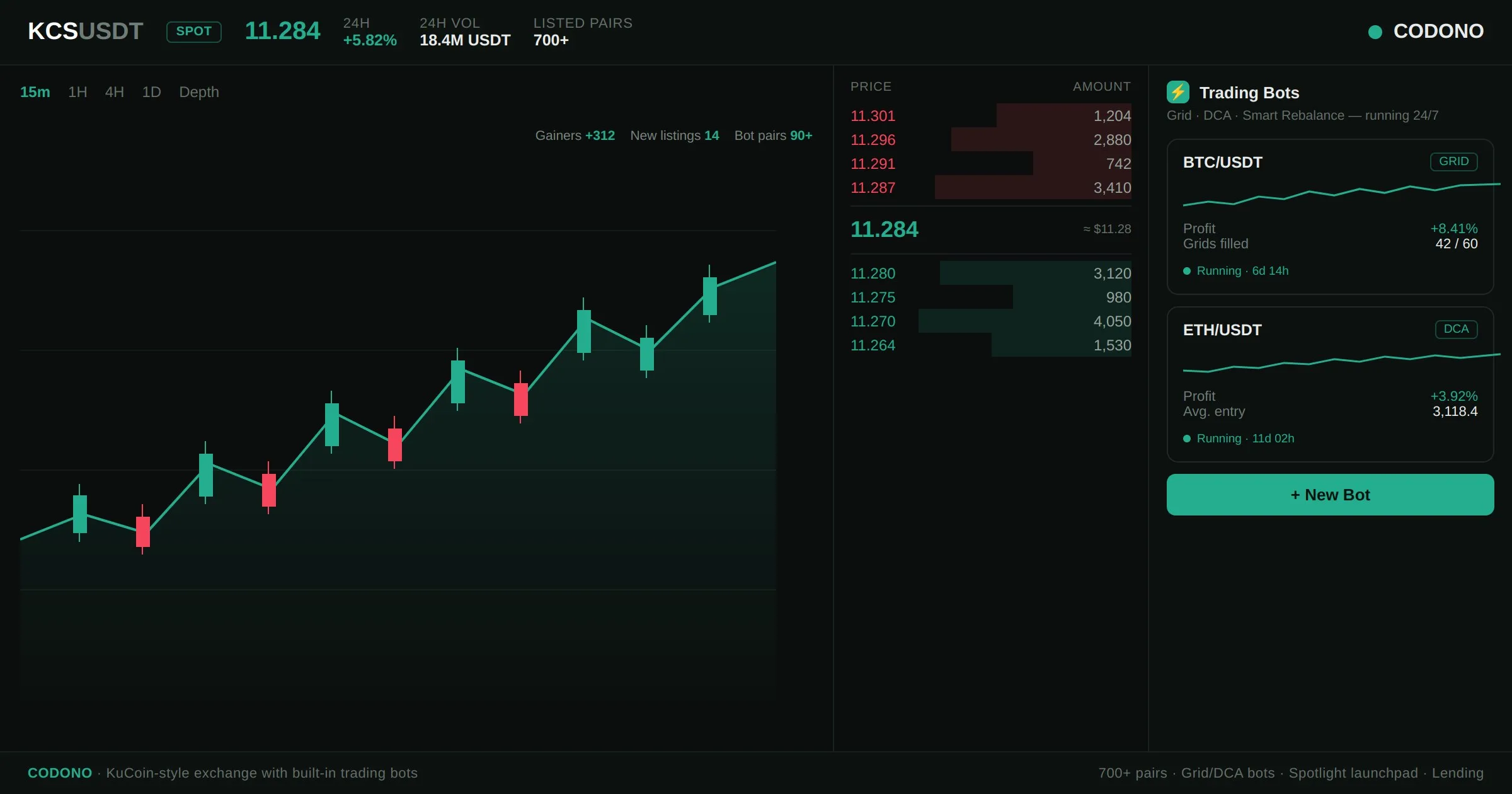
What is a KuCoin Clone Script?
A KuCoin clone script is enterprise-grade cryptocurrency exchange software that replicates the specific things that made KuCoin one of the most-used exchanges in the world - not just “an exchange,” but the KuCoin experience: a deep, fast-moving altcoin catalog, built-in trading bots that run automated strategies for users, a Spotlight-style launchpad, and lending and earn products.
Codono is an independently built, unbranded codebase. Configured as a KuCoin clone, it gives you the altcoin-and-automation positioning that earned KuCoin the “People’s Exchange” nickname - launched under your own brand, domain and logo, with full source-code access.
This page is deliberately specific to the KuCoin model. If you want the broadest possible feature set, the Binance clone is the full-suite option; if derivatives are your core revenue, the Bybit clone leads with perpetuals. The clone that fits you depends on your market - the clone-script overview compares all of them.
Why Clone KuCoin Specifically?
Binance wins on blue-chip depth. Bybit wins on derivatives. KuCoin wins on two very different things - and if those match your strategy, this is the model to build.
1. Altcoin breadth and listing speed. KuCoin built its reputation as the place altcoins list early, often before the larger exchanges. Traders hunting the next mid-cap go where the listings are freshest. A KuCoin-style exchange competes on catalog size and how fast you can add markets - a strategy that lets a new exchange win a passionate altcoin audience without going head-to-head with Binance on BTC/USDT liquidity.
2. Built-in trading bots. KuCoin normalized the idea that ordinary users - not just quants with API keys - can run automated strategies directly inside the exchange. Grid bots, DCA bots and smart-rebalance strategies became a headline feature, and a powerful retention mechanic: a user with a bot running leaves funds on your platform for weeks. Most clone scripts do not ship real trading bots. This one does, and it is the single strongest differentiator in the KuCoin model.
Together those two make the KuCoin model a retention-and-breadth play: you attract users with listings they cannot find elsewhere, and you keep them with automation that runs while they sleep.
Feature Comparison With KuCoin
| Feature | KuCoin | Our Clone Script |
|---|---|---|
| Spot trading | ✓ | ✓ |
| Altcoin listings | ✓ 700+ | ✓ 700+ supported |
| Grid trading bot | ✓ | ✓ |
| DCA trading bot | ✓ | ✓ |
| Smart rebalance | ✓ | ✓ |
| Spotlight-style launchpad | ✓ | ✓ |
| Lending / Earn | ✓ | ✓ |
| Margin trading | ✓ | ✓ Up to 10x |
| Futures | ✓ | ✓ (add-on module) |
| P2P trading | ✓ | ✓ |
| Native token discounts (KCS-style) | ✓ | ✓ Configurable |
| Cross-Platform mobile apps | ✓ | ✓ iOS & Android |
The Signature KuCoin Features, Replicated
Trading Bots - Grid, DCA & Smart Rebalance
This is the module that makes the clone feel like KuCoin. Bots run server-side, 24/7, independent of whether the user’s browser is open:
- Grid bots place a ladder of buy and sell orders across a price range, profiting from volatility in sideways markets - the classic KuCoin grid experience.
- DCA bots average into a position on a schedule, smoothing entry price over time.
- Smart-rebalance strategies maintain a target portfolio allocation automatically.
Operators control which bot types are enabled and can charge for premium strategies. Because bots keep funds and attention on the platform, they are one of the highest-ROI retention features you can offer - and a genuine differentiator against clone scripts that ship only manual trading.
A Fast Altcoin Listing Pipeline
The admin panel is built to add markets quickly - configure a new coin, its trading pairs, fee schedule and deposit/withdrawal parameters without engineering work. Listing velocity is a KuCoin hallmark and a real competitive lever for a new exchange: the faster you can safely list, the more altcoin traders you win.
Spotlight-Style Launchpad
Our launchpad module mirrors the KuCoin Spotlight mechanic - holding-period snapshots, lottery and subscription allocation models - so your native token can drive a listing flywheel while you earn launchpad and listing fees. Projects get distribution; your token gets utility; you get revenue.
Lending & Earn
Passive-income products keep funds on the platform. The clone includes flexible and locked staking, savings-style yield and lending markets - the KuCoin Earn pattern - giving users a reason to hold balances with you and giving you another revenue stream.
Native-Token Discounts (the KCS Pattern)
KuCoin’s KCS token grants trading-fee discounts and a share of revenue. The clone’s fee engine supports the same pattern: issue your own native token, grant tiered fee discounts for holding it, and configure the discount application order end-to-end.
Running Trading Bots as an Operator
Trading bots are not just a feature to switch on and forget — they change how your exchange performs as a business, and it’s worth understanding the operator side before you launch on this model.
Bots are a retention machine. A user running a grid bot has a reason to keep a balance on your platform for weeks, not minutes. That directly lifts the metrics that matter to a new exchange: assets under custody, session frequency, and lifetime value per user. Where a spot-only exchange fights daily to bring traders back, a bot-driven exchange keeps them engaged passively. In practice, the bot user base becomes your stickiest cohort.
How you monetize them. There are three common models, all supported by the fee engine: (1) charge nothing and profit from the trading fees the bots generate — grid bots in particular place many small orders, so fee volume compounds; (2) charge a subscription for premium strategy types or higher bot counts; (3) take a performance share on bot profits. Most operators start with option 1 because free bots maximize adoption and the trading-fee flow alone is substantial, then layer in premium tiers as the user base matures.
What bots demand from your infrastructure. Because strategies run server-side and continuously, bots put steady load on the matching engine and require reliable market-data feeds — a bot acting on a stale price is a support ticket and a trust problem. This is why the bot module runs on the same production matching engine and real-time data pipeline as the rest of the platform, not a bolted-on script. Plan server capacity for the number of concurrent strategies you intend to support; the technical-specifications section below covers sizing.
Risk framing you should set. Bots automate execution, not judgment — a grid bot in a market that trends hard against the grid can accumulate an unrealized loss. Reputable exchanges present bots with clear expectations rather than as guaranteed profit. The clone’s bot UI is built to show realized/unrealized PnL honestly, and you should keep it that way: the trust you build by being straight about bot risk is worth more than the sign-ups you’d get by overselling.
Core Modules Included
Beyond the KuCoin-signature features, every deployment includes the full Codono trading stack:
Spot Trading Engine
A price-time-priority matching engine with in-memory order books, processing thousands of orders per second with sub-5ms latency. Real-time order books over WebSocket, TradingView charts , and configurable pairs and fees. See the spot trading engine for detail.
Multi-Chain Wallet Infrastructure
Automated deposit detection, withdrawal queuing and hot/cold rebalancing across 50+ blockchains - essential when you are listing hundreds of altcoins across many networks. See the multi-chain wallet system .
KYC/AML & Compliance
Tiered verification, transaction monitoring and audit-ready logging via the KYC/AML system - configured to the compliance requirements of your jurisdiction.
P2P Marketplace
Escrow-protected peer-to-peer trading with 100+ payment methods via the P2P module - useful for on-ramping users in markets without easy fiat rails.
Admin Dashboard
Full back office: user management, KYC review queues, hot/cold wallet controls, fee configuration, bot-strategy management, and revenue reporting.
Cross-Platform Mobile Apps
iOS and Android apps with full trading and bot management, biometric login, price alerts and push notifications.
Technical Specifications
Backend: Java (Spring) microservices with a Node.js matching engine, MySQL with a double-entry ledger, Redis for sessions and real-time data, Kafka for async events between services.
Frontend: Next.js (React) with TypeScript, TradingView Advanced Charts, Tailwind CSS.
Mobile: Cross-platform (Ionic) app for iOS and Android from one codebase, with full source included.
Infrastructure: Minimum 8GB RAM / 4 cores / 100GB SSD; recommended 32GB RAM / 8 cores / 500GB NVMe; production runs load-balanced across multiple servers. Because bots run server-side, plan capacity for the number of concurrent strategies you intend to support.
Revenue Model for Operators
The KuCoin model has more revenue levers than a plain spot exchange, which is much of its appeal:
- Spot trading fees - 0.1% maker/taker typical, across a wide altcoin catalog.
- Trading-bot fees - charge for premium bot strategies or take a performance cut.
- Launchpad & listing fees - Spotlight-style token sales and new-coin listings.
- Lending & Earn spread - the margin between borrower and lender rates.
- Margin interest - daily interest on borrowed funds.
- Native-token economics - fee discounts that drive demand for your token.
- Withdrawal fees - network-fee markup.
The listing pipeline and bots do double duty here: they are acquisition and retention features and direct revenue lines.
Who the KuCoin Model Is Right For — and Who It Isn’t
Choosing the right clone model is the most important decision you’ll make, so here’s the honest fit test rather than a pitch.
The KuCoin model is right for you if:
- You want to compete on breadth and listing speed rather than fighting Binance for blue-chip liquidity.
- Your target users are active altcoin traders who value automation — the kind of audience that adopts bots.
- You want strong retention economics from day one, and you’re prepared to run a genuine listing pipeline (which means real diligence on the tokens you list).
- You see a native-token strategy (the KCS pattern) as part of your growth plan.
It’s probably not the right model if:
- Your revenue plan centers on derivatives — then the Bybit clone model, where futures fees dominate, fits better.
- You want a regulated, fiat-first retail experience for a trust-sensitive market — the Coinbase clone suits that better.
- Your market is primarily peer-to-peer on-ramping — the Paxful clone model is the fit.
- You want to be a one-stop full-suite exchange without a specific specialty — the Binance clone covers everything in one platform.
Because every model shares one codebase, this is not a permanent lock-in — you can launch on the KuCoin model and switch on futures or a deeper P2P marketplace later. But leading with the model that matches your market’s habits is what wins the first cohort of users. If you’re weighing several, the clone-script overview lays them side by side.
Is a KuCoin Clone Legal?
The honest answer, same as for any clone: the line is between functionality and intellectual property.
What is legal. Trading bots, altcoin markets, a launchpad, lending - these are functional mechanics, not KuCoin inventions, and building software that offers them is entirely legal. Grid and DCA bots in particular are standard automated-trading concepts used across the industry.
What is not legal. You cannot copy KuCoin’s actual source code (you are not - Codono is its own codebase). You cannot use the KuCoin name, logo or brand, or the KCS mark, on your exchange - those are registered trademarks, and using them implies an affiliation that does not exist. You cannot reproduce KuCoin’s copyrighted visual assets pixel-for-pixel.
The practical rules: launch under your own brand and domain; do not copy KuCoin’s exact colors, copy or trademarked UI; keep “KuCoin clone” as an internal description of what you are building, not public branding. And remember the real legal work is licensing - holding the right operating license and running the compliance program underneath it is what makes your exchange legal to operate, as covered in the compliance requirements page and the crypto exchange license guide .
In short: replicating what KuCoin does is legal; impersonating who KuCoin is is not. Codono gives you the first and deliberately excludes the second.
Looking for a KuCoin Clone Alternative?
If you are searching for a KuCoin clone alternative, it is usually because generic clone scripts ship encrypted, unmaintained, and without a matching engine that survives real load. Codono is the alternative built to last: full unencrypted source code, a production matching engine, and the complete KuCoin-style feature set above — from spot and futures to staking and launchpad.
Getting Started
- Consultation - your target market, listing strategy and which bot types you want to lead with.
- License selection - choose from our pricing plans based on the modules you need.
- Configuration - branding, altcoin catalog, trading-bot setup, fees and payment methods.
- Deployment - server provisioning, installation, blockchain nodes and SSL (2-4 weeks).
- Launch - go live with 12 months of updates and technical support.
Contact us for a consultation on the KuCoin model, or explore the live demo to try the trading bots and listing flow before you decide.