 Crypto Exchange Software
  White Label Crypto Exchange
  P2P Crypto Exchange
  Crypto Futures Trading
  Forex Trading Software
  Token Launchpad
  Margin Trading
  Liquidity Engine
  Crypto Wallet
  KYC & AML
  Exchange Security
  Crypto Staking Software
  Crypto Lending Software
  Crypto Earn Module
  Exchange Integrations
How to Build an AI-Agent-Ready Crypto Exchange in 2026
Table of Contents
- Introduction: From Bots to Agents
- What AI-Agent-Ready Means for an Exchange
- The Six Technical Pillars of an AI-Agent-Ready Exchange
- Architecture: Agent → Exchange → Market
- Real-World Use Cases
- Build, Integrate, or White-Label?
- Security and Compliance Considerations
- Checklist: Is Your Exchange AI-Agent-Ready?
- Bottom Line and Next Steps
Introduction: From Bots to Agents
In 2026, the conversation around automated crypto trading has shifted. For years, exchanges optimized for bots: rule-based scripts that executed fixed strategies. Now the market is moving toward autonomous AI agents — systems that perceive market conditions, set their own sub-goals, and take actions without a human approving every order.
This is not a sci-fi premise. Major DeFi protocols already host agent-driven liquidity managers. Hedge funds are deploying large language models to parse news, social sentiment, and on-chain signals into live execution strategies. Centralized exchanges now face pressure from institutional clients who want to plug autonomous agents directly into their order books, wallets, and risk systems.
The shift creates a new product category: the AI-agent-ready crypto exchange. This post is the operator-side companion to our earlier guide on AI trading features for end users. While that post covered the features retail traders see in the UI, this one covers the architecture exchange founders need underneath — the APIs, permissions, risk gates, custody policies, and messaging protocols that make an ai agent crypto exchange safe for autonomous trading.
Founders often ask whether agents are just better bots. The short answer is no. Bots follow a script. Agents interpret a goal. A bot places a grid order when price crosses a threshold. An agent decides which pairs to trade, how much capital to allocate, when to cut losses, and whether to pause entirely when volatility spikes. That difference has profound implications for exchange infrastructure.
If your platform is not designed for agents, the first high-volume integration is likely to expose brittle APIs, coarse permission models, and blind spots in your audit trail. The result is not a minor integration headache — it is a reputational and financial risk. This guide walks through what it takes to be ready.
What AI-Agent-Ready Means for an Exchange
An AI-agent-ready exchange is one that can safely host, authenticate, observe, and constrain autonomous software actors. It treats an agent as a distinct class of user: not a human clicking buttons, not a simple bot with one purpose, but a decision-making system that may adapt its behavior over time.
Readiness means three things in practice. First, the exchange exposes interfaces that agents can consume programmatically — unified REST and WebSocket APIs, event streams, and preferably standard agent messaging protocols. Second, the exchange can isolate agent activity from human activity and from other agents, so a runaway strategy cannot drain the main treasury. Third, the exchange enforces hard limits that no agent can override, regardless of how clever its reasoning becomes.
The distinction between bots, agents, and multi-agent systems matters because each requires a different level of trust and control:
| System | Trigger | Decision scope | Example |
|---|---|---|---|
| Trading bot | Rule / schedule | Single strategy, fixed params | Grid bot on BTC/USDT |
| AI agent | Goal + environment | Adapts strategy, chooses actions | Autonomous market maker reallocating across pairs |
| Multi-agent system | Coordination protocol | Distributed roles, shared state | Risk agent + execution agent + liquidity agent |
A trading bot is predictable. An AI agent is adaptive. A multi-agent system is collaborative. An exchange built only for the first category will struggle to support the other two without major rework.
The Six Technical Pillars of an AI-Agent-Ready Exchange
1. Unified, Low-Latency API with Granular Permissions
Agents consume APIs differently from human traders. They place orders in bursts, react to events in milliseconds, and often maintain long-lived connections. A fragmented API — part REST, part legacy RPC, part undocumented endpoints — forces agents into brittle wrappers that break whenever the exchange changes.
The foundation is a crypto exchange API that exposes market data, order management, account state, and wallet operations through consistent endpoints. REST should handle state-changing actions with idempotency keys. WebSocket should push order book updates, trades, and private account events with sequence numbers so agents can reconstruct state after a disconnect.
Latency expectations are rising. Sub-100 ms order acknowledgment is the 2026 baseline for spot markets; sub-50 ms is expected by serious algo desks. Agents will route around exchanges that cannot meet these numbers because latency directly affects their ability to act on signals before they decay.
Agents also depend on predictable contract surfaces. Clear documentation, stable versioning, and machine-readable OpenAPI schemas reduce the integration churn that breaks agent workflows whenever an endpoint changes.
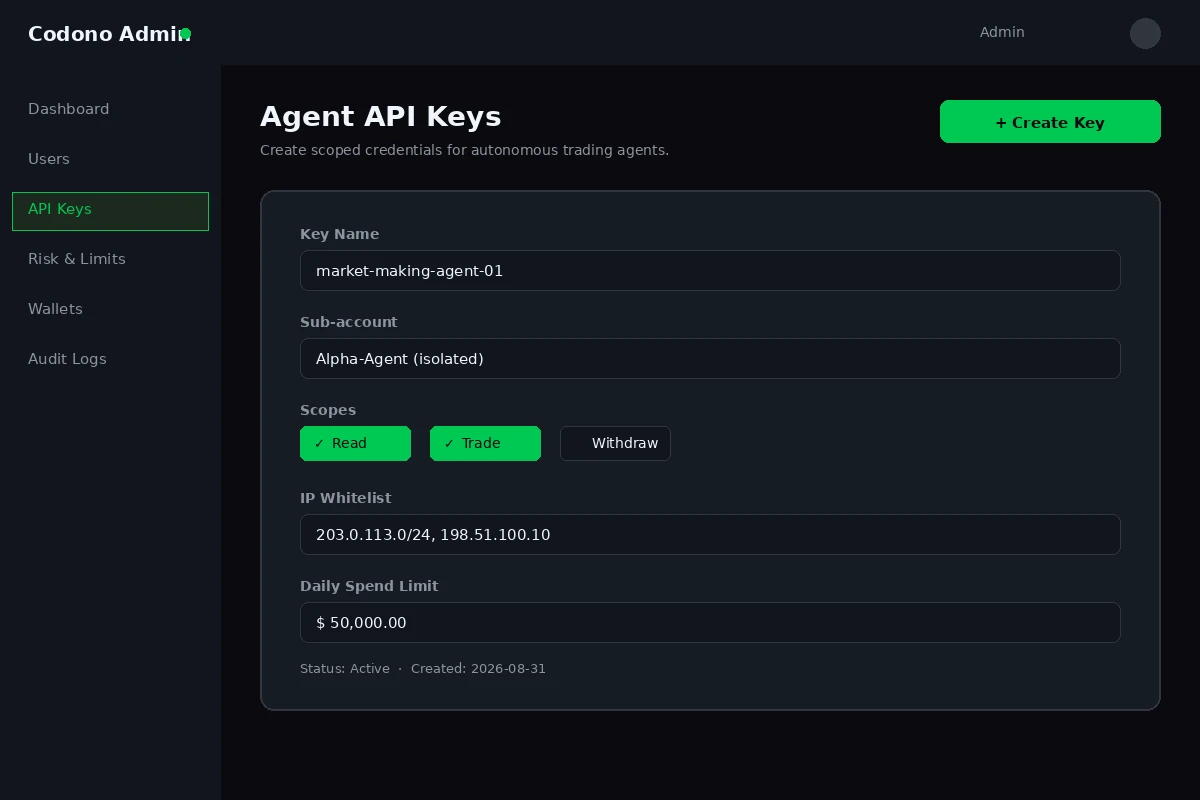
Permission granularity is equally important. Agents should never receive broad “trade and withdraw” keys. A production agent integration should support scoped API keys: read-only market data, trade-only for specific pairs, trade-only within a sub-account, and withdrawal to pre-approved addresses. Each key should have rate limits, IP allowlists, and time-bound expiry.
2. Account and Sub-Account Isolation
Autonomous agents make mistakes. An agent that misinterprets a signal can open oversized positions, chase losses, or fat-finger an order. If that agent has access to the exchange’s main operating account, one error can be catastrophic.
Sub-accounts solve this. Each agent operates inside its own silo with its own balance, positions, and risk limits. The parent account can sweep profits and replenish capital, but the agent cannot escape its container. This model also simplifies accounting: each agent’s P&L, fees, and trade history are isolated by default.
For exchanges offering white-label or source-code platforms, sub-account support should be a first-class primitive, not a bolt-on. Agents should be creatable via API, assigned to wallets, and monitored from a unified dashboard. Without this, institutional agent operators will choose infrastructure that gives them cleaner isolation.
3. Non-Negotiable Risk Limits
No agent should be allowed to decide its own risk parameters in real time. Risk limits must be enforced by the exchange, not by the agent, because a compromised or hallucinating agent can simply ignore client-side rules.
Hard limits every AI-agent-ready exchange needs include:
- Maximum position size per pair and per account
- Maximum drawdown before automatic pause
- Daily, hourly, and per-trade spend caps
- Leverage ceilings for margin and futures products
- Restricted trading pairs, especially for newly listed or low-liquidity markets
- Whitelisted counterparties or markets for cross-exchange arbitrage
These limits should live in the exchange’s risk engine and be evaluated on every order. When a limit is breached, the order should be rejected and an alert fired to both the operator and the agent’s owner. Codono’s security infrastructure is designed around this philosophy: policy is enforced at the platform layer, not trusted to the client.
4. Event Streaming and Observability
Humans notice when a UI behaves strangely. Agents do not. They will continue executing a broken strategy until the exchange stops them or the account runs out of capital. That makes observability a safety feature, not a convenience.
Every agent action should be auditable: order placement, cancellation, position change, balance transfer, risk limit interaction, and API key usage. These events should stream in real time through WebSocket or webhooks and be archived in immutable logs for compliance review.
A useful pattern is to expose an agent-specific event stream that a monitoring system can subscribe to. A risk agent — separate from the trading agent — can listen to this stream and trigger circuit breakers when behavior diverges from expectation. The admin dashboard becomes the command center where operators watch agent health, latency, error rates, and capital allocation in one view.
5. Wallet and Custody Policies
Agents need access to capital, but that access must be tightly constrained. The wallet layer should support hot wallets for active trading, warm wallets for scheduled settlement, and cold storage for the majority of reserves. Agent withdrawals should never originate from cold storage directly; they should flow through policy gates that require human or multi-sig approval.
A common architecture is to assign each agent a dedicated hot wallet or sub-wallet with a capped balance. When the agent needs more capital, it requests a refill from the treasury wallet. When it accumulates profit above a threshold, it sweeps back to treasury automatically. This caps the maximum loss from any single agent while keeping capital productive.
For exchanges evaluating wallet infrastructure, look for policy engines that support programmable rules: withdrawal address whitelists, time delays, multi-sig thresholds, and transaction amount bands. These features are essential once autonomous systems have signing authority.
6. Protocol Compatibility (MCP and Agent Messaging)
In 2026, agent interoperability is becoming as important as API consistency. The Model Context Protocol (MCP), introduced by Anthropic and adopted across the agent ecosystem, defines how an AI agent discovers tools, reads context, and executes actions through a standardized interface. For an exchange, supporting MCP means an agent can query balances, read market data, and place orders through a structured protocol rather than custom API wrappers.
MCP compatibility lowers integration friction. An agent framework like LangChain, AutoGPT, or a custom fund infrastructure can connect to the exchange through an MCP server and immediately understand available actions, required parameters, and returned schemas. This reduces the bespoke integration work that currently slows down institutional deployments.
Beyond MCP, exchanges should watch emerging standards for agent identity, attestation, and inter-agent communication. Multi-agent systems will need to prove that an agent is authorized by a specific owner, that its permissions have not been revoked, and that messages between agents have not been tampered with. Building on protocols that support these guarantees is a long-term advantage.
Architecture: Agent → Exchange → Market
The simplest way to visualize an AI-agent-ready exchange is as a controlled bridge between autonomous decision-makers and regulated market access.
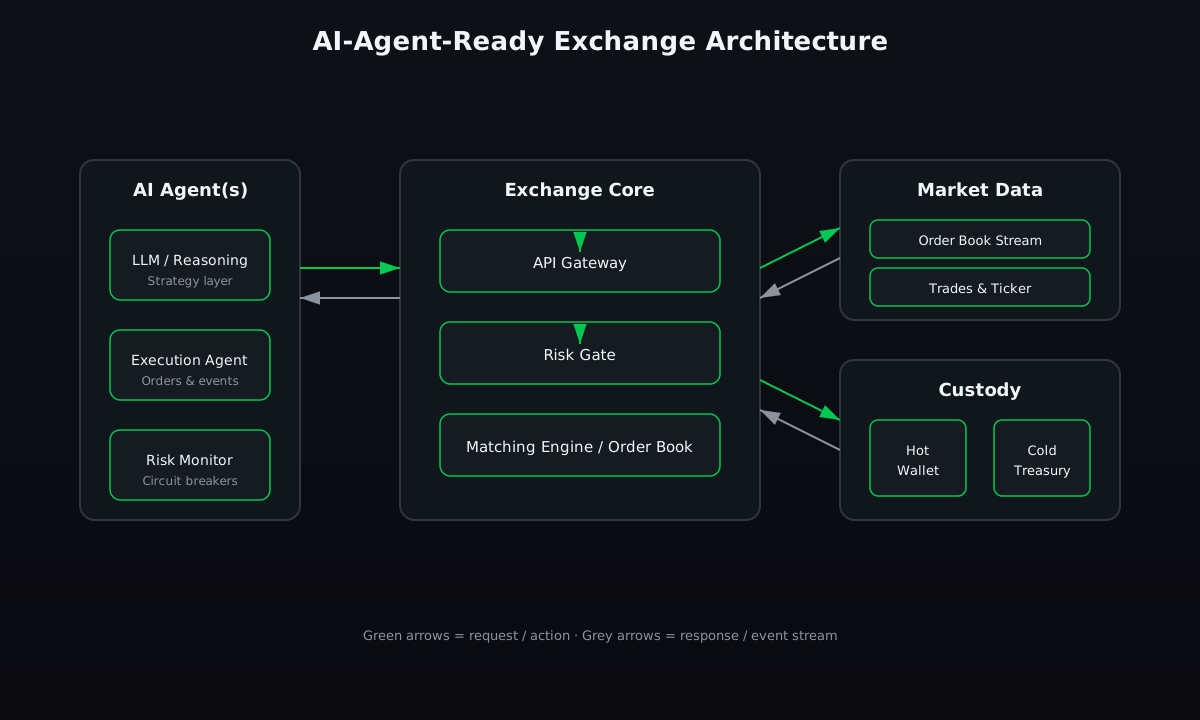
On the left, the agent layer contains one or more autonomous systems. These may be internal proprietary agents, third-party fund algorithms, or multi-agent orchestrations. Each agent holds a credential — typically a scoped API key or an authenticated MCP session — that identifies it to the exchange.
In the middle sits the exchange itself. The API gateway authenticates the agent, checks rate limits, and routes requests. The risk engine evaluates every order against hard limits and market conditions. The order management system tracks positions and enforces sub-account isolation. The wallet layer manages balances, settlement, and withdrawal policy. The event stream emits a real-time audit trail.
On the right, the exchange connects to the market: its own order book, external liquidity venues, clearing systems, and custody partners. The agent never touches the market directly. Every action passes through the exchange’s policy and observability layers.
This architecture only works if every hop is synchronous enough for the agent’s decision loop and asynchronous enough to survive failures. REST gives control. WebSocket gives speed. Event logs give accountability. Risk gates give safety.
Real-World Use Cases
The following patterns are already appearing on agent-ready exchanges in 2026. Each one places a different load on the exchange stack, which is why the technical pillars above need to work together.
Autonomous Market Maker
A market-making agent continuously quotes bid and ask prices across multiple trading pairs. Unlike a static grid bot, it adjusts spread width based on volatility, inventory risk, and predicted price direction. It may pull quotes entirely during flash crashes and re-enter when conditions stabilize. For the exchange, this improves liquidity; for the agent operator, it captures spread income. The exchange must provide sub-100 ms order updates, bulk cancellation, and position limits to make this viable.
AI Portfolio Manager
A portfolio manager agent rebalances user allocations across spot and derivatives markets. It reads macro signals, social sentiment, and on-chain flows, then decides how to shift capital. On an exchange with sub-accounts, each user can run their own instance of the agent with isolated balances. The exchange’s role is to provide unified market access, real-time P&L, and risk controls that prevent any instance from over-concentrating in a single asset.
Multi-Agent Risk and Liquidation Manager
In futures trading, a liquidation engine is traditionally reactive: it closes positions after margin requirements are breached. A multi-agent system can be proactive. One agent monitors systemic risk, another manages individual liquidations, and a third communicates with the insurance fund. They coordinate to widen maintenance margins, throttle leverage, or pause new positions before a cascade. This requires the exchange to expose internal risk metrics and accept control signals from authorized agents.
Agent-Driven Support and Operations
Beyond trading, agents are beginning to handle operational tasks: monitoring API health, detecting anomalous deposits, and triaging support tickets. These agents need read access to exchange data and the ability to trigger alerts or pause services. They do not need trading permissions, which is why granular API scopes are essential.
Build, Integrate, or White-Label?
Exchange founders face a familiar choice when adding agent support. The right answer depends on what the agent layer is meant to accomplish.
-
Build in-house when agent execution is the core product. If your exchange differentiates itself through proprietary AI trading, you need full control over latency, risk policy, and data access. Building gives you that control, but it requires a strong engineering team and 6–12 months of focused work.
-
Integrate third-party agent frameworks when speed matters and margins allow. Frameworks like LangChain, AutoGPT, or specialized quant-agent platforms can accelerate time to market. The trade-off is dependency: you are constrained by their roadmap, their latency, and their security model.
-
Start with a white-label or source-code platform when you need the API, custody, and risk primitives without rebuilding the exchange stack. A platform like Codono’s exchange software already includes REST and WebSocket APIs, sub-accounts, risk engines, wallet infrastructure, and admin tooling. You add the agent layer on top rather than building the foundation from scratch. This is usually the fastest path for founders who want to ship an agent-ready exchange in 2026.
Cost and timeline are not the only factors. Consider custody philosophy, regulatory jurisdiction, whether your target clients require custom risk rules, and how the model fits your budget. See Codono pricing for deployment options. A platform with source-code access makes it easier to adapt the infrastructure to specialized agent workflows without forking your entire stack. Most founders we speak with reach a working agent integration in 8–16 weeks when the exchange layer is already complete.
Security and Compliance Considerations
Granting API access to autonomous systems multiplies security risk. A leaked API key becomes an open door for an attacker to drain funds at machine speed. Exchanges must treat agent credentials with the same rigor as cold-storage keys.
For a deeper look at the platform controls that protect both human and autonomous users, see our guide to crypto exchange security architecture. It explains how identity, custody, and monitoring layers work together to contain breaches before they spread.
Best practices include:
- Short-lived API keys rotated on a schedule or after every deployment
- Scoped permissions that map exactly to what the agent needs, reviewed quarterly
- IP allowlists and mutual-TLS for high-value agent integrations
- Comprehensive audit logs retained long enough to satisfy regulators and forensic review
- Circuit breakers that pause agent activity when anomaly detection flags unusual behavior
Compliance is also evolving. MiCA in Europe requires clear accountability for algorithmic trading, including the ability to identify the owner of an algorithm and to halt its activity. Travel Rule obligations apply when agents initiate withdrawals to external wallets. Design agent onboarding so that each agent is linked to a verified beneficial owner and each transaction is traceable. Regulators increasingly expect a human-in-the-loop or kill-switch for high-value or high-frequency agent actions.
A secure exchange foundation from day one makes these requirements far easier to meet than retrofitting them later.
Checklist: Is Your Exchange AI-Agent-Ready?
- REST and WebSocket APIs with sub-100 ms order latency
- Scoped API keys with read/trade/withdraw separation
- Sub-accounts or agent-specific wallets
- Hard risk limits (position size, drawdown, daily spend)
- Real-time audit logs of every agent action
- Hot/cold wallet segregation
- Webhook or event stream for agent state updates
- Sandbox environment for agent testing
- MCP or equivalent agent protocol support
- Incident response plan for agent misbehavior
- Verified agent-to-owner mapping for compliance
- Source-code or API access that supports custom agent workflows
Bottom Line and Next Steps
AI agents are moving from experiment to production. The exchanges that win in 2026 will not be the ones with the most trading pairs or the flashiest marketing. They will be the ones that can safely host autonomous decision-makers at scale.
Being AI-agent-ready means treating agents as a distinct user class with dedicated APIs, isolated accounts, hard risk limits, and full observability. It means supporting emerging protocols like MCP so agents can integrate without bespoke engineering. And it means building custody and compliance policies that assume autonomous systems will sometimes behave unpredictably.
If you are evaluating exchange infrastructure, start by auditing your API, risk engine, and wallet policies against the checklist above. The gaps you find are the roadmap.
Ready to build an AI-agent-ready exchange? Request a demo or explore Codono crypto exchange software to see the architecture in action.
The Codono Team has been building crypto exchange infrastructure since 2017. This guide reflects production experience across 250+ exchanges and the emerging requirements of autonomous trading systems.
Codono Team
Codono builds enterprise-grade crypto exchange software deployed by 250+ operators across 30+ countries. Our team writes from production experience running spot, derivatives, custody, and compliance at scale.
View all posts by Codono Team →