Coinbase Clone

Coinbase Clone Script - Launch a Regulated Retail Exchange With Fiat On-Ramps

Build a Coinbase-style exchange for mainstream users - a clean buy/sell experience, card and bank fiat on-ramps, recurring buys, staking rewards, and a compliance-first posture that earns trust. Full source-code access, one-time fee.

100+ Exchanges Deployed
30+ Countries
50+ Blockchains
One-Time License, No Rev-Share

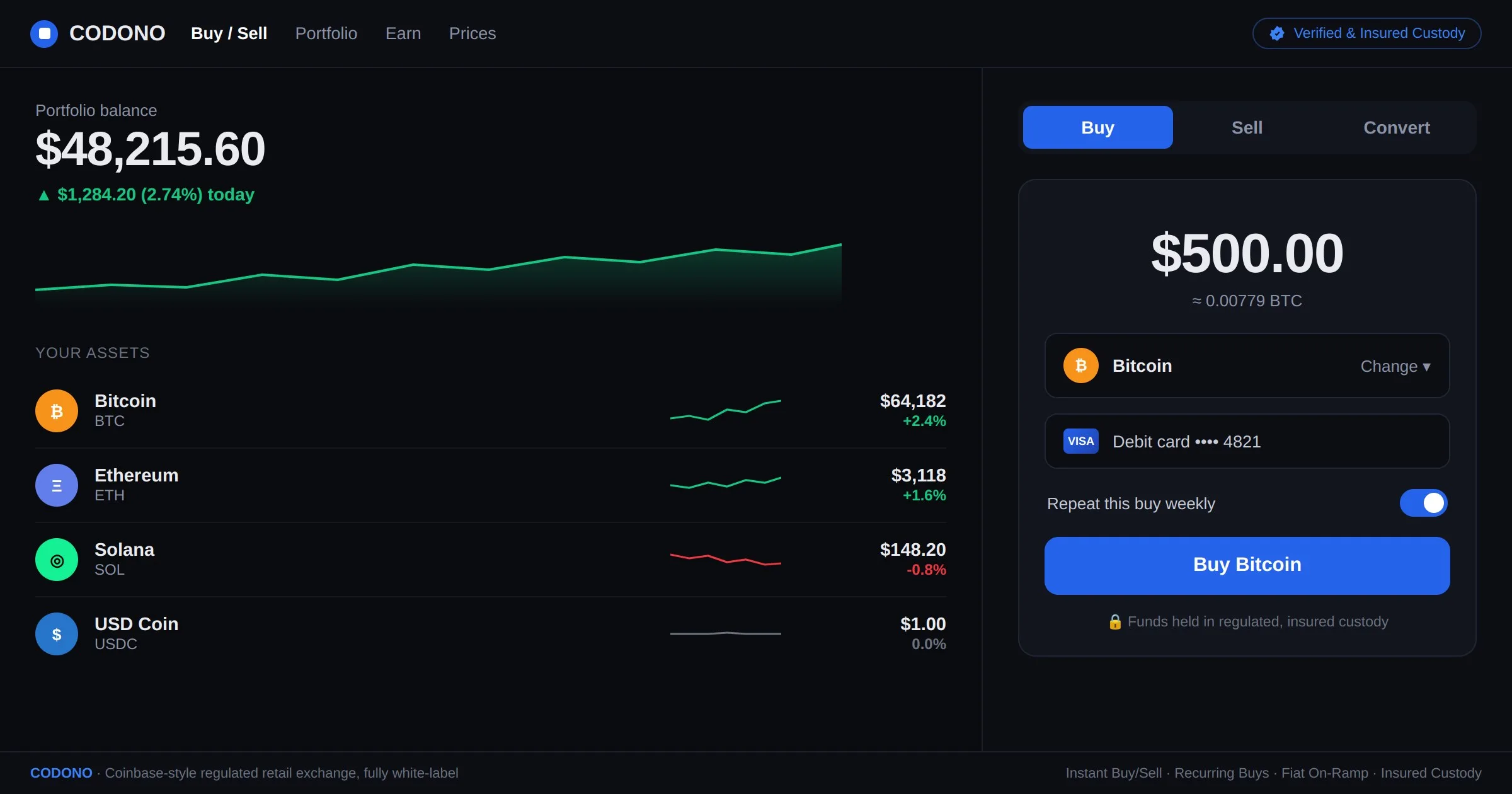
Coinbase-style regulated retail exchange interface built with Codono - portfolio balance, an asset list with live prices, and a simple buy card with recurring-buy toggle and insured-custody badge

What is a Coinbase Clone Script?

A Coinbase clone script is exchange software that replicates the specific things that made Coinbase the way most people first buy crypto - not a pro-trader terminal, but a clean, trustworthy, regulation-forward retail experience: buy and sell in a few taps, fund with a card or bank account, set up recurring buys, earn staking rewards, and trust that your money is safely held.

Codono is an independently built, unbranded codebase. Configured as a Coinbase clone, it gives you a mainstream retail exchange - launched under your own brand, domain and logo, with full source-code access. This is the model to choose when your users are everyday people, not traders, and trust matters more than order types.

This page is specific to the Coinbase model. If you want a full-suite trading platform, the Binance clone covers that; if derivatives are your plan, the Bybit clone leads with perpetuals. The clone-script overview compares every model on one engine.

Why Clone Coinbase Specifically?

Coinbase did not win by having the most features - it won by having the fewest barriers for a mainstream user, wrapped in credibility. If that is your market, this is the model to build.

1. The fiat on-ramp is the whole game. Most people who want to buy crypto do not already hold crypto - they hold dollars, euros or rupees in a bank account. Coinbase’s core innovation was making that first purchase frictionless: link a card or bank, tap buy, done. A retail exchange lives or dies on how smooth that on-ramp is, and the Coinbase model puts it front and center rather than burying it behind a pro trading interface.

2. Trust is the product. For a first-time buyer, the deciding question is not “what’s the maker fee” - it’s “will my money be safe?” Coinbase built a brand on regulatory compliance, insured custody and a clean, non-intimidating interface. A Coinbase-style exchange competes on credibility: visible compliance, transparent custody, and a UX simple enough that a newcomer never feels lost.

Together they make the Coinbase model a mainstream-adoption play: you are not fighting for active traders, you are onboarding the far larger population of people making their first crypto purchase - and keeping them with simplicity and trust.

Feature Comparison With Coinbase

FeatureCoinbaseOur Clone Script
Simple buy / sell
Card & bank on-ramp
Apple Pay / Google Pay-style✓ Configurable
Recurring buys (DCA)
Convert / swap
Staking rewards
Advanced trading view✓ (optional)
Hot/cold insured-style custody
Learn & earn education✓ Configurable
Native mobile apps✓ iOS & Android

The Signature Coinbase Features, Replicated

Instant Buy / Sell With Fiat

The heart of the model. Users buy crypto directly with local currency through the payment gateway - card, bank transfer and wallet methods - in a card-based flow that shows the amount, the asset and the fee plainly. No order book to interpret, no jargon. This is the difference between an exchange a newcomer can use and one they bounce off.

Recurring Buys

Scheduled automatic purchases - daily, weekly or monthly - that dollar-cost-average a user into an asset. It is one of Coinbase’s most effective retention features because it turns a one-time buyer into a recurring one, and it smooths your fee revenue into a predictable stream. Operators configure the available cadences and minimums.

Staking & Earn for Retail

Retail users want their holdings to do something. The clone includes staking and earn products presented in a retail-friendly way - clear APY, one-tap opt-in - so users earn yield on assets they already hold. It increases balances held on your platform and adds a staking-spread revenue line.

A Trust-First Interface

The retail UX surfaces custody and compliance as features: a “regulated, insured custody” style badge, clear verification status, transparent fee display. For mainstream users this is not decoration - it is the reason they choose you over a scary-looking pro exchange. You configure these signals to accurately reflect your licensing and custody arrangements (accuracy matters - see the legal section).

Optional Advanced View

Some retail users grow into active traders. The clone can expose an optional advanced trading view - full order book and order types - alongside the simple buy/sell flow, so you retain users as they level up instead of losing them to a pro exchange. It is the same spot engine underneath, just a different surface.

Compliance Is the Product

Every clone model needs compliance, but for the Coinbase model compliance is not a checkbox - it is the entire value proposition. Coinbase’s moat is regulatory: licenses in major markets, a public compliance posture, and the trust that follows. If you are cloning Coinbase, you are cloning a regulated business, and the software has to make that credible.

The clone includes the infrastructure that a retail fiat exchange needs to operate under real regulatory scrutiny:

  • KYC/AML pipeline with tiered verification, integrated identity providers, and enhanced due diligence for higher limits - the first thing a regulator examines.
  • Transaction monitoring and suspicious-activity flagging, because a fiat on-ramp is exactly where regulators expect AML controls.
  • Audit-ready logging across every user action, fund movement and KYC decision.
  • Configurable custody policy - hot/cold thresholds, multi-signature withdrawal approvals - that you map to your insurance and licensing.

See the compliance requirements page for how these map to specific jurisdictions. The honest framing for this model: the software gives you a compliant-capable platform; the license and the program you run on top of it are what make you actually Coinbase-like.

Launching a Retail Exchange: The On-Ramp Is the Hard Part

If you take one operational insight from this page, make it this: in the Coinbase model, the software is not the hard part — securing reliable fiat rails is. A beautiful buy/sell UX is worthless if you can’t actually move a user’s money in and out, and payment access is where most retail-exchange launches stall.

Payment partnerships are the gating item. Card acquirers and banks are cautious about crypto, and getting (and keeping) a card-processing or bank relationship is a licensing-and-trust exercise that runs in parallel with — and usually longer than — your technical build. Plan for it early: the clone integrates the rails through the payment gateway, but the commercial relationships behind those rails are yours to establish, and they depend on your licensing being credible.

Chargebacks and fraud are the on-ramp’s tax. Card purchases can be reversed; crypto sent out cannot. That asymmetry is the classic retail-exchange loss vector, so the model needs friction in the right places: staged limits for new users, holds on freshly-funded balances before withdrawal, velocity checks, and strong KYC before the first fiat purchase. The clone’s tiered-verification and withdrawal-hold controls exist precisely to manage this — configure them conservatively at launch and loosen as a user builds history.

Trust signals must be true. Retail users decide on credibility, so the temptation is to display “insured” and “regulated” badges early. Only display what is actually true for your business — an inaccurate trust claim is both a compliance violation and the fastest way to destroy the very trust the model runs on. Earn the badges, then show them.

Get the on-ramp right and the rest of the Coinbase model is straightforward. Get it wrong and no amount of UX polish saves the launch.

Core Modules Included

Beyond the retail-signature features, every deployment includes the full Codono stack:

Payment & Fiat Layer

The crypto payment gateway handles card, bank and wallet on-ramps and off-ramps - the plumbing that lets users move between local currency and crypto, which is the retail model’s lifeblood.

Spot Engine

A production matching engine powers instant buy/sell and the optional advanced view - price-time priority, in-memory order books, sub-5ms latency.

Multi-Chain Wallets

Automated multi-chain wallets across 50+ networks with hot/cold security and multi-signature withdrawals - the custody backbone the trust story depends on.

Admin Dashboard

Full back office: KYC review queues, withdrawal approvals, custody oversight with reconciliation, fee configuration and compliance reporting.

Native Mobile Apps

iOS and Android with the full buy/sell, recurring-buy and staking experience, biometric login and push notifications - essential, since retail users trade on their phones.

Revenue Model for Operators

The Coinbase model monetizes simplicity and trust rather than trading volume:

  1. Spread and buy/sell fees - retail users pay for convenience; simple-flow fees are typically higher than pro-trading fees.
  2. Fiat on-ramp fees - a margin on card and bank purchases.
  3. Staking spread - the margin between network rewards and what you pass to users.
  4. Recurring-buy volume - predictable, compounding fee flow.
  5. Convert/swap fees - one-tap conversions between assets.
  6. Withdrawal fees - network-fee markup.

Retail users are less fee-sensitive than active traders because they value simplicity and trust over saving a few basis points - which is why the retail model can sustain healthier margins per trade.

Who the Coinbase Model Is Right For — and Who It Isn’t

The Coinbase model is right for you if:

  • Your users are mainstream, first-time buyers, not active traders.
  • You can clear the regulatory bar - a retail fiat exchange is the most licensing-intensive model, and you should treat that as a prerequisite, not an afterthought.
  • You want to compete on trust, simplicity and fiat access rather than trading features or fees.
  • You have (or can build) reliable local payment rails - the on-ramp is everything.

It’s probably not the right model if:

  • Your users are active traders - the Binance clone (full-suite) or KuCoin clone (altcoins + bots) fit better.
  • Derivatives are your revenue plan - build the Bybit clone.
  • You cannot yet secure the licensing a retail fiat exchange requires - starting here without it is a compliance risk, not a shortcut.

Because every model shares one codebase, you can start with a simple retail buy/sell surface and switch on an advanced trading view, staking or more assets as you grow. The clone-script overview compares the options side by side.

The honest answer, with the regulatory point front and center for this model.

What is legal. Buy/sell, recurring buys, staking, a simple retail UX - these are functional mechanics, not Coinbase inventions, and building software that offers them is entirely legal.

What is not legal. You cannot copy Coinbase’s actual source code (you are not - Codono is its own codebase). You cannot use the Coinbase name, logo or brand on your exchange - those are registered trademarks. You cannot reproduce Coinbase’s copyrighted visual assets pixel-for-pixel, and you must not display trust signals (“insured,” “regulated”) that are not true for your business.

The regulatory reality - which matters most here. The Coinbase model is a regulated retail fiat business. Operating one legally depends on holding the right money-transmitter or VASP license in each market you serve and running a genuine compliance program - this is heavier than for a crypto-only trading platform, because you are handling fiat for the general public. The compliance page and the crypto exchange license guide cover what that involves. Do not treat licensing as a formality to sort out later; for this model it is the business.

The practical rules are otherwise standard: launch under your own brand and domain; do not copy Coinbase’s exact colors, copy or trademarked UI; keep “Coinbase clone” as an internal description, not public branding.

In short: replicating what Coinbase does is legal; impersonating who Coinbase is - or claiming a regulatory status you do not hold - is not.

Getting Started

  1. Consultation - your target market, payment rails, and licensing position.
  2. License selection - choose from our pricing plans based on the modules you need.
  3. Configuration - branding, fiat on-ramp integration, KYC tiers, custody policy and fees.
  4. Deployment - server provisioning, installation, blockchain nodes and SSL (2-4 weeks).
  5. Launch - go live with 12 months of updates and technical support.

Contact us for a consultation on the Coinbase model, or explore the live demo to try the buy/sell and recurring-buy flow before you decide.

자주 묻는 질문

What is a Coinbase clone script?
A Coinbase clone script is ready-made exchange software that replicates the features that made Coinbase the on-ramp for mainstream users - a simple buy/sell experience, fiat on-ramps via card and bank, recurring buys, staking rewards, and a compliance-first posture - so you can launch a comparable regulated retail exchange in weeks. Codono is an independently built codebase that ships unbranded; you configure it to mirror Coinbase's experience and launch under your own brand.
Does the Coinbase clone include fiat on-ramps?
Yes. Fiat on-ramps are the core of the Coinbase model, and the clone integrates card payments, bank transfers, and wallet methods (Apple Pay / Google Pay-style) through the payment gateway module. Users buy crypto directly with local currency rather than needing to already hold crypto - the single most important feature for a mainstream retail exchange.
Is a Coinbase clone legal?
Replicating Coinbase's functionality - buy/sell, recurring buys, staking, a simple retail UX - is legal, because these are functional mechanics, not protectable intellectual property. What is not legal is using Coinbase's name, logo or brand, or copying its source code. Codono is an independently written codebase that ships unbranded. Because the Coinbase model is regulation-first, the licensing work matters more here than for any other model: you need the right money-transmitter / VASP license and a real compliance program to operate a retail fiat exchange legally.
Does it support recurring buys and dollar-cost averaging?
Yes. Recurring buys - scheduled automatic purchases that dollar-cost-average a user into an asset - are a signature Coinbase retention feature, and the clone supports configurable daily, weekly and monthly recurring orders. They keep users engaged passively and smooth your trading-fee revenue.
Can retail users earn staking rewards?
Yes. The clone includes staking and earn products so retail users can earn yield on assets they already hold - the Coinbase Earn pattern. It is a low-friction way to increase balances held on your platform and adds a revenue stream through the staking spread.
How does the clone handle custody and trust?
The platform uses a hot/cold wallet architecture with the majority of funds in cold storage, multi-signature withdrawal controls, and complete audit logging. The retail UX surfaces this as a trust signal - a "regulated, insured custody" style badge - because for mainstream users, trust in custody is the deciding factor, not trading features. You configure the custody policy to match your licensing and insurance arrangements.
What is the tech stack?
A Java (Spring) microservices backend with a Node.js matching engine, MySQL with a double-entry ledger, Redis for real-time data, and Kafka for events. The web app is Next.js (React); mobile apps are native iOS and Android - important for a retail audience that trades primarily on phones. You receive full source-code access under a one-time license.
How long does it take to launch?
Most operators go live within 2-4 weeks with deployment assistance - server setup, branding, payment-gateway integration, KYC configuration and testing. Note that the gating item for a Coinbase-style retail exchange is usually your licensing timeline, not the software. The license includes 12 months of updates and technical support.

거래소를 출시할 준비가 되셨습니까?

맞춤 데모를 받고 Codono가 어떻게 귀하의 암호화폐 거래소 비즈니스를 지원할 수 있는지 확인하세요.

No credit card required. Full-access demo environment.