 取引所ソフトウェア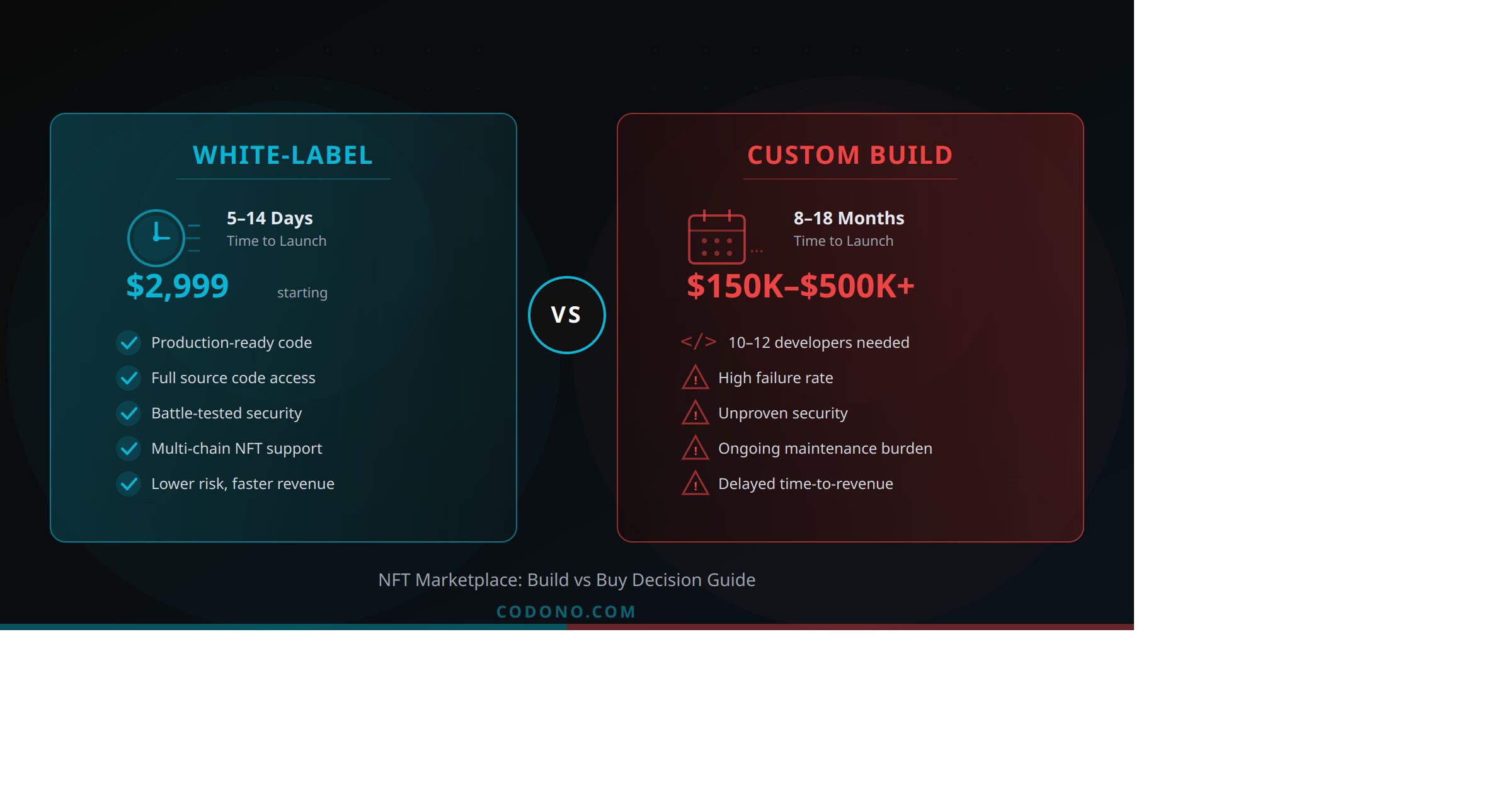
White-Label NFT Marketplace vs Custom Build — Which Is Right for You?
Table of Contents
- The State of NFT Marketplace Development in 2026
- What Is a White-Label NFT Platform?
- What Does Custom NFT Marketplace Development Involve?
- Cost Comparison: White-Label vs Custom Build
- Timeline Comparison: Speed to Market Matters
- Feature Parity Analysis
- Scalability and Performance
- When to Choose a White-Label NFT Marketplace
- When Custom Build Makes Sense
- The Hybrid Approach: Best of Both Worlds
- Decision Framework: Making the Right Choice
- Getting Started with Your NFT Marketplace
The State of NFT Marketplace Development in 2026
The NFT marketplace landscape in 2026 looks nothing like the speculative frenzy of 2021-2022. What emerged from the market correction is a legitimate digital asset infrastructure powering gaming economies, real-world asset tokenization, music rights distribution, loyalty programs, and digital identity systems. According to industry reports, global NFT trading volume exceeded $28 billion in 2025, with the majority driven by utility-focused applications rather than profile picture speculation.
This maturation has created a massive opportunity for entrepreneurs and businesses looking to launch niche NFT marketplaces. The general-purpose giants — OpenSea, Blur, Magic Eden — still dominate broad trading, but vertical-specific platforms are capturing increasingly valuable market segments. A gaming NFT marketplace serving a specific ecosystem. A real estate tokenization platform for a particular region. A music rights marketplace connecting independent artists with collectors.
The question facing these entrepreneurs is no longer whether to build an NFT marketplace, but how. And that decision comes down to two fundamentally different paths: deploying a white-label NFT marketplace platform or commissioning a custom build from scratch. We covered the technical architecture of building an NFT marketplace in our complete build guide, and the monetization strategies in our NFT business model guide. This article focuses specifically on the build-versus-buy decision and the real numbers behind each approach.
Getting this decision wrong is expensive. Not just in dollars, but in time. Every month your marketplace isn’t live is a month your competitors are capturing users, building network effects, and locking in creators. The cost of delay in a network-effects business is almost always higher than the cost of imperfection.
What Is a White-Label NFT Platform?
A white-label NFT marketplace is a pre-built, production-ready NFT trading platform that you license, rebrand, and deploy under your own identity. The term “white-label” comes from the practice of removing the manufacturer’s label and replacing it with your own — but in the software context, it means far more than a logo swap.
Modern white-label NFT marketplace solutions provide the complete technology stack required to operate a professional NFT trading platform:
- Smart contract infrastructure for minting, listing, bidding, and transferring NFTs across multiple blockchains
- Frontend marketplace with collection pages, NFT detail views, user profiles, search, and filtering
- Backend services handling user authentication, transaction processing, indexing, notifications, and analytics
- Wallet integration supporting MetaMask, WalletConnect, Phantom, and other popular wallets
- Admin dashboard for platform management, content moderation, fee configuration, and reporting
- IPFS/decentralized storage integration for NFT metadata and media files
The critical distinction between modern white-label solutions and the SaaS-based “marketplace builders” of earlier years is full source-code access. Leading platforms like Codono’s NFT marketplace software provide the complete source code with the license. You’re not renting access to someone else’s platform — you get the source code, host it on your infrastructure, and can modify anything from the smart contracts to the user interface. This is functionally the same as having a custom-built platform, except someone else already spent years writing, testing, and hardening the code.
This ownership model eliminates the biggest historical objection to white-label solutions: vendor lock-in. If you have the source code, you have the same freedom as a custom build. The difference is that you’re starting from a working product instead of a blank IDE.
What Does Custom NFT Marketplace Development Involve?
Building an NFT marketplace from scratch means assembling a development team, designing the architecture, writing every line of code, and testing every edge case yourself. Let us be specific about what “from scratch” actually entails, because this is where most founders underestimate the scope.
Smart Contract Development
You need ERC-721 and ERC-1155 contracts at minimum, plus marketplace contracts handling listings, offers, auctions, and royalty distribution. Each supported blockchain requires its own contract suite. These contracts must be audited by a reputable firm before mainnet deployment — a single vulnerability can drain your entire platform.
Blockchain Indexing Layer
Your marketplace needs to track every NFT transfer, mint, and sale across supported chains in real-time. This means building or integrating blockchain indexers that listen to contract events, parse transaction data, and maintain a synchronized database. Supporting multiple chains multiplies this complexity.
Backend API and Services
User authentication, KYC/AML compliance, payment processing, notification systems, search indexing, image processing, metadata caching, rate limiting, admin APIs — the backend of an NFT marketplace is comparable in complexity to a full crypto exchange platform. Our technology stack deep-dive covers the infrastructure decisions involved, and most of them apply directly to NFT marketplace development.
Frontend Application
A production-quality NFT marketplace frontend is a substantial application: collection galleries with infinite scroll, real-time bidding interfaces, wallet connection flows, transaction status tracking, responsive design for mobile, SEO optimization, and accessibility compliance. This alone requires 2-3 experienced frontend engineers working for 6+ months.
Security Infrastructure
NFT marketplaces handle real assets with real value. You need protection against smart contract exploits, API abuse, DDoS attacks, cross-site scripting, SQL injection, and the creative attack vectors that specifically target crypto platforms. Building enterprise-grade security from scratch means hiring dedicated security engineers and paying for multiple rounds of penetration testing.
DevOps and Infrastructure
Container orchestration, CI/CD pipelines, monitoring, alerting, log aggregation, database replication, CDN configuration, SSL management, and auto-scaling infrastructure. Someone has to build and maintain all of this.
The total scope is enormous. Most founders who choose custom development have never built a blockchain application before, and they consistently underestimate the complexity by a factor of three to five.
Cost Comparison: White-Label vs Custom Build
Numbers tell the real story. Here is a detailed comparison across every dimension that affects your total cost of ownership.
Head-to-Head Comparison Table
| Dimension | White-Label NFT Platform | Custom Build |
|---|---|---|
| Initial cost | $1,899 - $12,500 | $150,000 - $500,000+ |
| Time to launch | 5 - 14 days | 8 - 18 months |
| Team required | 1 - 3 people | 10 - 15 people |
| Monthly maintenance | $500 - $2,000 (hosting + support) | $15,000 - $40,000 (team salaries) |
| Smart contract audit | Included (pre-audited) | $15,000 - $80,000 per audit |
| Multi-chain support | Included (5+ chains) | 2 - 4 months per additional chain |
| Security hardening | Years of production testing | Starts at zero, builds over years |
| Feature completeness | 90 - 95% on day one | 40 - 60% at initial launch |
| Customizability | Full (with source code license) | Full (you built it) |
| Scalability | Proven under load | Unproven until tested |
| Risk level | Low — working product exists | High — most custom projects fail |
| Time to first revenue | 2 - 4 weeks | 9 - 20 months |
| Year 1 total cost | $10,000 - $40,000 | $250,000 - $800,000 |
| Ongoing updates | Vendor updates available | 100% self-maintained |
| Documentation | Included | Must write from scratch |
Custom Build Developer Salary Breakdown
If you choose custom development, here is what a realistic team costs annually in 2026. Even with offshore rates, the numbers add up fast.
| Role | US Salary | Offshore (Eastern Europe) | Headcount |
|---|---|---|---|
| Senior Solidity Developer | $180,000 - $250,000 | $80,000 - $120,000 | 1 - 2 |
| Backend Engineer | $150,000 - $220,000 | $60,000 - $100,000 | 3 - 4 |
| Frontend Engineer (React/Vue) | $140,000 - $200,000 | $50,000 - $90,000 | 2 - 3 |
| DevOps Engineer | $160,000 - $230,000 | $70,000 - $110,000 | 1 |
| Security Engineer | $170,000 - $240,000 | $80,000 - $130,000 | 1 |
| QA Engineer | $100,000 - $150,000 | $40,000 - $70,000 | 1 |
| UI/UX Designer | $120,000 - $180,000 | $50,000 - $80,000 | 1 |
| Project Manager | $130,000 - $180,000 | $50,000 - $80,000 | 1 |
| Total (US team) | $1,500,000 - $2,500,000/yr | 10 - 14 | |
| Total (Offshore team) | $500,000 - $900,000/yr | 10 - 14 |
These figures represent fully loaded costs (salary, benefits, equipment, software licenses). The offshore column assumes senior talent in Poland, Ukraine, or similar markets — junior offshore developers cost less but ship slower and introduce more bugs, which often negates the savings.
Compare that to a white-label license starting at $1,899 with a deployment timeline measured in days rather than months. Even adding $20,000 - $50,000 for custom modifications, branding, and initial marketing, the white-label path costs roughly 5-10% of what custom development requires.
For a deeper look at exchange-specific costs, our cost to build a crypto exchange analysis covers the financial landscape in detail — and the same cost dynamics apply to NFT marketplace development.
Timeline Comparison: Speed to Market Matters
Time is the hidden cost that most founders fail to account for. In a market where network effects determine winners, being live six months earlier can be the difference between capturing a niche and arriving after someone else already locked it down.
White-Label Deployment Timeline
| Phase | Duration | Activities |
|---|---|---|
| License and setup | Day 1 - 2 | Purchase license, receive source code, provision servers |
| Branding and UI customization | Day 2 - 7 | Logo, color scheme, landing pages, custom copy |
| Smart contract deployment | Day 5 - 8 | Deploy contracts to target chains, configure gas settings |
| Admin configuration | Day 7 - 10 | Fee structure, supported collections, moderation rules |
| Testing and QA | Day 8 - 12 | End-to-end testing, wallet flows, transaction verification |
| Soft launch | Day 12 - 14 | Invite beta users, monitor transactions, fix edge cases |
Total: 5 - 14 days to a live, revenue-generating marketplace.
Custom Build Timeline
| Phase | Duration | Activities |
|---|---|---|
| Requirements and architecture | Month 1 - 2 | Tech stack decisions, system design, contract specifications |
| Smart contract development | Month 2 - 5 | Write, test, and internally audit ERC-721/1155 contracts |
| Backend MVP | Month 3 - 8 | API development, blockchain indexing, database design |
| Frontend MVP | Month 4 - 9 | Marketplace UI, wallet integration, responsive design |
| Integration and testing | Month 8 - 12 | Connect all systems, end-to-end testing, load testing |
| Security audit | Month 12 - 14 | External smart contract audit, penetration testing |
| Bug fixes and hardening | Month 14 - 16 | Address audit findings, fix critical bugs, performance tuning |
| Beta launch | Month 16 - 18 | Limited release, gather feedback, iterate |
Total: 8 - 18 months before generating any revenue.
The gap is stark. With white-label, you’re collecting trading fees in week two. With custom, you’re still writing unit tests in month six. That 12-16 month head start compounds — early users become creators, creators attract buyers, buyers attract more creators. Network effects are unforgiving to latecomers.
Feature Parity Analysis
One of the most common objections to white-label solutions is the assumption that they ship with fewer features or lower quality than a custom build. In practice, the opposite is usually true. A mature white-label NFT marketplace has been in development for years, incorporating feedback from dozens or hundreds of deployments. A custom build starts at zero.
Here is what a typical white-label NFT marketplace includes out of the box versus what a custom build can realistically deliver in its first 12 months:
| Feature | White-Label (Day 1) | Custom Build (Month 12) |
|---|---|---|
| NFT minting (ERC-721/1155) | Included | Available |
| Multi-chain support | 5+ chains | 1 - 2 chains |
| Auction and bidding system | Included | Basic implementation |
| Fixed-price listings | Included | Available |
| Collection pages | Included | Available |
| Creator royalties (on-chain) | Included | Partial |
| Wallet integration (5+ wallets) | Included | 2 - 3 wallets |
| IPFS/Arweave storage | Included | Basic IPFS |
| Admin dashboard | Full-featured | Basic |
| Analytics and reporting | Included | Minimal |
| Search and filtering | Advanced | Basic |
| Mobile-responsive UI | Included | Varies |
| KYC/AML integration | Included | Partial |
| API for third-party integrations | Included | Limited |
| Lazy minting (gasless) | Included | Usually absent |
| Bulk minting tools | Included | Usually absent |
The white-label platform delivers approximately 90-95% of the features a mature marketplace needs on day one. A custom build at the 12-month mark typically covers 40-60% of those same features, with the remainder added incrementally over another 6-12 months.
The feature gap is particularly visible in areas like the admin dashboard, where white-label platforms provide complete management tools that take months of dedicated development to replicate in a custom build.
Scalability and Performance
A legitimate concern for operators considering white-label is whether the platform can scale with their growth. This deserves an honest answer.
White-Label Scalability
Mature white-label platforms have been load-tested across multiple deployments. The architecture is typically designed for horizontal scaling from the start because the vendor knows their software will run in environments ranging from small niche marketplaces to high-traffic platforms. Codono’s crypto exchange infrastructure handles thousands of concurrent operations — the same architecture underpins the NFT marketplace module.
Key scalability features in production-grade white-label platforms:
- Database read replicas for high-query-volume scenarios
- Redis caching for collection data, pricing, and metadata
- CDN integration for NFT media delivery
- WebSocket connections for real-time bidding updates
- Queue-based processing for minting and indexing operations
Custom Build Scalability
Custom builds have theoretical unlimited scalability because you control every architectural decision. In practice, achieving that scalability requires experienced engineers who have already solved these problems before. Most custom NFT marketplaces face their first scaling crisis within weeks of launch — usually when a popular collection drops and traffic spikes 50x overnight. If your team hasn’t designed for this scenario, the platform goes down at the worst possible moment.
The honest assessment: white-label platforms offer proven scalability within known parameters. Custom builds offer unbounded scalability potential, but only if you have the engineering talent and budget to realize it. For 95% of NFT marketplace operators, proven scalability within known parameters is exactly what they need.
When to Choose a White-Label NFT Marketplace
White-label is the right choice in most scenarios. Here are the specific situations where it makes the most strategic sense:
You are a startup validating a market. Spending $150,000+ to test whether your niche NFT marketplace concept has product-market fit is irrational. A white-label platform lets you launch for under $15,000, validate demand, and then invest in customization based on real user feedback. This is lean methodology applied to blockchain product development.
You have a non-technical founding team. If your core competency is in business development, community building, or domain expertise (gaming, art, music, real estate) rather than software engineering, a white-label platform lets you focus on what you’re good at. Managing a 10-person development team is a full-time job that distracts from the activities that actually determine whether your marketplace succeeds — building supply (creators) and demand (collectors).
You need revenue within 90 days. Investors, partners, and co-founders lose patience. If your business plan requires demonstrating traction within a quarter, custom development is not an option. The white-label crypto exchange model has proven repeatedly that fast deployment does not mean low quality — it means leveraging existing work instead of recreating it.
Your differentiation is not in the technology. Most successful niche NFT marketplaces win on curation, community, partnerships, and go-to-market strategy — not on having a marginally different frontend framework. If your competitive advantage is your understanding of the gaming NFT market in Southeast Asia, you don’t need custom code. You need a working marketplace and a brilliant go-to-market plan.
You want to minimize financial risk. Software projects fail. Custom blockchain projects fail at even higher rates because the technology is genuinely difficult and the talent pool is small. A white-label approach limits your downside to the license cost while preserving the full upside of a successful marketplace.
When Custom Build Makes Sense
Despite the strong case for white-label, custom development is the right choice in certain specific situations:
You are building a fundamentally new type of NFT interaction. If your marketplace concept involves novel smart contract mechanics that don’t exist in any current platform — for example, fractional ownership with dynamic pricing, or cross-chain atomic swaps between NFTs and DeFi positions — then no white-label solution will cover your core use case. You need custom contracts and potentially custom infrastructure.
You have an existing engineering team with blockchain experience. If you’re a technology company that already employs senior Solidity developers, blockchain infrastructure engineers, and production DevOps staff, the incremental cost of building an NFT marketplace is lower because you’re not hiring from zero. The team already exists and has the relevant skills.
You are a large enterprise with unique compliance requirements. If your NFT marketplace must integrate with existing enterprise systems (specific ERP platforms, proprietary identity verification, custom regulatory reporting), and the integration surface is so extensive that modifying a white-label solution would amount to rewriting most of it anyway, custom may be more efficient.
You need absolute control over every technical decision. Some organizations have non-negotiable requirements around specific technology stacks, deployment environments, or architectural patterns that conflict with how white-label solutions are built. Government-adjacent projects with specific security clearance requirements, for instance.
Your budget exceeds $500,000 and your timeline exceeds 12 months. If you genuinely have the capital to fund a full development team for 12-18 months with buffer, and your launch timeline accommodates this, custom development gives you a platform that is 100% purpose-built for your exact requirements.
Notice that each of these scenarios involves either unusual technical requirements, existing engineering capacity, or significant capital reserves. For the vast majority of NFT marketplace operators, none of these conditions apply.
The Hybrid Approach: Best of Both Worlds
The most sophisticated operators choose a third path that combines the speed of white-label deployment with the long-term flexibility of custom development. This hybrid approach works particularly well for businesses that need to move fast now but have plans to differentiate significantly over time.
How the Hybrid Model Works
Phase 1: Launch with white-label (weeks 1-4). Deploy a production-ready NFT marketplace using white-label software. Configure branding, fee structure, and supported chains. Go live and start acquiring users and creators.
Phase 2: Customize based on data (months 2-6). With real users on the platform, you now have data on what features they actually want, which collections drive volume, and where the friction points are. Use the source code access to make targeted modifications. This is dramatically more efficient than guessing what to build before you have any users.
Phase 3: Build custom modules for differentiation (months 6-12+). With revenue flowing and clear data on what makes your marketplace unique, invest in custom development for the specific features that differentiate you. This might mean a proprietary recommendation engine, a custom launchpad integration, or a unique social layer. If you want inspiration for adjacent features, our launchpad software and crypto wallet solution show how complementary modules can expand a platform’s value proposition.
This approach delivers 80% of the value of custom development at 20% of the cost, because you’re only building custom what actually needs to be custom. Everything else — the 95% of infrastructure that every NFT marketplace needs — comes pre-built and battle-tested.
Decision Framework: Making the Right Choice
If you’re still unsure, work through this structured decision framework. Answer honestly.
Budget Assessment
- Under $50,000 total budget: White-label is your only viable option, and it’s a good one.
- $50,000 - $200,000 budget: White-label with significant customization. You can build a highly differentiated platform by modifying a white-label base.
- $200,000 - $500,000 budget: Hybrid approach — launch white-label, then invest in custom modules.
- $500,000+ budget with 18+ month runway: Custom is feasible, but ask yourself whether it’s optimal.
Timeline Assessment
- Must launch within 30 days: White-label only.
- Must launch within 90 days: White-label with customization.
- Must launch within 6 months: Hybrid approach or aggressive custom (with an experienced team).
- 12+ months acceptable: Custom is feasible if the budget matches.
Team Assessment
- No technical co-founder or in-house engineers: White-label. Do not attempt custom development without technical leadership.
- 1-3 developers with web experience but no blockchain: White-label. Your team can customize but shouldn’t build from scratch.
- 5+ developers including blockchain specialists: Hybrid or custom, depending on budget and timeline.
- 10+ developers with production blockchain experience: Custom is a realistic option.
Differentiation Assessment
- Your competitive advantage is non-technical (community, niche, partnerships, geography): White-label.
- Your competitive advantage is UX and curation: White-label with frontend customization.
- Your competitive advantage requires novel smart contract mechanics: Custom or heavy hybrid.
- Your competitive advantage is proprietary technology: Custom.
For the majority of founders reading this article, the honest answers to these questions point toward white-label or hybrid. And that’s not a consolation prize — it’s a strategic advantage. The fastest path to market, the lowest financial risk, and the most efficient use of limited resources.
Check our pricing page to see where your budget fits, or explore a working platform through the live demo to evaluate feature completeness firsthand.
Getting Started with Your NFT Marketplace
The decision between white-label and custom build is fundamentally a question of resource allocation. Where do you want to invest your time, money, and energy — in rebuilding infrastructure that already exists, or in the activities that will actually determine whether your marketplace succeeds?
For most businesses, the answer is clear. A white-label NFT marketplace gets you to market in days, not months. It gives you production-ready infrastructure, pre-audited smart contracts, and a complete feature set. With source code access, you retain the freedom to customize anything and everything as your business evolves.
Here is a practical path to launch:
- Evaluate your requirements. List the chains you need to support, the types of NFTs you’ll host, and any specific features your niche demands.
- Review the platform. Explore Codono’s NFT marketplace solution and the admin dashboard to assess feature coverage against your requirements.
- Request a demo. See the live demo to evaluate the trading experience, admin capabilities, and customization options.
- Plan your customization. Identify the 5-10% of the platform that needs modification for your specific use case. That targeted customization is where your budget creates the most value.
- Launch and iterate. Deploy the platform, onboard your first creators and collectors, and let real-world usage data guide your development priorities.
The NFT marketplace opportunity in 2026 is real, but it rewards operators who move decisively. Every week spent deliberating between build approaches is a week your future competitors are onboarding creators, building community, and establishing the network effects that make late entry exponentially harder.
Whether you choose white-label, custom, or hybrid, the most important thing is to start. And for most businesses, white-label NFT marketplace software is the fastest, most cost-effective way to do exactly that.
Codono Team
Codono builds enterprise-grade crypto exchange software deployed by 250+ operators across 30+ countries. Our team writes from production experience running spot, derivatives, custody, and compliance at scale.
View all posts by Codono Team →