 Software Exchange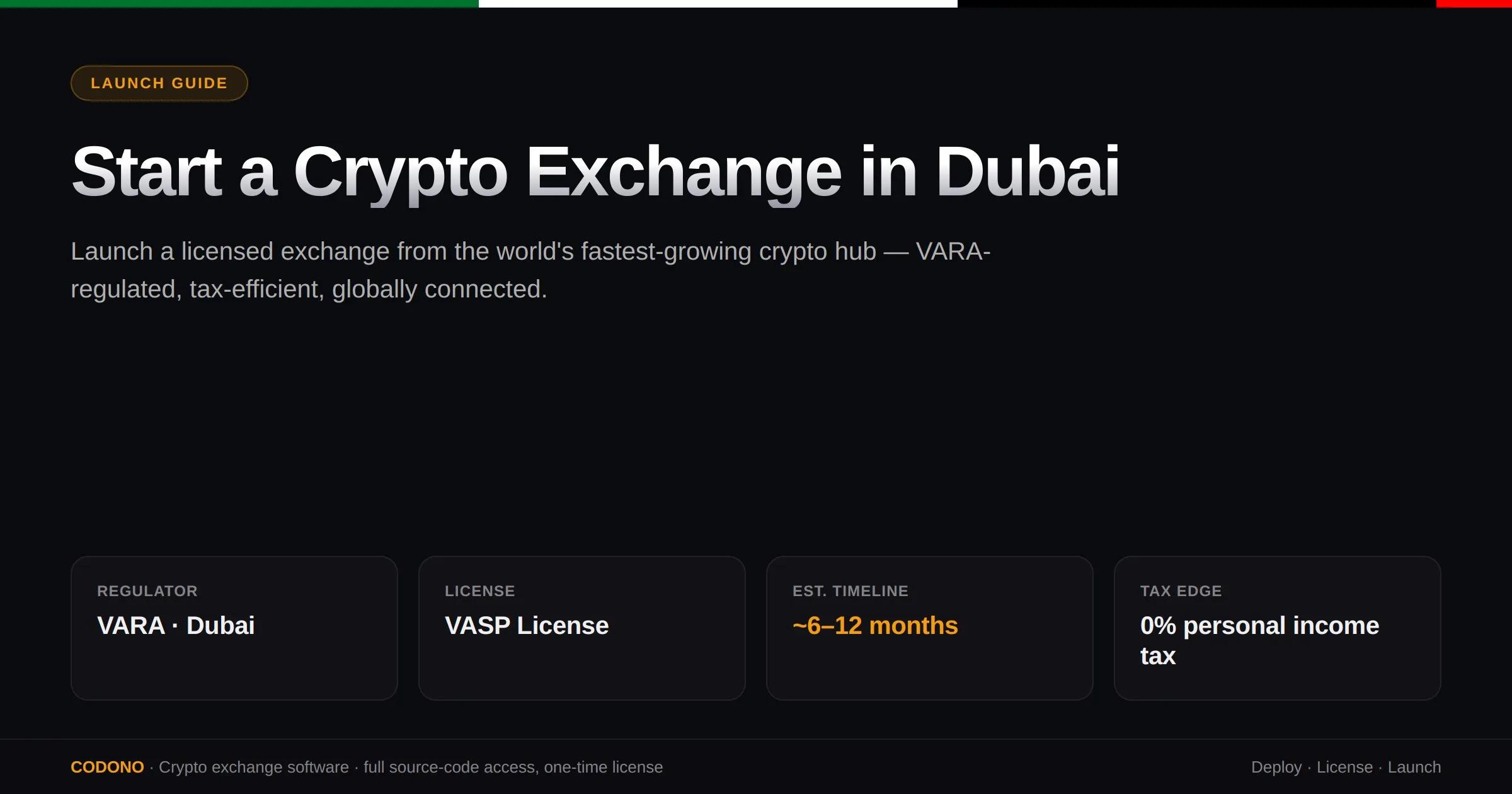
Dubai has become one of the most sought-after places on earth to launch a regulated crypto exchange. The reason is simple: it paired a dedicated crypto regulator with a tax-efficient, business-friendly environment and a globally connected market — regulatory clarity and commercial advantage in one jurisdiction. This guide walks the practical path to launching there, from the VARA licensing route to the software that runs underneath.
Why Launch a Crypto Exchange in Dubai?
Most jurisdictions force a trade-off: clear regulation but a hostile tax and cost environment, or low friction but no regulatory certainty. Dubai’s appeal is that it minimizes that trade-off.
- A crypto-specific regulator. VARA (the Virtual Assets Regulatory Authority) was created specifically to license and supervise virtual-asset businesses. That specialization means clearer rules and a defined path, versus jurisdictions where crypto is squeezed into legacy financial regulation.
- Tax efficiency. The UAE levies no personal income tax and offers attractive corporate structures, which materially changes the economics for founders and operators compared with high-tax jurisdictions.
- A global, connected market. Dubai is a crossroads for capital from the Middle East, South Asia, Africa and beyond, with a large expatriate and high-net-worth population and strong institutional presence — a natural base for an exchange with international ambitions.
The net effect: Dubai lets you build a compliant, credibly-regulated exchange without the tax drag, in a market with genuine reach. That is why operators increasingly choose it as their licensed home base.
The VARA Licensing Path
The single most important thing to understand: in Dubai, the license is the hard part, not the software. You cannot offer exchange services to the public without VARA authorization, and securing it is a structured, multi-month process.
At a high level, the VASP authorization path involves establishing a properly-formed UAE entity with real local substance, demonstrating fit-and-proper ownership and management, meeting regulatory capital requirements, and standing up a genuine compliance program — KYC/AML, transaction monitoring, governance and risk controls — that VARA will examine in detail. Different activities (exchange, broker-dealer, custody) map to different license categories, so the exact requirements depend on what you intend to offer.
This page is an orientation, not legal advice. For the detailed walk-through of the process, see the Dubai VARA license guide , and engage a local regulatory and corporate-services advisor early — they are not optional for a VARA application.
VARA License Categories
One nuance that shapes your entire budget and timeline: VARA does not issue a single generic “exchange licence.” Authorization is activity-based — the services you intend to provide map to different categories, each with its own requirements and capital. At a high level, the activities a crypto business might be authorized for include:
- Exchange services — operating the trading venue where users buy and sell virtual assets.
- Broker-dealer services — matching or executing orders on behalf of clients.
- Custody services — safekeeping client assets and keys.
- Lending, advisory and management — related services with their own authorizations.
Most operators launching a trading platform are focused on the exchange (and often custody) activities, but the exact combination you apply for determines your capital, your compliance obligations and how long authorization takes. Scope your services deliberately — applying for more activities than you need adds cost and time; applying for too few limits what you can offer. A local advisor will help you map your business model to the right categories before you file. Note too that Abu Dhabi’s ADGM/FSRA operates a separate framework, so part of the early decision is which UAE regime fits your structure.
What It Costs
Budgeting for a Dubai launch means separating several components, because the software is the small, predictable part and the regulatory side is the large, variable part:
| Cost component | Character |
|---|---|
| VARA application & supervision fees | Regulatory, varies by license category |
| Regulatory capital | Often the largest requirement; category-dependent |
| UAE company formation & substance | Local entity, office, governance |
| Compliance staffing | MLRO / compliance function, ongoing |
| Exchange software | One-time license, full source-code access — fixed, comparatively small |
| Infrastructure & operations | Servers, security, support |
The honest framing: the regulatory and capital components typically dominate the budget, and they are the numbers to confirm first with a local advisor, since they move with license category and regulatory updates. The exchange software is a fixed one-time cost — see pricing — which makes it one of the easier lines to plan around.
How to Launch, Step by Step
- Scope your model and market. Decide what you’re offering (spot, derivatives, retail, institutional) and to whom — this drives your license category and capital.
- Engage local advisors. A UAE regulatory/legal and corporate-services team, before anything else.
- Form the UAE entity. Establish the company with appropriate substance, governance and banking.
- Prepare and file the VARA application. Ownership, management, capital, and a documented compliance program.
- Build in parallel. While licensing proceeds, deploy and configure the exchange software — branding, KYC tiers, custody policy, trading pairs. The software build (2–4 weeks) fits comfortably inside the licensing window.
- Satisfy regulatory review. Work through VARA’s questions, demonstrate your controls, meet conditions.
- Launch on authorization. Go live once approved, with your compliance program running from day one.
The pattern to internalize: licensing and software run in parallel, and licensing sets the timeline.
Local Requirements That Matter
- A real UAE presence. Substance, governance and a compliance function — not a paper company.
- Compliance staffing. A qualified compliance officer / MLRO is expected as part of authorization.
- Custody standards. Hot/cold segregation, multi-signature controls and safeguarding of client assets are core to what VARA examines — all provided by the platform’s wallet infrastructure .
- Regional market fit. Arabic-language support and locally-relevant payment and fiat rails improve conversion in the Gulf market; the platform localizes and integrates fiat via the payment gateway .
Who Your Users Are in Dubai
Dubai’s user base is distinctive, and it should shape what you build. Unlike an emerging-market P2P audience or an Indian retail base, Dubai skews toward capital and sophistication:
- Institutional and professional traders. Dubai attracts funds, trading firms and family offices drawn by the regulatory clarity and tax environment. They expect deep liquidity, a robust API , and derivatives — which favors a full-suite or derivatives-capable platform.
- High-net-worth individuals. A large HNW population, local and expatriate, wants a credible, well-custodied venue more than the cheapest fees. Trust signals and strong custody matter more than aggressive pricing.
- A global expatriate community. Dubai’s residents come from South Asia, the Middle East, Africa, Europe and beyond, often moving money across borders. Multi-currency support, broad asset coverage and localization pay off.
- Regional gateway users. As a hub, a Dubai exchange can serve the wider Gulf and beyond, so think of your market as regional, not just the emirate.
The practical implication: Dubai rewards a premium, institution-grade, liquidity-deep exchange over a bare-bones retail app. That points most operators toward a full-suite or derivatives model — which the next section covers.
The Software That Runs Underneath
Once you hold (or are progressing toward) authorization, you need a platform that meets VARA’s expectations out of the box. Codono provides exactly the infrastructure a regulator examines:
- KYC/AML pipeline — tiered verification, integrated identity providers, transaction monitoring and suspicious-activity workflows.
- Custody controls — hot/cold segregation and multi-signature withdrawals across 50+ chains.
- Audit-ready logging — complete trails across trades, fund movements and KYC/admin decisions.
- Full source-code access — a one-time license, so you own and control the platform rather than renting it.
Which model you launch is your choice. Dubai’s international and institutional character often suits a full-suite or derivatives-capable exchange — the Binance clone (full-suite) or Bybit clone (derivatives) are natural fits — but every model is supported. The clone-script overview helps you match one to your strategy, and the compliance requirements page maps the controls VARA expects.
Dubai vs Other Regulated Hubs
If you’re deciding where to base a licensed exchange, it helps to see how Dubai stacks up against the other credible options:
- Dubai vs the EU (MiCA). The EU’s MiCA regime offers a 27-state passport — unmatched market access — but with heavier prudential and capital demands and no tax advantage. Dubai offers a lighter tax burden and a business-friendly setup, but serves its market and region rather than a single-authorization bloc. Choose the EU for breadth of market; Dubai for tax efficiency and a Gulf/global base.
- Dubai vs Singapore. Both are respected, well-regulated hubs. Singapore (MAS) is a mature financial center with a demanding licensing bar; Dubai combined comparable credibility with a newer, crypto-specific regulator and a stronger tax position. Many operators view them as the two premier “credible-and-commercial” hubs.
- Dubai vs offshore. Some operators still consider light-touch offshore jurisdictions for speed and low cost. The trade-off is credibility: offshore status increasingly limits banking access, institutional partnerships and user trust. Dubai’s appeal is getting real regulatory standing without the tax and cost penalty of onshore Western jurisdictions.
The pattern: Dubai’s niche is credibility without the tax drag — which is why it wins operators who want to be taken seriously by banks, institutions and users while keeping favorable economics. Match the hub to your priority: market breadth (EU), maturity (Singapore), or credible tax-efficiency (Dubai).
Realistic Timeline
- Software deployment: 2–4 weeks (branding, configuration, testing).
- Company formation: weeks to a couple of months.
- VARA authorization: commonly several months, often in the six-to-twelve-month range depending on category, capital and application quality.
Plan your launch around the licensing timeline, and use the licensing window to get the software fully built and tested so you can go live the moment authorization lands.
Getting Started
- Consultation — your target market, model, and licensing position.
- Software — choose from our pricing plans and start configuring while licensing proceeds.
- Deploy & test — a fully-branded, VARA-ready platform inside the licensing window.
- Launch on authorization — go live with 12 months of updates and technical support.
Contact us to plan your Dubai launch, or explore the live demo to see the platform you’ll be deploying.