 Software Exchange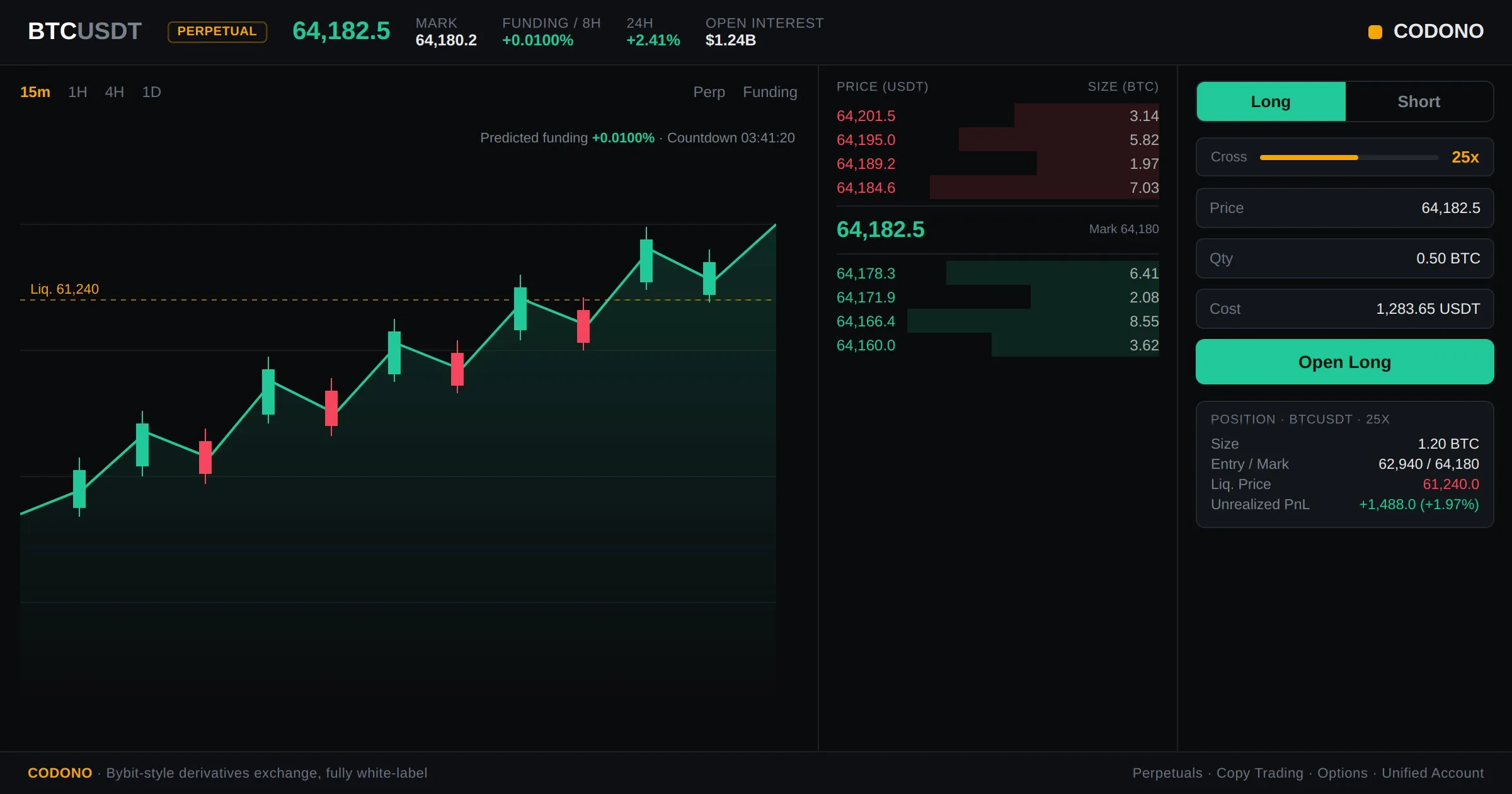
What is a Bybit Clone Script?
A Bybit clone script is enterprise-grade cryptocurrency exchange software that replicates the specific features that made Bybit a top derivatives exchange - not “an exchange” generically, but the Bybit model: perpetual futures as the main event, high leverage, a unified trading account, and copy trading as the growth engine.
Codono is an independently built, unbranded codebase. Configured as a Bybit clone, it gives you a derivatives-first platform - launched under your own brand, domain and logo, with full source-code access. This is the model to choose when futures fees, not spot fees, are your revenue plan. (For the vendor-neutral product category rather than a Bybit-specific model, see crypto derivatives exchange software .)
This page is specific to the Bybit model. If you want the broadest feature set, the Binance clone is the full-suite option; if altcoin listings and trading bots are your edge, the KuCoin clone leads with those. The clone-script overview compares every model on one engine.
Why Clone Bybit Specifically?
Two structural facts make the Bybit model attractive - and if they fit your plan, this is the exchange to build.
1. Derivatives fees dwarf spot fees. Perpetual futures generate far more trading volume and fee revenue per user than spot markets, because leverage multiplies position size and traders turn over capital constantly. A derivatives-first exchange can out-earn a spot exchange with a fraction of the users. Bybit grew into a top-five exchange largely on perpetuals - and the fee economics are the reason.
2. Copy trading is a self-reinforcing growth loop. Bybit turned its best traders into a marketing channel: lead traders publish strategies, followers mirror them automatically, and everyone’s volume - and your fees - go up. It is one of the most effective acquisition-and-retention mechanics in crypto, because it makes skilled users want to bring their audience to your platform. Most clone scripts do not ship real copy trading. This one does.
Together they make the Bybit model a high-revenue-per-user, viral-growth play - concentrated on derivatives rather than trying to be everything to everyone.
Feature Comparison With Bybit
| Feature | Bybit | Our Clone Script |
|---|---|---|
| USDT-margined perpetuals | ✓ | ✓ |
| Inverse (coin-margined) contracts | ✓ | ✓ |
| High leverage | ✓ | ✓ Configurable limits |
| Copy trading | ✓ | ✓ |
| Unified trading account | ✓ | ✓ |
| Funding-rate mechanism | ✓ | ✓ |
| Insurance fund | ✓ | ✓ |
| Auto-deleveraging (ADL) | ✓ | ✓ |
| Spot trading | ✓ | ✓ |
| Options | ✓ | Coming Soon |
| Launchpad | ✓ | ✓ |
| Cross-Platform mobile apps | ✓ | ✓ iOS & Android |
The Signature Bybit Features, Replicated
Perpetual Futures - USDT & Inverse
The heart of the model. The clone ships a production perpetual-futures engine covering both USDT-margined contracts (the mainstream product) and inverse, coin-margined contracts, with a funding-rate mechanism that anchors the perpetual price to spot, plus mark-price and index-price systems that prevent manipulation-driven liquidations. This is the same engine documented on our futures trading software page - verified in real deployments processing derivatives volume.
Copy Trading
Lead traders publish their positions; followers allocate capital and mirror trades automatically, with proportional sizing and configurable risk limits. Operators set the lead-trader approval process and the profit-share split. Because copy trading converts your top traders into an acquisition channel, it is the single highest-leverage growth feature in the Bybit model - and a genuine differentiator against clones that ship only manual trading.
Unified Trading Account
Bybit popularized letting one margin balance back spot, margin and derivatives positions at once, instead of forcing users to shuffle funds between separate wallets. The clone supports a unified account so capital is used efficiently and the experience matches what Bybit users expect when they arrive.
Pro-Trader UX
Derivatives traders are demanding: they expect a leverage slider, one-click long/short, visible funding countdown, position PnL and liquidation price on screen, and the full order-type matrix (limit, market, conditional, TP/SL, post-only, reduce-only). The clone’s trading interface is built for that audience - the difference between a derivatives exchange pros actually use and a spot UI with a futures tab bolted on.
The Risk Engine That Keeps You Solvent
This is where most “futures clones” quietly fail. Adding “perpetual futures” to a feature list is easy; building a risk engine that survives a liquidation cascade without bankrupting the house is the hard part - and it is the part that determines whether your derivatives exchange lives or dies on its first volatile day.
The clone includes the same risk primitives that keep major derivatives exchanges solvent:
- Mark price aggregation - liquidations trigger on a manipulation-resistant mark price, not the last trade, so a thin-book wick cannot cascade wrongful liquidations.
- Partial liquidation - positions are reduced incrementally rather than dumped whole, minimizing market impact.
- Insurance fund - absorbs the gap when a liquidation closes below bankruptcy price, protecting winning traders from socialized losses.
- Auto-deleveraging (ADL) - a ranked, last-resort mechanism when the insurance fund is exhausted.
- Configurable risk tiers - maximum leverage steps down as position size grows, capping the exchange’s tail risk.
These are not optional extras in the derivatives model - they are what stands between you and insolvency during the market events that derivatives traders live for.
Running Copy Trading as an Operator
Copy trading is the growth engine of the Bybit model, but it’s also a system you operate — not a button you press. Understanding the operator side before launch is what separates a copy-trading program that compounds from one that stalls.
Why it compounds. A skilled lead trader with a following has a direct incentive to bring that audience to your platform, because copiers amplify the lead’s own volume and profit share. Each successful lead becomes an acquisition channel you don’t pay for up front — and their copiers, once mirroring, generate steady leveraged volume. This is the self-reinforcing loop that let Bybit punch above its user count: a few hundred strong lead traders can drive the volume of a far larger flat user base.
The levers you control. The clone lets you configure the mechanics that determine whether the program is healthy: the lead-trader approval process (vetting who can be copied protects your copiers and your reputation), the profit-share split between lead, platform and copier, per-copier risk caps and maximum allocation, and drawdown limits that pause copying when a lead blows past a threshold. Setting these well is the difference between a program that builds trust and one that produces a wave of losses and chargebacks.
The follower-protection duty. Copiers are, by definition, delegating judgment to someone else — so the honest operator surfaces each lead’s real track record: verified PnL, maximum drawdown, and copier count, not a cherry-picked win rate. The clone’s copy-trading UI is built to show verified performance history, and you should preserve that. A program that lets unproven “leads” attract copiers with fake stats is both a trust disaster and, in many jurisdictions, a regulatory one.
How to seed it. Copy trading has a cold-start problem — no copiers want to follow an empty leaderboard. Operators typically seed it by recruiting a first cohort of credible traders (sometimes with a temporary elevated profit share), running a copy-trading competition, or migrating known traders from a community. Once the leaderboard has verified performers, the loop becomes self-sustaining.
Core Modules Included
Beyond the derivatives-signature features, every deployment includes the full Codono stack:
Matching Engine
Price-time-priority with in-memory order books, thousands of orders per second at sub-5ms latency - and it holds that latency when volume spikes 50x during a liquidation event, exactly when a derivatives exchange is under the most load.
Spot & Margin
Full spot trading and margin trading up to 10x, sharing the unified account so users can hedge and trade across products.
Multi-Chain Wallets & Compliance
Automated multi-chain wallets across 50+ networks, and a KYC/AML pipeline configured to your jurisdiction’s compliance requirements - which matter more for derivatives, given the heavier regulatory scrutiny.
Admin Dashboard & API
Full back office for risk monitoring, liquidation controls, funding configuration and reporting, plus a REST & WebSocket API for the algorithmic traders who dominate derivatives volume.
Cross-Platform Mobile Apps
iOS and Android with full derivatives trading, position management, and push alerts for funding, margin and liquidation.
Revenue Model for Operators
The Bybit model concentrates revenue on the highest-margin activity in crypto:
- Futures trading fees - 0.02% maker / 0.055% taker typical, on leveraged volume that far exceeds spot turnover.
- Funding-rate flow - the mechanism that balances long/short demand keeps volume high.
- Copy-trading profit share - a cut of follower profits or a platform fee on copied volume.
- Liquidation flow - the insurance fund captures value from the liquidation process.
- Spot & margin fees - secondary revenue from the unified account.
- Withdrawal fees - network-fee markup.
Because leverage multiplies volume, a derivatives exchange can reach meaningful fee revenue with a smaller active-user base than a spot-only platform - the core reason operators choose this model.
Who the Bybit Model Is Right For — and Who It Isn’t
The derivatives model is the highest-revenue clone option, but it’s also the one with the most demanding requirements. Here’s the honest fit test.
The Bybit model is right for you if:
- Derivatives fees are your revenue plan — you want the highest revenue-per-user in crypto and are building around perpetuals, not spot.
- You can clear the licensing bar for derivatives in your target markets, or you’re targeting jurisdictions where leveraged crypto products are permitted.
- You want a viral growth loop and are prepared to operate a copy-trading program properly — vetting leads, seeding the leaderboard, protecting copiers.
- You understand that a derivatives exchange lives or dies on its risk engine, and you’ll run it with appropriate conservatism (leverage caps, funded insurance fund).
It’s probably not the right model if:
- You can’t yet secure the regulatory footing for leveraged products — derivatives are restricted or prohibited for retail in several major markets, and launching without that footing is a serious risk, not a growth hack.
- Your edge is altcoin listings and automation — the KuCoin clone model fits that better.
- You want a simple, fiat-first retail exchange — the Coinbase clone is the fit.
- You want a one-stop full-suite platform without leading on derivatives — the Binance clone includes futures within a broader feature set.
Because every model shares one codebase, you can also launch spot-first and switch on derivatives once your licensing is in place — a common, lower-risk path onto the Bybit model. If you’re weighing options, the clone-script overview compares them side by side.
Is a Bybit Clone Legal?
The honest answer, with one extra caution specific to derivatives.
What is legal. Perpetuals, leverage, copy trading, a unified account - these are functional trading mechanics, not Bybit inventions, and building software that offers them is entirely legal.
What is not legal. You cannot copy Bybit’s actual source code (you are not - Codono is its own codebase). You cannot use the Bybit name, logo or brand on your exchange - those are registered trademarks. You cannot reproduce Bybit’s copyrighted visual assets pixel-for-pixel.
The derivatives-specific caution. Derivatives are more heavily regulated than spot trading in most jurisdictions, and leveraged crypto products are restricted or prohibited for retail users in several markets (the UK and others). The software gives you the capability; whether you may offer it to a given user depends on your license and their jurisdiction. This makes the compliance and licensing work more important for the Bybit model than for a spot exchange - confirm your licensing and geo-restrictions before you launch derivatives.
The practical rules are otherwise standard: launch under your own brand and domain; do not copy Bybit’s exact colors, copy or trademarked UI; keep “Bybit clone” as an internal description, not public branding.
In short: replicating what Bybit does is legal; impersonating who Bybit is is not - and offering derivatives legally is a licensing question you must answer for your market.
Looking for a Bybit Clone Alternative?
Many operators search for a Bybit clone alternative after discovering that cheap clone scripts ship with encrypted code, abandoned updates, and no risk engine. Codono is both: a complete Bybit-style platform and the alternative to throwaway clones — full unencrypted source code, a real liquidation/risk engine, and a vendor that has shipped since 2017. If you are comparing generic clone scripts, the feature comparison above is the checklist to hold any vendor against.
Getting Started
- Consultation - your target market, which contracts you want to list, and your licensing position for derivatives.
- License selection - choose from our pricing plans based on the modules you need.
- Configuration - branding, contracts, leverage and risk tiers, copy-trading rules, fees and payment methods.
- Deployment - server provisioning, installation, blockchain nodes and SSL (2-4 weeks).
- Launch - go live with 12 months of updates and technical support.
Contact us for a consultation on the Bybit model, or explore the live demo to try the perpetuals and copy-trading flow before you decide.