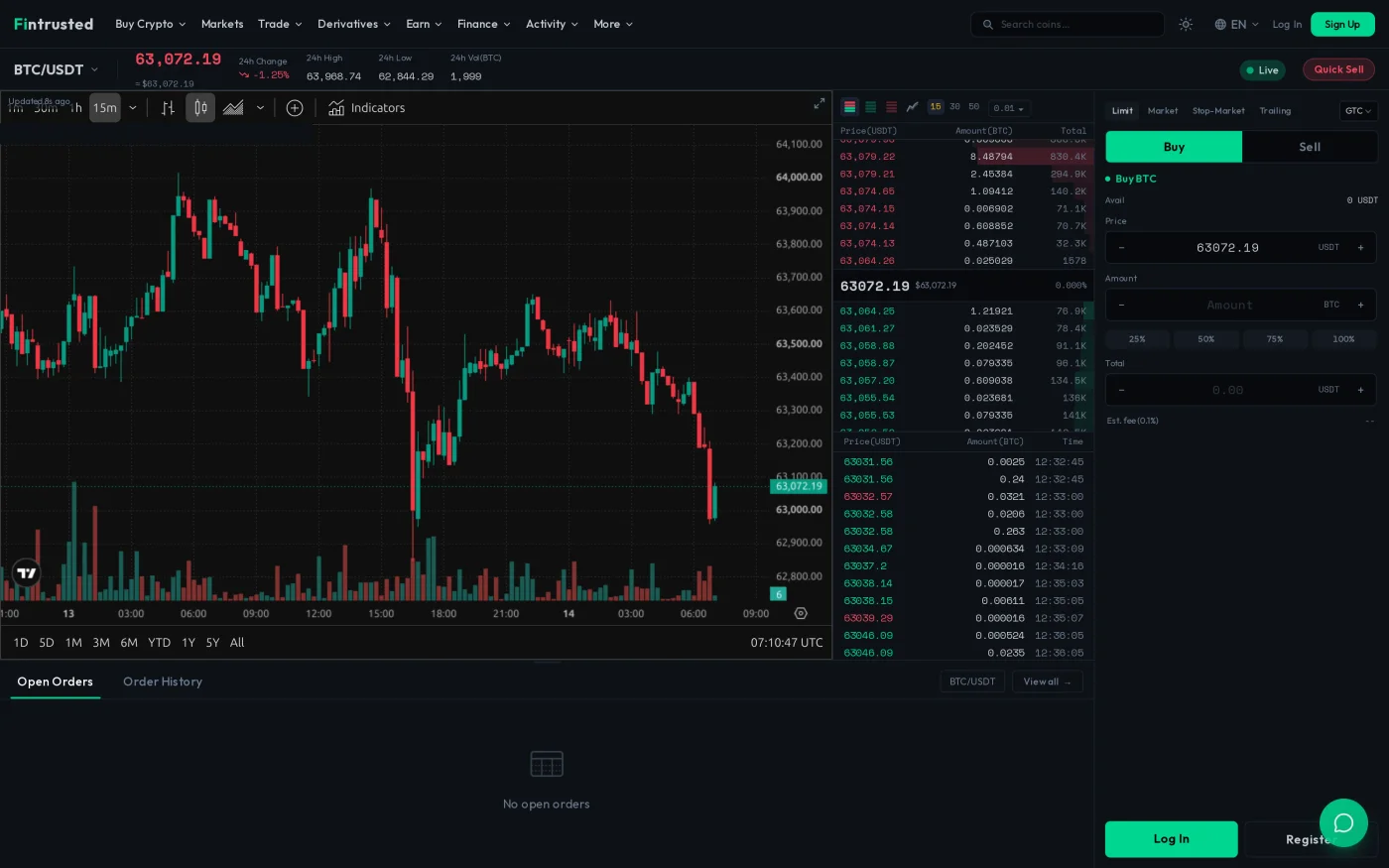
From License to Live Exchange: What Deployment Looks Like
Deploying Codono is not a DIY guessing game. Every license includes assisted deployment where our engineering team configures your server environment, connects blockchain nodes, sets up the matching engine, integrates your chosen KYC provider, applies your branding, and runs production readiness checks. The typical timeline from license purchase to live exchange is 14-21 days.
Week 1: Server provisioning on your chosen infrastructure (AWS, Hetzner, DigitalOcean, or bare metal), database setup, SSL configuration, domain pointing, and core platform deployment. Blockchain node connections for your target chains are established and synchronized.
Week 2: Trading pair configuration based on your market strategy, fee schedule setup, KYC provider integration with Sumsub or your preferred provider, liquidity source connections, fiat payment gateway integration, and branding customization including logo, color scheme, and email templates.
Week 3 (if needed): Load testing under simulated market conditions, security hardening review, complete QA across all trading flows, and soft launch with a controlled user group to validate system behavior under real conditions.
After launch, your exchange runs independently on your infrastructure. You have full source-code access, control the servers, and keep 100% of trading revenue. Our 12-month support package covers security patches, blockchain compatibility updates, and technical assistance — but your exchange operates without any dependency on our systems.
Operational Economics: Running Your Exchange
The operational cost of running a Codono-powered exchange breaks down into infrastructure and staffing. Infrastructure costs typically range from $200-$800/month for cloud hosting, depending on your traffic and the number of blockchain nodes you run. A starter exchange serving 1,000-5,000 daily active users can run comfortably on $300/month of cloud infrastructure.
Staffing depends on your scale. Solo operators and small teams (1-3 people) handle most exchanges under 5,000 DAU using the admin dashboard for day-to-day operations. Growing exchanges with 5,000-50,000 DAU typically add dedicated customer support and compliance review staff. The platform automates trading operations, wallet management, and fee collection — your team focuses on users, compliance, and business development.
Revenue scales with volume. At $1M daily trading volume with standard 0.1% maker/0.2% taker fees, an exchange generates approximately $3,000/day in trading fees alone. Add margin interest, futures funding rates, withdrawal fees, and listing fees, and revenue per dollar of volume increases significantly. Most Codono operators reach profitability within 3-6 months of launch, depending on their market and user acquisition strategy.
Under the Hood: Architecture That Survives Volatile Markets
What separates enterprise crypto exchange software from a clone script shows up on the worst day, not the best. The architecture decisions below are the ones that matter when a market moves 20% in an hour and every user hits the platform at once — the conditions that expose whether infrastructure is production-grade or demonstration-ready.
Matching engine. Orders match in memory using price-time priority, with every state change journaled for recovery. The engine supports the full order-type set professional traders expect — limit, market, stop-limit, OCO, fill-or-kill, immediate-or-cancel, and post-only — with per-pair precision configuration so small-cap listings don't inherit BTC's decimal assumptions. Fee calculation happens at match time with maker/taker differentiation and VIP-tier discounts applied server-side.
Wallet layer. Each supported chain runs behind a unified driver abstraction: deposit scanning, address derivation, transaction building, and broadcast are chain-specific implementations behind one interface. That is how the platform covers 50+ networks — Bitcoin-family UTXO chains, every EVM network, Solana, Tron, TON, XRP — without the wallet code metastasizing. Hot wallets hold working float; cold storage holds the treasury; withdrawal flows enforce configurable approval thresholds and multi-signature policies between them.
Risk controls. Margin and futures positions are monitored continuously against mark prices aggregated from multiple external venues — a median across sources, so a single venue's bad print can't trigger cascade liquidations. Insurance funds absorb liquidation shortfalls, and exposure caps gate every position-opening path, including API orders.
Operations. The admin panel is the operator's cockpit: user management with KYC review queues, wallet oversight with balance reconciliation views, fee and pair configuration, withdrawal approval workflows, and immutable audit logs on every administrative action. Double-entry ledger records back every balance mutation, which is what your auditor — and your own 3 a.m. debugging session — will thank you for.
Technical evaluators can go deeper: the crypto exchange script page covers the codebase from a developer's perspective, and the API reference documents the REST and WebSocket surface.
Technology Stack
Boring, proven infrastructure by design. Every layer is a technology your team can hire for, that has survived a decade of production finance workloads, and that carries no per-seat vendor licensing:
| Layer | Technology | Why it's there |
| Backend services | Java · Spring Boot / Spring Cloud microservices | Independent user, trading, market-data, and admin services with service discovery — scale and deploy each separately |
| Matching & real-time engine | Node.js · TypeScript | In-memory order matching with write-ahead journaling and WebSocket fan-out |
| Primary datastore | MySQL | Balances, orders, and the double-entry ledger — ACID where money lives |
| Cache & coordination | Redis | Sessions, distributed locks, rate limits, kill-switches, hot market data |
| Event streaming | Kafka | Order events, notifications, and cross-service messaging without tight coupling |
| Time-series & chat | ClickHouse · MongoDB | OHLCV candle history at scale; live chat and high-churn documents |
| Web frontends | Next.js (React) · TypeScript · Tailwind | Responsive trading UI and a separate operator admin panel |
| Mobile | React Native | Native iOS/Android apps from one codebase, push notifications included |
| Custody signer | Go · threshold MPC | Isolated signing service — key shares never assemble on one machine |
| Charting | TradingView | The charting professional traders already know |
| Infrastructure | Linux · Nginx | Runs on any cloud or bare metal you control — no proprietary runtime |
The stack decomposes into independent services, so a busy exchange scales the matching path without touching the user service, and your team can modify any layer — it's all in the source you license.
How Codono Compares to Other Crypto Exchange Software
Most buyers evaluating enterprise crypto exchange software shortlist the same handful of vendors: Codono, HollaEx, AlphaPoint, and OpenDAX, plus development agencies selling clone scripts. The platforms differ less in feature checklists than in three structural decisions that shape everything downstream: who owns the code, how you pay, and what ships in the box.
Ownership. Codono licenses ship 100% unencrypted source code — matching engine, wallets, admin, and mobile apps — with no license servers or callbacks. HollaEx open-sources its core kit but keeps advanced functionality in paid cloud plans. AlphaPoint is closed SaaS: capable enterprise infrastructure, but you never see the code, and leaving means rebuilding. OpenDAX's community edition is open but requires substantial engineering investment to reach production readiness.
Cost structure. A one-time license changes exchange economics. SaaS platforms charge monthly platform fees that scale with your success, and some enterprise contracts include revenue sharing. Over five years, a mid-size exchange pays roughly $60,000 in total cost on Codono versus $150,000+ on cloud-hosted alternatives and $450,000+ on enterprise SaaS — the full TCO breakdown itemizes these estimates.
Included scope. Spot trading is table stakes; the differences appear in the second module. Margin, perpetual futures, P2P fiat markets, staking, launchpad, and native iOS/Android apps are included in every Codono license. On most alternatives these are paid add-ons, PWA substitutes, or simply absent — meaning the "cheaper" platform often costs more by the time it matches the launch scope you actually planned.
For head-to-head evaluations, see the dedicated comparisons: Codono vs HollaEx, Codono vs AlphaPoint, HollaEx alternatives, and OpenDAX alternatives.
How to Evaluate Crypto Exchange Software: A Buyer's Checklist
After hundreds of operator conversations, the same evaluation mistakes come up repeatedly. Use this checklist before committing to any vendor — including us.
1. Demand a live demo, not screenshots. Trade on the demo. Place a limit order, cancel it, check the fee math, test a withdrawal flow. Exchange software fails in the details — order-book behavior under load, decimal precision on small-cap pairs, withdrawal confirmation UX. A vendor who won't give you a full-access demo is telling you something.
2. Verify source-code claims precisely. "Open source", "source available", and "full source code" mean different things. Ask: is any component encrypted or obfuscated? Does the platform call home? What happens to your exchange if the vendor disappears? Get the answer in the contract, not the sales call.
3. Model five-year cost, not sticker price. Add monthly platform fees, revenue share, hosting, KYC provider fees, mobile app development if not included, and the developer time needed to reach production. Open-source kits with $0 license fees routinely cost more than commercial licenses once engineering salaries are counted.
4. Check module depth, not module names. "Futures" can mean full perpetual contracts with funding rates, insurance funds, and liquidation engines — or a thin CFD wrapper. "P2P" can mean escrowed fiat marketplaces with dispute resolution — or a message board. Ask how each module handles the failure cases: liquidation cascades, payment disputes, stuck withdrawals.
5. Test support before you buy. Send a technical pre-sales question and measure response time and answer quality. Support quality during the sales process is the ceiling, not the floor, of what you'll get after payment.
Ready to run this checklist against Codono? Open the live demo, review license tiers, or ask our team the hard questions.