 交易所软件
交易所软件 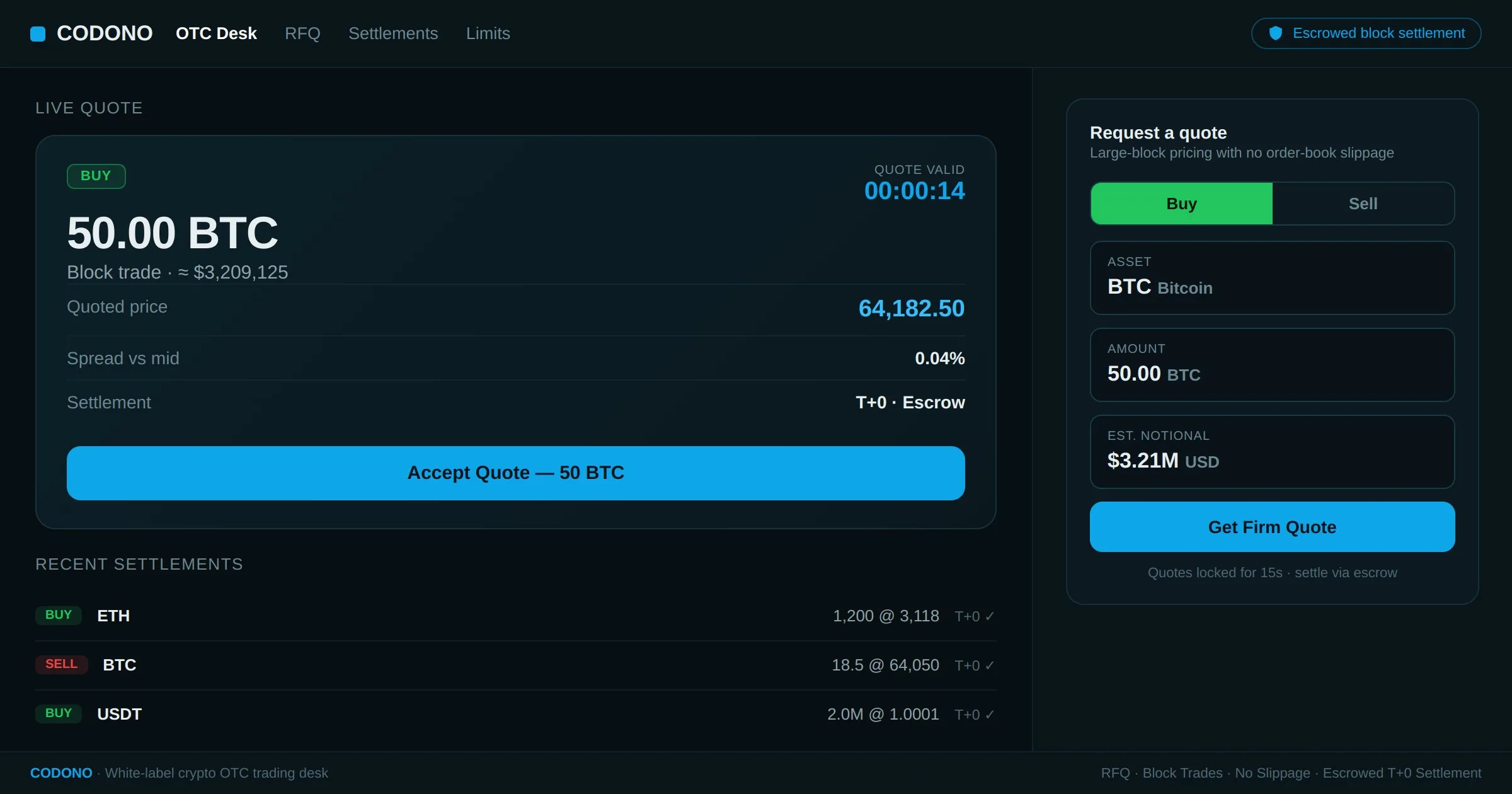
What Is Crypto OTC Trading Software?
Crypto OTC (over-the-counter) trading software runs a desk for large-block trades executed at a single agreed price, off the public order book. Rather than sweeping the book — moving the price against themselves and broadcasting their intent — a client requests a quote for a large size, receives a firm, time-locked price, and settles the entire block at once.
Codono provides this as a source-available product with a one-time license: you own and self-host the OTC desk, running it under your own brand. This page covers the OTC desk specifically; it runs on the same platform as spot and derivatives , so most operators offer it alongside their exchange to capture their largest clients.
Why Block Trades Go OTC
The whole reason OTC exists is one word: slippage. A public order book has finite depth at each price level. Execute a large order against it and you eat through level after level, each worse than the last — the market moves against you, and everyone watching the book sees the size coming. For a meaningful trade, that market impact is a real, quantifiable cost.
An OTC desk removes it. The desk prices the whole block at one firm quote, so a client buying 50 BTC gets a single price with no slippage and no market signal. That’s why the participants who trade size — institutions, high-net-worth individuals, miners liquidating rewards, funds and corporate treasuries — route block trades through OTC desks rather than the order book. An operator who can’t serve those clients OTC simply loses their volume to a desk that can.
Who Uses an OTC Desk
Knowing your OTC clients explains why the desk is worth running — these are the highest-value, stickiest relationships in an exchange business:
- Institutions and funds deploying or rotating large positions, who cannot move size on a public book without moving the market. They trade regularly and in size, and they value a reliable desk relationship.
- High-net-worth individuals and “whales” entering or exiting positions large enough that slippage and signaling are real costs. Discretion matters to them as much as price.
- Miners converting block rewards to fiat or stablecoins on a schedule — a recurring, predictable flow that a desk can build a standing relationship around.
- Corporate treasuries and businesses managing crypto on their balance sheet, or converting between crypto and fiat for operations, who need firm pricing and clean settlement records for their books.
- Other exchanges and desks sourcing liquidity for their own large fills.
The common thread: these clients trade large, repeatedly, and with a strong preference for a trusted counterparty. That makes an OTC relationship far stickier than a retail account — a satisfied block client returns for every large trade, and the volume from a handful of them can rival a large retail base. It’s also why losing them hurts: if your platform can’t serve a client’s block, they open a relationship with a desk that can, and they take the rest of their business with them. An OTC desk is how you keep — and grow — your most valuable clients.
The RFQ and Quoting Flow
The desk runs on a request-for-quote model, and the platform provides the full workflow:
- Request. The client specifies asset, side (buy/sell) and size, and requests a quote.
- Firm quote. The desk returns a firm price, valid for a short window — typically around 15 seconds — sourced from aggregated liquidity plus your spread. The client sees the exact price and notional before committing.
- Accept or lapse. If the client accepts within the window, the trade locks. If the quote expires unaccepted, it simply lapses — protecting the desk from stale-price risk in a moving market.
- Settle. The locked block settles at once, typically T+0 via escrow.
That time-locked, all-or-nothing structure is exactly what makes block trading safe for both sides: the client gets price certainty, and the desk is never exposed to a quote it can no longer honor.
Settlement and Counterparty Safety
Large trades raise the stakes on settlement — no one wants to send millions in crypto or fiat and hope the other side follows through. The platform supports escrowed settlement, so assets are locked and released atomically: neither counterparty is exposed during the exchange. Combined with per-counterparty limits and complete audit trails, this gives block trades the settlement safety their size demands.
Compliance for Large-Block Trades
OTC deserves an honest compliance section, because large transfers attract the heaviest AML scrutiny in crypto. KYC/AML here is not optional — it’s the core of running a desk legitimately. The platform includes:
- Tiered KYC/AML with enhanced due diligence for large counterparties.
- Transaction monitoring and suspicious-activity workflows.
- Per-counterparty limits and eligibility controls.
- Complete audit logging of quotes, trades and settlements.
Large block trades may trigger travel-rule obligations and regulatory reporting depending on jurisdiction and threshold. The software provides the controls; configuring them to your obligations and confirming them with a compliance advisor is your responsibility. See the compliance requirements page for the framework.
Pricing and Desk Margin
Your quotes are built from aggregated liquidity — the liquidity engine sources pricing from major venues — plus your configured spread. You set the spread, which is the desk’s margin on each trade, and you can integrate external liquidity providers for deeper block pricing on the largest sizes. This gives you direct control over both competitiveness and profitability: tighten the spread to win flow, widen it for margin, per asset and size tier.
Runs on the Full Platform
The OTC desk shares the complete Codono platform — multi-chain wallets , KYC/AML, liquidity, admin controls and cross-platform mobile apps — with spot and derivatives. So you can run a standalone OTC desk, or (more commonly) offer OTC alongside your public exchange to serve the large clients who’d otherwise take their size elsewhere. Same audited codebase, full source-code access, one-time license.
Tech: Java (Spring) microservices, MySQL double-entry ledger, Redis, Kafka; Next.js web app; cross-platform iOS/Android — self-hosted on your servers with no recurring platform fees.
Getting Started
- See the desk — explore the live demo of the RFQ and quoting flow.
- Check the one-time price — pricing is published, with full source-code access.
- Plan your liquidity — built-in aggregation plus optional external providers via the liquidity engine .
- Talk it through — contact us to scope an OTC desk, standalone or alongside your exchange.
An OTC desk is how you keep your largest clients from trading elsewhere. Codono gives you the RFQ workflow, escrowed settlement and AML controls to run one under your own brand.