 Borsa Yazılımı
 How to Start a Cryptocurrency Exchange Business
Everything you need to launch a crypto exchange in 2026. This guide covers market analysis, business planning, regulatory licensing, technology selection, security architecture, liquidity strategy, compliance integration, and go-to-market execution. Written from the experience of supporting 250+ exchange launches across 30+ countries.
Why Start a Crypto Exchange in 2026?
The cryptocurrency market in 2026 is fundamentally different from five years ago. Regulatory frameworks have matured across the EU (MiCA), UAE (VARA), Singapore (MAS), and dozens of other jurisdictions. Institutional adoption has moved from experimental allocations to strategic portfolio positions. Bitcoin ETFs have brought hundreds of billions in new capital into the ecosystem.
This regulatory clarity creates an opportunity that did not exist before. Licensed exchanges now have clear competitive advantages: banking partnerships, fiat on-ramp access, institutional client eligibility, and the ability to market legally. The era of unregulated grey-area exchanges is ending, replaced by a professional market where compliant operators thrive.
The technology barrier has also collapsed. What required a $500,000 development budget and 18 months of engineering in 2020 is now available as white-label exchange software deployable in two weeks. You focus on the business. The technology is solved.
- 600M+ crypto users globally, growing 20-30% annually
- Clear regulatory frameworks in 50+ countries
- White-label technology eliminates the engineering barrier
- Multiple revenue streams: fees, listings, staking, margin
- Regional exchanges serving local markets are underrepresented
Choose Your Exchange Model
Each model serves different markets and generates revenue differently
Spot Exchange
The core product. Users buy and sell cryptocurrencies at market prices. Supports limit, market, and stop orders. Revenue comes from maker/taker trading fees. This is where every exchange starts.
Learn about spot tradingFutures & Derivatives
Perpetual contracts with leverage up to 100x. Generates 5-20x higher fee revenue per dollar of exposure compared to spot. Requires more sophisticated risk management and liquidation infrastructure.
Learn about futuresP2P Exchange
Users trade directly with each other using escrow. Supports 300+ payment methods including bank transfer, mobile money, and cash. Ideal for markets with limited banking access or fiat restrictions.
Learn about P2PMulti-Asset Platform
Combine crypto with forex, precious metals, and commodities. Serve traders who want a single platform for all asset classes. Higher revenue per user and stronger retention.
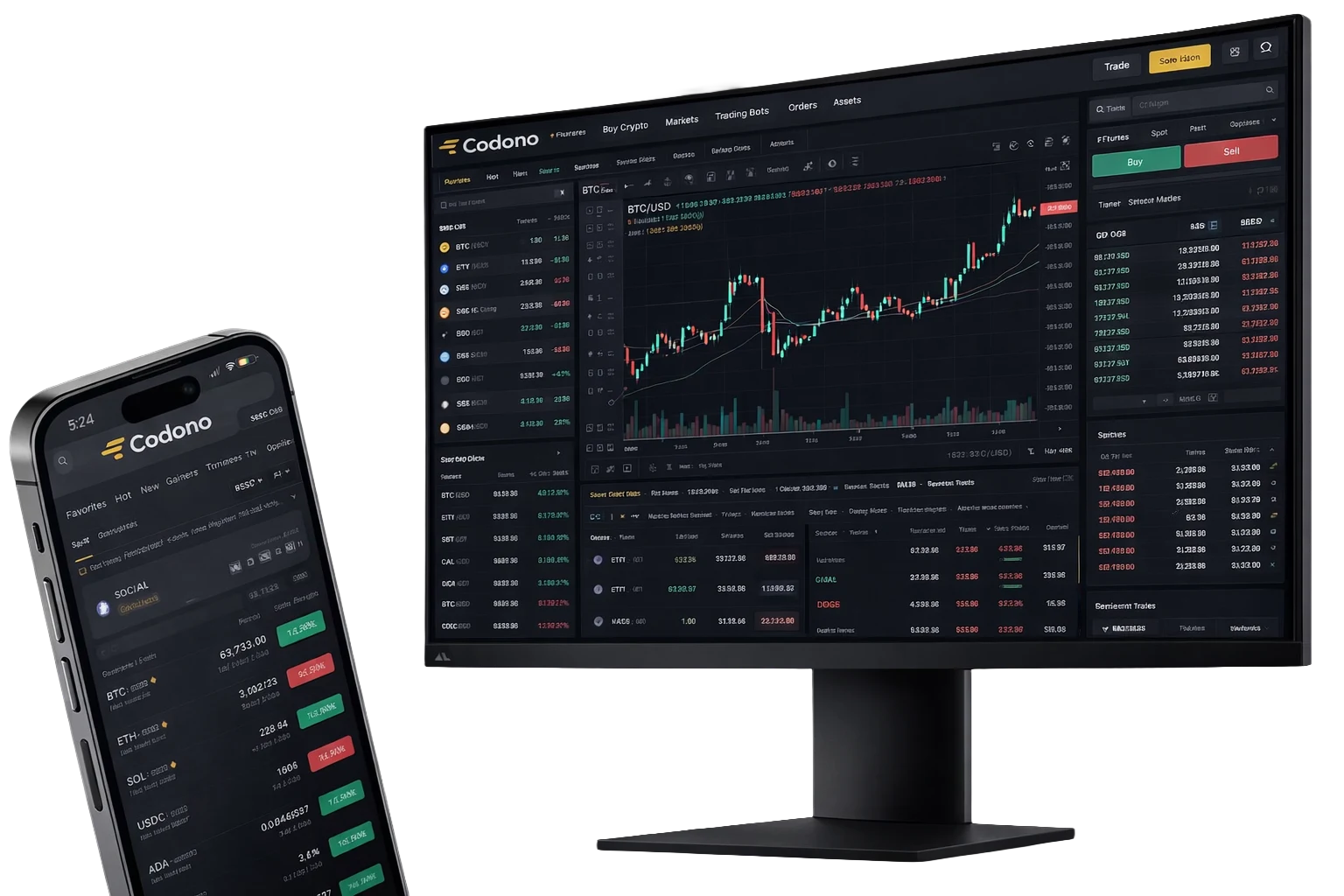
Learn about forexMost operators start with spot trading and add additional modules as their user base grows. Codono supports all models with the same core platform, so you can expand without rebuilding.
Launching in a Specific Market?
Licensing, rails, and user behavior differ by jurisdiction. These launch guides cover the practical path for the highest-demand markets.
Dubai / UAE
VARA licensing, tax-efficient base, institutional and HNW audience. The credible-but-commercial hub for a global exchange.
Start a crypto exchange in DubaiIndia
INR rails, UPI deposits, FIU-IND registration and TDS handling. One of the largest user bases on earth.
Start a crypto exchange in IndiaNigeria
Africa's largest crypto market, P2P-first, stablecoin-driven, with an evolving SEC framework.
Start a crypto exchange in NigeriaEurope
One MiCA authorization passports your exchange across all 27 EU states under a single harmonized regime.
Start a crypto exchange in Europe8-Step Roadmap to Launch
A proven process refined across 250+ exchange deployments
Market Research & Business Planning
Before writing a single line of code or choosing software, understand the market you are entering. Define your target geography, user demographics, and exchange model.
- Identify your target market and underserved regions
- Choose exchange model: spot, derivatives, P2P, or multi-asset
- Analyze competitors in your target geography
- Create financial projections with realistic volume assumptions
- Determine initial capitalization requirements
- Define your unique value proposition
Legal Structure & Licensing
Register your business entity in a suitable jurisdiction and begin the regulatory licensing process. This step takes the longest and should start as early as possible.
- Choose business registration jurisdiction
- Engage crypto-specialized legal counsel
- Apply for required licenses (MSB, VASP, etc.)
- Draft Terms of Service and Privacy Policy
- Establish compliance officer role
- Set up corporate banking relationships
Technology Selection & Setup
Choose between white-label exchange software and custom development. For 95% of new operators, white-label delivers better outcomes faster and at a fraction of the cost.
- Evaluate white-label vs custom development
- Select exchange software provider
- Provision server infrastructure
- Configure domain and SSL certificates
- Set up development and staging environments
- Plan customization and branding work
Branding & Customization
Apply your brand identity to every touchpoint: trading interface, mobile apps, email templates, and landing pages. Your exchange should look and feel uniquely yours.
- Design logo and brand identity system
- Apply color scheme and typography
- Customize email and notification templates
- Create landing pages and marketing content
- Configure mobile app branding and icons
- Set up custom domain with branding
Security Implementation
Security is not optional. Deploy multi-layered protection before a single user creates an account. One breach can end your exchange permanently.
- Configure cold and hot wallet architecture
- Deploy two-factor authentication (TOTP)
- Set up DDoS protection and rate limiting
- Implement withdrawal address whitelisting
- Configure IP monitoring and device fingerprinting
- Establish incident response procedures
Compliance Integration
Integrate KYC identity verification and AML monitoring. Configure verification tiers, withdrawal limits, and sanctions screening for your regulatory requirements.
- Select and integrate KYC provider (e.g., SumSub)
- Configure verification tiers and document requirements
- Set withdrawal limits per verification level
- Enable AML transaction monitoring
- Configure sanctions and PEP screening
- Set up suspicious activity reporting
Liquidity & Market Configuration
No users means no liquidity. No liquidity means no users. Break this cycle by connecting to external liquidity sources before launch.
- Connect to liquidity aggregators
- Configure market maker integrations
- Set up initial trading pairs and base currencies
- Configure fee schedules (maker/taker)
- Set up referral and affiliate programs
- Test order book depth and spread quality
Testing & Launch
Run complete testing. Start with a soft launch to a limited group, gather feedback, fix issues, then scale to full public launch with marketing support.
- Full security audit and penetration testing
- Load testing for high-traffic scenarios
- End-to-end deposit and withdrawal testing
- Soft launch with limited user group
- Gather feedback and iterate
- Full public launch with marketing campaign
From Payment to Live Exchange in 21 Days
A realistic deployment timeline for operators using Codono white-label software
Choose License & Pay
Select Ultra or Enterprise, complete payment, and receive full source code plus deployment documentation.
Infrastructure Setup
Provision cloud servers (AWS, Hetzner, or DigitalOcean), configure DNS, SSL, and firewall rules.
Domain, Branding & KYC
Point your domain, apply brand assets, and connect your KYC/AML provider account.
Trading Pairs & Liquidity
Configure markets and base currencies, set fee tiers, and connect liquidity aggregators.
Mobile Apps Branded
Build and configure iOS/Android apps with your logo, colors, and app store metadata.
Security Review & Testing
Run end-to-end deposit and withdrawal tests, load tests, and final security hardening.
Soft Launch
Invite a limited user group, monitor systems, and fix any issues before going public.
Full Public Launch
Open registration publicly and begin your marketing campaigns.
Licensing is the longest lead time — typically 3–12 months depending on jurisdiction. The technology deployment itself takes 14–21 days, so start your legal work in parallel.
Choosing Your Exchange Technology
This is the single most impactful decision you will make. It determines your time to market, your first-year costs, and your technical risk profile.
Custom Development
- Budget: $200,000 - $500,000+
- Timeline: 12 to 18 months
- Team required: 8-15 engineers
- Full architectural control
- High risk: no production track record
- Ongoing maintenance: $10,000-30,000/month
White-Label Software
- Budget: $1,899 - $12,500+ (one-time)
- Timeline: 14 to 21 days
- No development team required
- Full source-code access
- Battle-tested across 250+ deployments
- Updates and security patches included
For 95% of new exchange operators, white-label software is the correct choice. The technology risk is eliminated, and you launch 10x faster at 2% of the cost. The only scenario where custom development makes sense is when you need a fundamentally different architecture that no existing solution provides.
Security Architecture for Your Exchange
Exchange security is non-negotiable. One breach ends your business permanently.
Wallet Security
Hot and cold wallet separation with 90-95% of funds in offline cold storage. Multi-signature authorization for cold wallet transactions. Automated threshold monitoring and alerts. Read more about wallet architecture.
User Authentication
TOTP-based two-factor authentication, anti-phishing codes, device fingerprinting, login notifications, and session management. Withdrawal address whitelisting with 24-hour activation delays.
Infrastructure Protection
DDoS mitigation, Web Application Firewall (WAF), rate limiting on all endpoints, IP reputation scoring, and real-time anomaly detection. See full security features.
Data Security
AES-256 encryption at rest for sensitive data, TLS 1.3 for all data in transit, encrypted database backups, and PCI-DSS aligned card data handling for fiat integrations.
Best Jurisdictions for Exchange Licensing
Compare regulatory environments, costs, and timelines
Licensing requirements evolve regularly. Always consult with a crypto-specialized legal firm in your target jurisdiction. For a deeper guide, read How to Get a Crypto Exchange License.
Realistic Cost Breakdown
What it actually costs to start and run a crypto exchange in 2026
Start with Codono's white-label platform from $1,899. One-time payment, no monthly software fees, no revenue sharing.
View Pricing PlansRevenue Potential of a Crypto Exchange
How exchanges generate revenue from day one
Trading Fees
The primary revenue source. Charge 0.1-0.3% on each trade. At $1M daily volume with 0.2% average fee, that generates $2,000/day ($730K/year). Volume compounds as you add users and trading pairs.
Withdrawal Fees
Flat fees per withdrawal per blockchain (e.g., $2 per BTC withdrawal, $1 per ETH). With 500 daily withdrawals averaging $1.50 each, that adds $750/day to revenue.
Token Listing Fees
New projects pay $5,000 to $50,000 for exchange listing. A growing exchange listing 2-3 tokens per month generates $10,000-150,000/month from listings alone.
Leverage Trading
Margin and futures generate 5-20x higher fees per dollar of exposure. A $100K leveraged trade at 20x generates fees on $2M notional. The highest revenue per user of any exchange product.
Staking & Earn
Offer staking products and keep a 1-3% spread on the APY. A staking platform with $5M in deposits at 2% spread generates $100K/year in passive revenue.
Fiat On-Ramp
Mark up card purchases by 1-3%. High-volume exchanges process $100K-1M/day in fiat deposits with 1.5% average markup, generating $1,500-15,000/day.
Conservative Revenue Projection
Projections based on aggregated data from Codono-powered exchanges across different markets. Actual results depend on jurisdiction, marketing investment, and competitive environment.
User Acquisition Strategies That Work
The most common failure mode for new exchanges is not technology. It is user acquisition. Building the exchange is the easy part. Filling it with active traders is the hard part. Here are strategies that successful Codono operators have used.
Geographic Focus
Target an underserved region where global exchanges do not offer local currency support, local payment methods, or local language. Southeast Asia, Africa, Latin America, and MENA all have fast-growing crypto markets with limited local exchange options. A regional exchange that offers local fiat rails and native language support captures demand that global platforms cannot.
Exclusive Token Listings
List tokens that are not available on major exchanges. Each new listing brings the token's community to your platform. Some operators generate 30-50% of their initial user base through strategic listings.
Trading Competitions
Run volume-based competitions with token prizes. Trading competitions create urgency, attract active traders, and generate concentrated volume spikes that improve order book depth. The cost is typically 5-10% of the fee revenue generated during the competition period.
Referral Programs
Commission-based referral programs where existing users earn a percentage of referee trading fees. The most effective programs offer 20-40% commission on trading fees for the referral lifetime. See user acquisition strategies for detailed playbooks.
Launch Checklist
- Business entity registered
- Legal counsel engaged
- Licensing application submitted
- Exchange software deployed
- Branding and customization complete
- KYC provider integrated
- Cold/hot wallets configured
- Security audit passed
- Liquidity sources connected
- Trading pairs configured
- Fee schedules set
- Terms of Service finalized
- Support system operational
- Monitoring and alerting active
- Soft launch with test users
- Marketing campaign ready
Frequently Asked Questions
Answers to the most common questions about starting a crypto exchange
How much does it cost to start a crypto exchange?
Starting a cryptocurrency exchange typically costs between $10,000 and $100,000 in the first year. White-label software like Codono starts at $1,899 as a one-time license. Additional costs include server hosting ($100-500/month), regulatory licensing ($5,000-100,000 depending on jurisdiction), KYC provider fees ($0.50-3 per verification), legal consultation ($2,000-20,000), and marketing ($5,000-50,000 for launch phase). Custom development pushes total costs to $300,000-800,000+.
Do I need a license to run a crypto exchange?
In most jurisdictions, yes. Regulatory requirements vary by country. The EU requires MiCA CASP registration. The US requires state-by-state Money Transmitter Licenses or FinCEN MSB registration. Dubai requires a VARA license. Singapore requires a MAS Payment Services license. Some jurisdictions like certain Caribbean nations have lighter requirements. Operating without proper licensing exposes you to legal risk, banking difficulties, and potential fines. Always engage local legal counsel before launching.
How long does it take to launch a crypto exchange?
The technology deployment takes 14 to 21 days with white-label software. However, regulatory licensing typically takes 3 to 12 months depending on jurisdiction. A realistic timeline including compliance, testing, and soft launch is 2 to 6 months for a fully compliant exchange. Some operators launch in crypto-friendly jurisdictions first and pursue additional licenses as the business grows.
What technology do I need to start a Bitcoin exchange?
A complete exchange requires an order matching engine, multi-chain wallet infrastructure, trading interface with professional charting, admin panel, KYC/AML system, API for trading bots, mobile apps, and security infrastructure. White-label solutions like Codono provide all these components pre-built and tested. You need secure hosting (cloud VPS or dedicated servers), SSL certificates, DDoS protection, and a domain name.
How do I get liquidity for my new crypto exchange?
There are five main approaches: (1) Connect to liquidity aggregators that pull orders from major exchanges. (2) Partner with professional market makers who provide continuous bid-ask quotes. (3) Use Codono's built-in liquidity engine to aggregate from external sources. (4) Run trading competitions and maker fee rebates to attract active traders. (5) List unique tokens that create exclusive demand on your platform. Most operators combine aggregated liquidity at launch with organic volume development over time.
Is it profitable to run a cryptocurrency exchange?
Yes, exchanges generate revenue from multiple streams: trading fees (0.1-0.3% per trade), withdrawal fees, listing fees ($5,000-50,000 per token), margin trading interest, futures funding rates, staking spreads, and fiat on-ramp markups. A mid-size exchange processing $2M daily volume at 0.2% average fees generates roughly $4,000 per day in trading fee revenue alone. Profitability depends on operational costs, user acquisition efficiency, and regulatory overhead.
What are the biggest challenges in starting a crypto exchange?
The five biggest challenges are: (1) Regulatory compliance and licensing costs. (2) Acquiring initial users and achieving liquidity critical mass. (3) Establishing banking relationships for fiat deposits and withdrawals. (4) Building user trust and security reputation in a competitive market. (5) Managing ongoing compliance as regulations evolve. Using proven white-label software eliminates the technical risk and lets you focus on these business challenges.
Can I start a crypto exchange without coding knowledge?
Yes. White-label exchange software provides a complete working platform with admin panels for managing all aspects of your exchange without coding. For basic operations including user management, trading pair configuration, KYC approvals, and fee settings, the admin dashboard handles everything. For deeper customization, hiring one or two developers is recommended, but it is not required for launch.
Which countries are best for starting a crypto exchange?
Popular jurisdictions include Dubai (VARA license, zero income tax), Estonia (EU MiCA pathway), Lithuania (quick crypto licensing), Singapore (MAS Payment Services Act), Switzerland (FINMA progressive framework), and several Caribbean nations with lighter requirements. The best jurisdiction depends on your target market, capital availability, and regulatory tolerance. Many operators register in a crypto-friendly jurisdiction while serving users globally.
What is the difference between a CEX and DEX, and which should I build?
A centralized exchange (CEX) offers custodial trading with fast execution, fiat support, regulatory compliance, and professional features. A decentralized exchange (DEX) uses smart contracts with no central operator. CEXs process 95% of all crypto volume because they deliver better user experience and support institutional requirements. Most new exchange businesses start with a CEX model because it generates more revenue, supports compliance, and serves a broader user base.
The Bottom Line: What It Takes to Succeed
Starting a crypto exchange is a business decision with real stakes — regulatory obligations, security responsibilities, and competitive pressure. The operators who succeed share three characteristics: they launch fast with proven infrastructure instead of building from scratch, they invest in compliance from day one instead of retrofitting it later, and they focus obsessively on their specific market instead of trying to compete globally on day one.
The technology decision is the easiest part. A production exchange platform with full source code, 50+ blockchain integrations, and built-in compliance tools costs a fraction of what custom development requires — and deploys in weeks instead of months. The harder decisions are your market positioning (which region, which user segment, which products), your regulatory strategy (which license, which jurisdiction, what compliance team), and your liquidity plan (which providers, what spread strategy, how to bootstrap volume).
This guide covered the complete roadmap from business planning through technology selection, licensing, security, and launch operations. Every section reflects real experience from 250+ exchange deployments. Not all of them became commercially successful — exchange businesses depend on execution, market timing, and operational discipline. But none of them failed because the technology couldn't handle the job.
Ready to Start Your Crypto Exchange?
Launch your exchange with Codono's white-label platform. Full source code, 50+ blockchain integrations, mobile apps, and deployment support. One-time payment starting at $1,899. No monthly fees. No revenue sharing. Deploy in 14-21 days.