 Borsa Yazılımı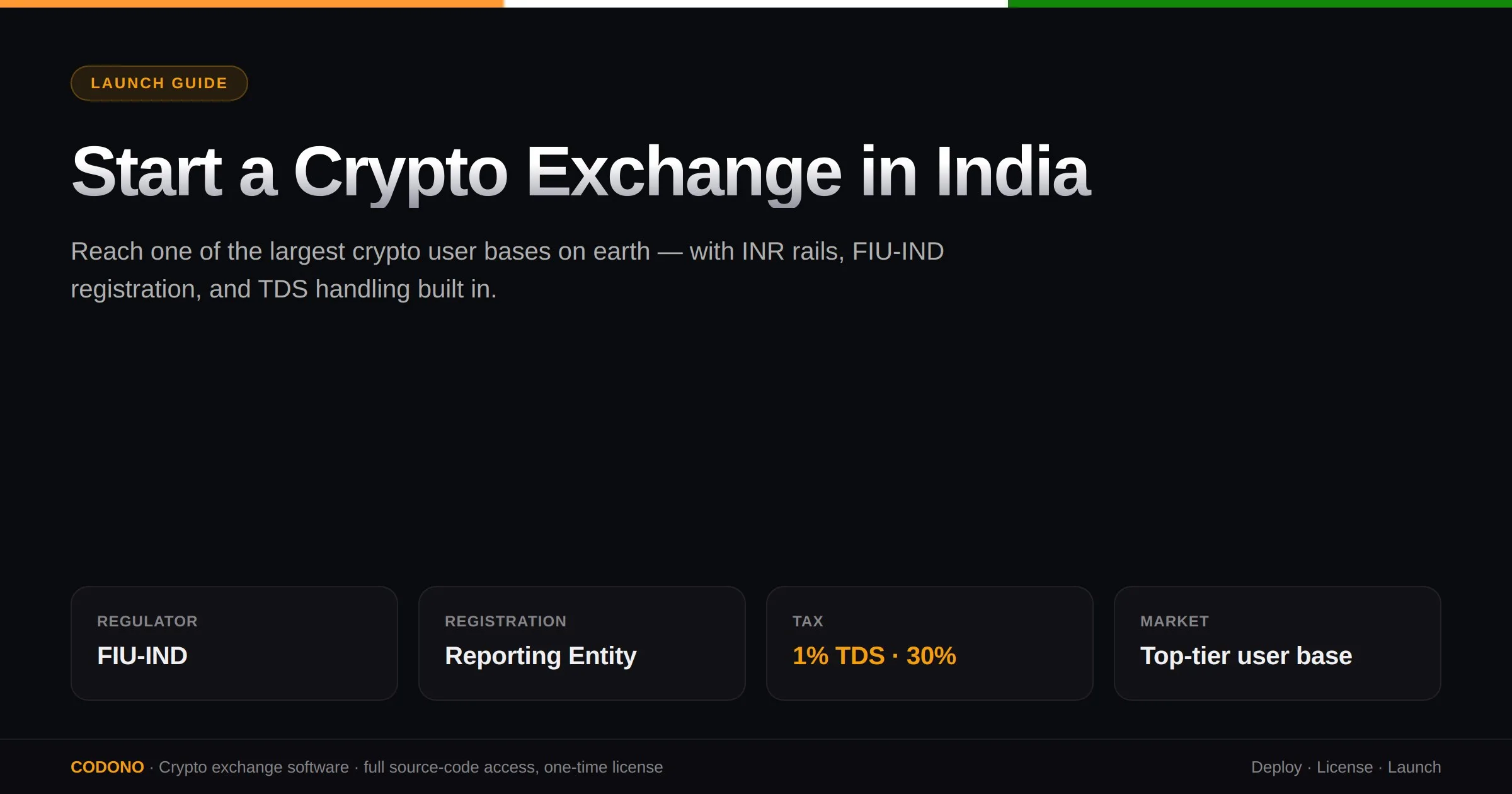
India is one of the largest crypto-user populations on earth — a market of enormous scale and appetite. But it is also a market with very specific rails and rules: rupee funding, UPI, FIU-IND registration, and crypto-specific taxation. Launching successfully in India means fitting all of them. This guide walks the practical path, and points you to the WazirX clone — the India-ready configuration of the platform — for the product itself.
Why Launch a Crypto Exchange in India?
The case for India is scale. It has one of the deepest pools of crypto interest anywhere, a young and digitally-native population, and mainstream payment infrastructure (UPI) that makes small-value transactions frictionless. For an operator who can navigate the local requirements, the addressable market is vast.
The catch is that a generic, dollar-denominated exchange does not fit India. Indian users fund in rupees via UPI, expect BTC/INR pricing, and must have their transactions handled for Indian tax. Winning here is less about having more features than global exchanges and more about fitting India’s rails, language and rules better than they do — which is exactly what an India-focused build does.
The Indian Crypto User
Building for India means understanding who you’re building for, because the Indian user differs from a Dubai institutional trader or a Nigerian P2P trader:
- Young and mobile-first. India’s crypto interest skews toward a large, young, digitally-native population that transacts overwhelmingly on phones. Cross-Platform mobile apps are not optional — they are the primary interface.
- UPI-native. UPI has made instant, small-value digital payments normal across India. Users expect the same frictionless experience funding a crypto account — a clunky bank-transfer-only flow loses them immediately.
- Price- and value-conscious. Indian users are attentive to fees and to the real, after-tax cost of trading. Transparent pricing and clean handling of the 1% TDS build trust.
- Linguistically diverse. English works for many, but regional-language support meaningfully widens your reach beyond metros into the fast-growing tier-2 and tier-3 markets.
The takeaway: an Indian exchange wins on frictionless mobile UPI funding, transparent costs, and local language — not on having the longest feature list.
The Regulatory Path: FIU-IND and Tax
India’s approach differs from license-based jurisdictions like Dubai or the EU. Rather than a single bespoke exchange license, the framework centers on two things:
- FIU-IND registration. Exchanges must register with the Financial Intelligence Unit (FIU-IND) as a reporting entity under the PMLA, taking on KYC/AML obligations, transaction monitoring, and suspicious-transaction reporting.
- Crypto taxation. India applies a 1% TDS on transfers above threshold and a 30% tax on gains (with no loss offset). As an operator you must support TDS deduction and reporting at the transaction level — this is an operational requirement, not an optional feature.
India’s crypto regulation and taxation have shifted repeatedly and will keep evolving, so this page is orientation, not legal or tax advice. Build a standing relationship with a local compliance and tax advisor, and see the general crypto exchange license guide and compliance requirements for the broader framework.
How TDS Shapes Your Product
India’s 1% TDS is worth its own section because it is not just a compliance line-item — it shapes the product and the user experience in ways that matter for retention.
It changes trading behavior. A 1% deduction on transfers above threshold makes high-frequency trading expensive, nudging Indian users toward lower-frequency, higher-conviction trades. Your product and fee design should account for that reality rather than assuming Binance-style churn.
Clean handling is a competitive edge. Users need TDS deducted correctly, clear records of what was withheld, and reports they can hand to an accountant at tax time. An exchange that makes this painless — accurate deduction, downloadable statements, a transparent breakdown on every trade — earns trust that a sloppy competitor bleeds. The platform handles transaction-level TDS deduction and record-keeping with configurable rates, so you can keep pace as rules change.
It must be right, and current. TDS and the 30% gains tax have been adjusted since introduction, and misconfiguring them is both a compliance risk and a user-trust problem. Keep the configurable rates aligned with current law, and confirm with a tax advisor — treat this as an ongoing setting, not a one-time switch.
Done well, tax handling stops being a burden and becomes a reason users choose you: the Indian exchange that makes crypto tax effortless has a real, defensible edge.
The Banking Challenge
If licensing is the hard part in Dubai, banking is the hard part in India. The recurring theme of Indian crypto has been banking friction — stretches where exchanges struggled to keep the bank and UPI relationships that let users deposit rupees.
The practical consequences shape how you build:
- Securing and keeping banking/UPI access is your primary operational risk, and it depends on your compliance being visibly solid. Plan for it as the central challenge, not an afterthought.
- An INR P2P marketplace is your resilience layer, not a nice-to-have. When direct rails waver, P2P lets users fund each other, keeping the exchange usable. Operators who treat P2P as core infrastructure — and cultivate trusted INR vendors early — survive banking shocks; those who bolt it on get caught out.
What It Costs
| Cost component | Character |
|---|---|
| FIU-IND registration & compliance | Lighter than license-heavy jurisdictions |
| Company formation | Indian entity, governance |
| Banking & payment rails | The hard, often costly part — plan around it |
| Compliance staffing | KYC/AML function, ongoing |
| Exchange software | One-time license, full source-code access — fixed, comparatively small |
Relative to Dubai or the EU, India’s regulatory setup is lighter, but banking access is the expensive, uncertain variable. The software is a fixed one-time cost — see pricing .
How to Launch, Step by Step
- Engage local advisors — compliance and tax specialists, first.
- Form the Indian entity with appropriate governance.
- Register with FIU-IND as a reporting entity and stand up KYC/AML.
- Secure banking and UPI relationships — the critical path; start early.
- Deploy the WazirX-model platform in parallel — INR pairs, UPI integration, INR P2P, TDS configuration (2–4 weeks).
- Configure tax handling — TDS deduction, records and reporting to current rules.
- Launch with P2P live from day one as your funding-resilience layer.
The Software That Runs Underneath
The India-ready configuration of Codono is the WazirX clone — that page covers the product in depth. In short, it provides what an Indian exchange specifically needs:
- INR markets and instant UPI/IMPS deposits via the payment gateway .
- An INR P2P marketplace with escrow and local payment methods.
- TDS handling — transaction-level deduction, records and reporting, configurable to current law.
- Tiered KYC/AML mapped to Indian identity verification and FIU-IND obligations.
- Regional-language localization and cross-platform mobile apps for a mobile-first market.
- Full source-code access under a one-time license.
Common Mistakes When Launching in India
Operators who struggle in India usually make one of a handful of avoidable errors. Knowing them up front saves months:
- Treating banking as an afterthought. The single biggest mistake is building the product first and scrambling for banking/UPI access later. Banking is the critical path — start those relationships before, or in parallel with, everything else, and design P2P as your fallback from day one.
- Under-investing in P2P. Operators who treat the INR P2P marketplace as a checkbox get caught out the first time direct rails wobble. In India, P2P is infrastructure, not a feature — cultivate trusted vendors early.
- Getting TDS wrong. Misconfigured or opaque TDS handling is both a compliance risk and a fast way to lose user trust. Configure it correctly, keep it current, and make the records effortless for users.
- Copying a Western exchange’s UX. A dollar-first, desktop-oriented, high-frequency-trading interface fits India poorly. Lead with mobile, UPI, INR pricing and regional language.
- Ignoring regulatory drift. India’s rules have changed repeatedly. Operators who set up once and stop paying attention get surprised — keep a standing advisor relationship and treat compliance as ongoing.
Avoid these five and you’re ahead of most new entrants, because each is a mistake that a generic global-exchange playbook actively encourages.
Realistic Timeline
- Software deployment: 2–4 weeks.
- FIU-IND registration & company setup: weeks to months.
- Banking/UPI access: the variable that usually sets your real timeline — start it first.
Plan the launch around banking access, and use the lead time to get the platform fully built, TDS-configured and P2P-ready.
Getting Started
- Consultation — your target regions in India, banking position, and compliance readiness.
- Software — start with the WazirX model ; choose from our pricing plans .
- Deploy & configure — INR rails, P2P, TDS and KYC while registration and banking proceed.
- Launch — go live with 12 months of updates and technical support.
Contact us to plan your India launch, or explore the live demo to see the INR trading and UPI flow.