 Borsa Yazılımı
 European Union
MiCA-ready
VASP registration support and product gating
Every serious jurisdiction asks for the same four things: verified identities, monitored transactions, Travel Rule data-sharing, and provable governance. This page lists the requirements — FATF, MiCA, FinCEN, MAS, VARA — and shows the exact platform control that enforces each one, with the thresholds, checklists, and evidence trails examiners ask for.

Configure policy once and adapt per jurisdiction
VASP registration support and product gating
Financial promotions, TR requirements
KYC/KYT, sanctions screening, reporting workflows
Travel Rule and segregation controls
Product suitability gating
Marketing and disclosure controls
KYC/KYT, STR workflows
Leverage compliance modules and disclosures
Onboarding flows with PII verification, sanctions screening, case management, and configurable risk tiers.
Connect chain‑analytics providers to score deposits/withdrawals and apply automated policies.
Exchange counterparty information when required and keep evidence automatically
Detect applicability based on flow, jurisdiction, and thresholds.
Integrates with leading Travel Rule providers for secure messaging.
Signed receipts, reconciliation, and immutable logs for examiners.
Jump‑start your documentation and keep versions in sync
Data minimization, rights workflows, encryption in transit and at rest.
Governance, risk assessment, procedures, and testing cadence.
Jurisdiction‑specific risk statements and product disclosures.
Frameworks differ on thresholds and filings, but underneath they ask for the same four things. Get these right and every jurisdiction becomes a variation on a theme you already know.
Tiered KYC and KYB with document and liveness checks, plus sanctions and PEP screening at onboarding and continuously after. Verification tier gates what a user may do — deposit, trade, withdraw, and how much.
Transaction monitoring across fiat and crypto legs, blockchain analytics (KYT) on deposits and withdrawals, velocity rules, and a case path from alert to disposition to suspicious-activity report.
The FATF Travel Rule: transmitting originator and beneficiary data alongside qualifying transfers, verifying counterparty VASPs, and keeping evidence of every exchange.
A written AML program, a named compliance officer, role-separated administration, immutable audit trails, independent review, and records regulators can actually inspect.
Every framework below — MiCA, FinCEN's MSB regime, MAS PSA, VARA — is a jurisdiction-specific expression of these four pillars.
| Jurisdiction | Framework | Travel Rule threshold | Notable requirements | Deep dive |
|---|---|---|---|---|
| FATF baseline | Recommendation 16 | USD/EUR 1,000 (guidance) | VASP registration, originator/beneficiary data, counterparty due diligence | License guide |
| European Union | MiCA + Transfer of Funds Reg. | No minimum between CASPs | CASP authorization, prudential safeguards, white-paper duties | MiCA guide |
| United States | FinCEN MSB + state MTLs | $3,000 | MSB registration (Form 107, biennial), four-pillar AML program, SAR/CTR filing, OFAC screening | Audit guide |
| United Kingdom | FCA registration + MLRs | No de-minimis | Financial-promotions regime, MLR registration | License guide |
| Singapore | MAS Payment Services Act | SGD 1,500 | PSN02 AML notices, segregation of customer assets | MAS guide |
| UAE (Dubai) | VARA rulebooks | AED 3,500 | Activity-specific rulebooks, marketing controls | VARA guide |
| Japan | PSA / JVCEA | No threshold | Exchange registration, cold-storage ratios | License guide |
| Latin America | Country-specific | Varies | Rapidly evolving; several FATF-aligned regimes | LatAm guide |
Figures as commonly cited in mid-2026; verify with counsel, as several are under revision. Note that outside the US, most listed figures set the point above which a fuller data set must travel — not a value below which the rule is switched off (the EU, UK, and Japan apply it to transfers of any size).
The 2025 shift worth planning around: FATF's supervisory best-practices guidance now tells authorities they may treat Travel Rule capability as a licensing prerequisite, and jurisdictions including Singapore and Hong Kong already require applicants to demonstrate it before approval. Data-sharing has moved from "post-launch obligation" to "application exhibit" — which is why it ships in the platform rather than on the roadmap.
This is the part most compliance guides skip, because most are written by firms that sell advice rather than infrastructure. Each row names the regulatory requirement and the specific, inspectable control in Codono's platform that enforces it:
| Requirement | Enforcing control |
|---|---|
| Tiered customer due diligence | KYC tiers with pluggable providers; limits and product access bound to verification level |
| Sanctions / PEP screening | Screening at onboarding + rescreening; blocked-jurisdiction gating at registration and per-action |
| Transaction monitoring | Velocity rules, risk scoring, KYT connectors on deposits/withdrawals, reviewer queues with dispositions |
| Travel Rule data-sharing | Originator/beneficiary data fields, applicability engine per jurisdiction threshold, evidence logging |
| Custody safeguards | Threshold MPC signing, hot/cold segregation, withdrawal allowlists and kill-switches |
| Four-eyes principle | Maker-checker approval queues — the initiating admin can never be the approver |
| Records & audit | Immutable admin audit logs, double-entry ledger behind every balance change, exportable evidence |
| Product suitability gating | Per-jurisdiction module switches (margin, perpetuals, staking) tied to user country and tier |
| Solvency demonstration | Standard on-chain addresses compatible with proof-of-reserves attestations; continuous ledger-vs-chain reconciliation |
| Market integrity | Surveillance-ready trade data, per-account rate limits, and manipulation-pattern reporting |
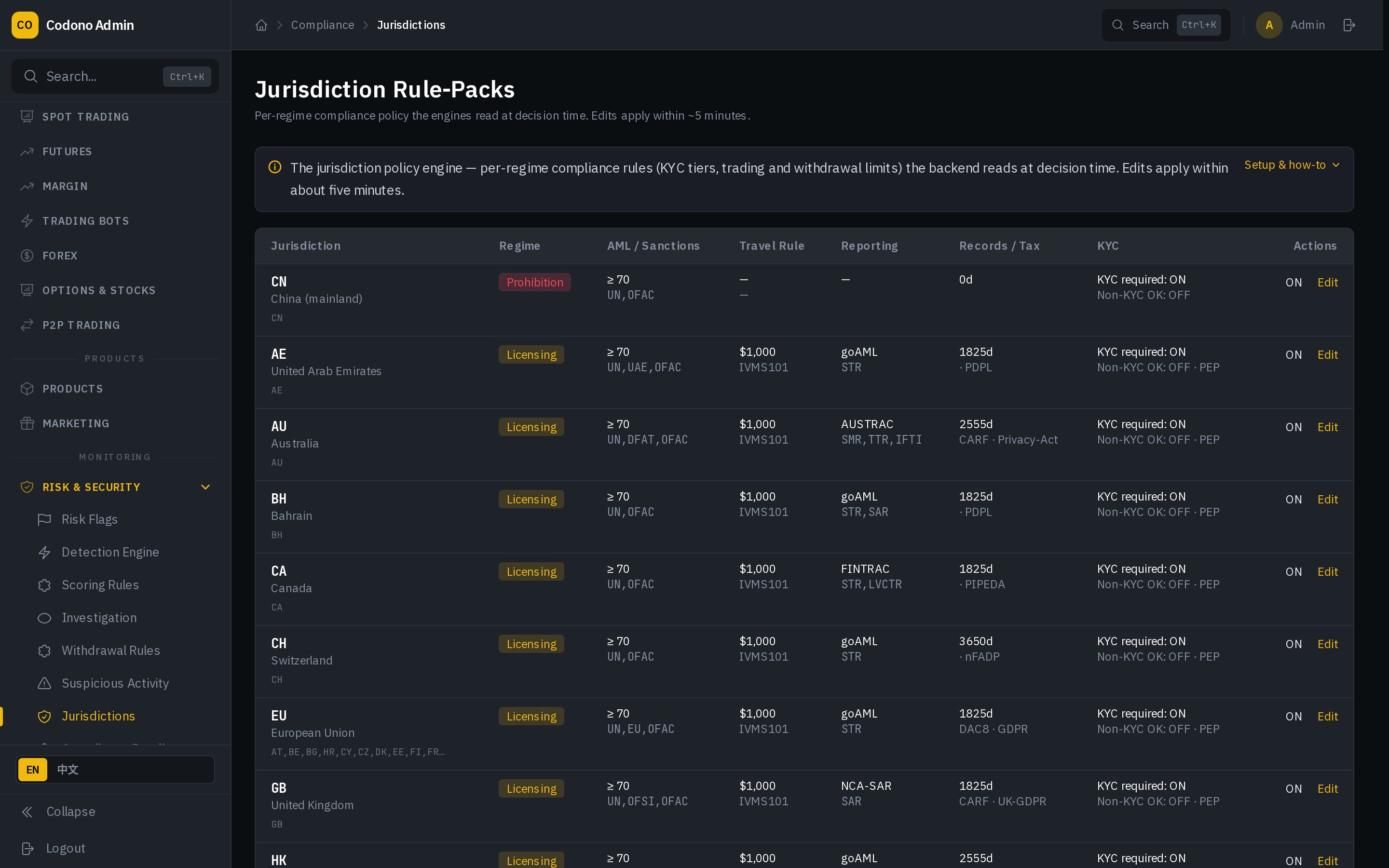
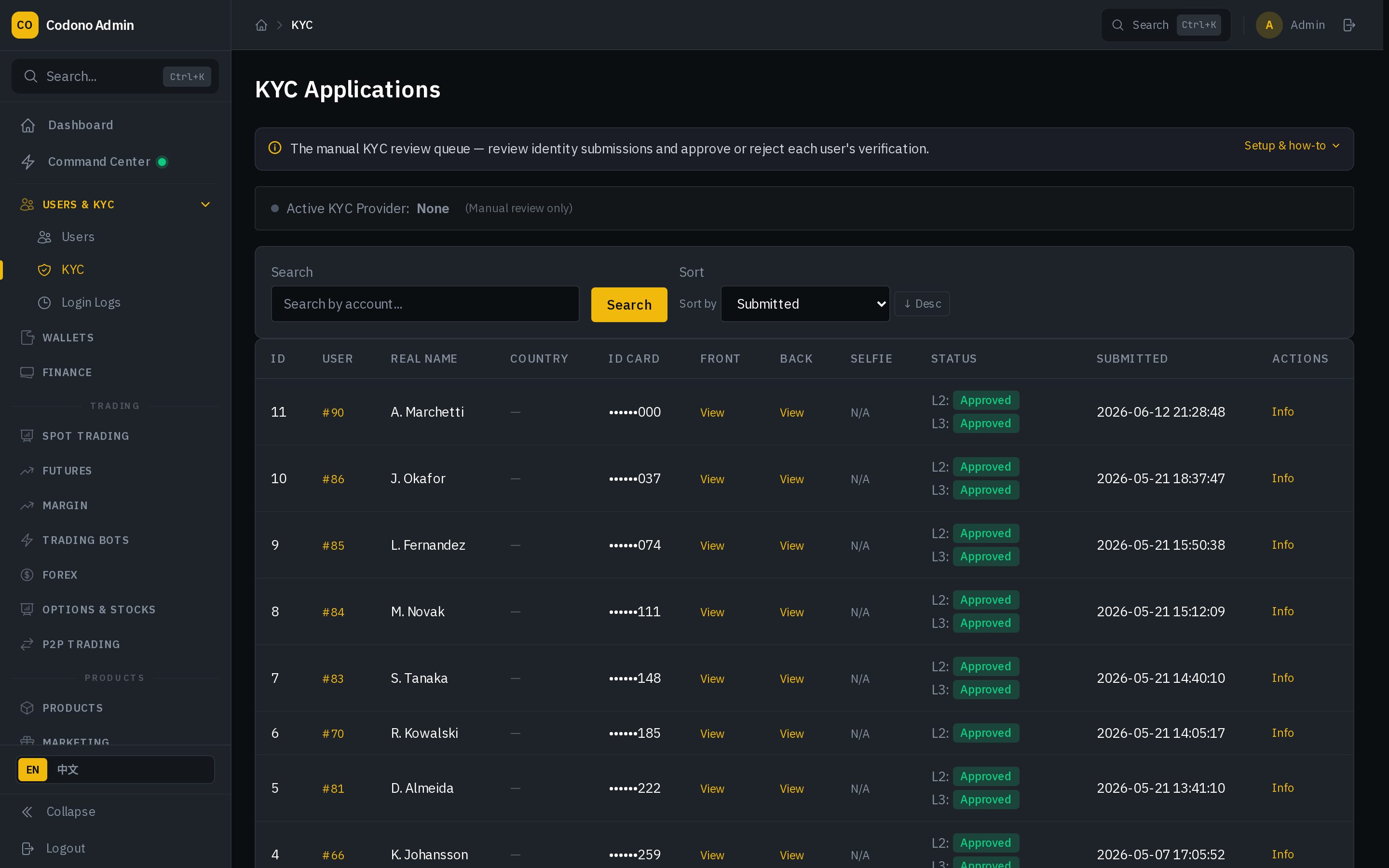
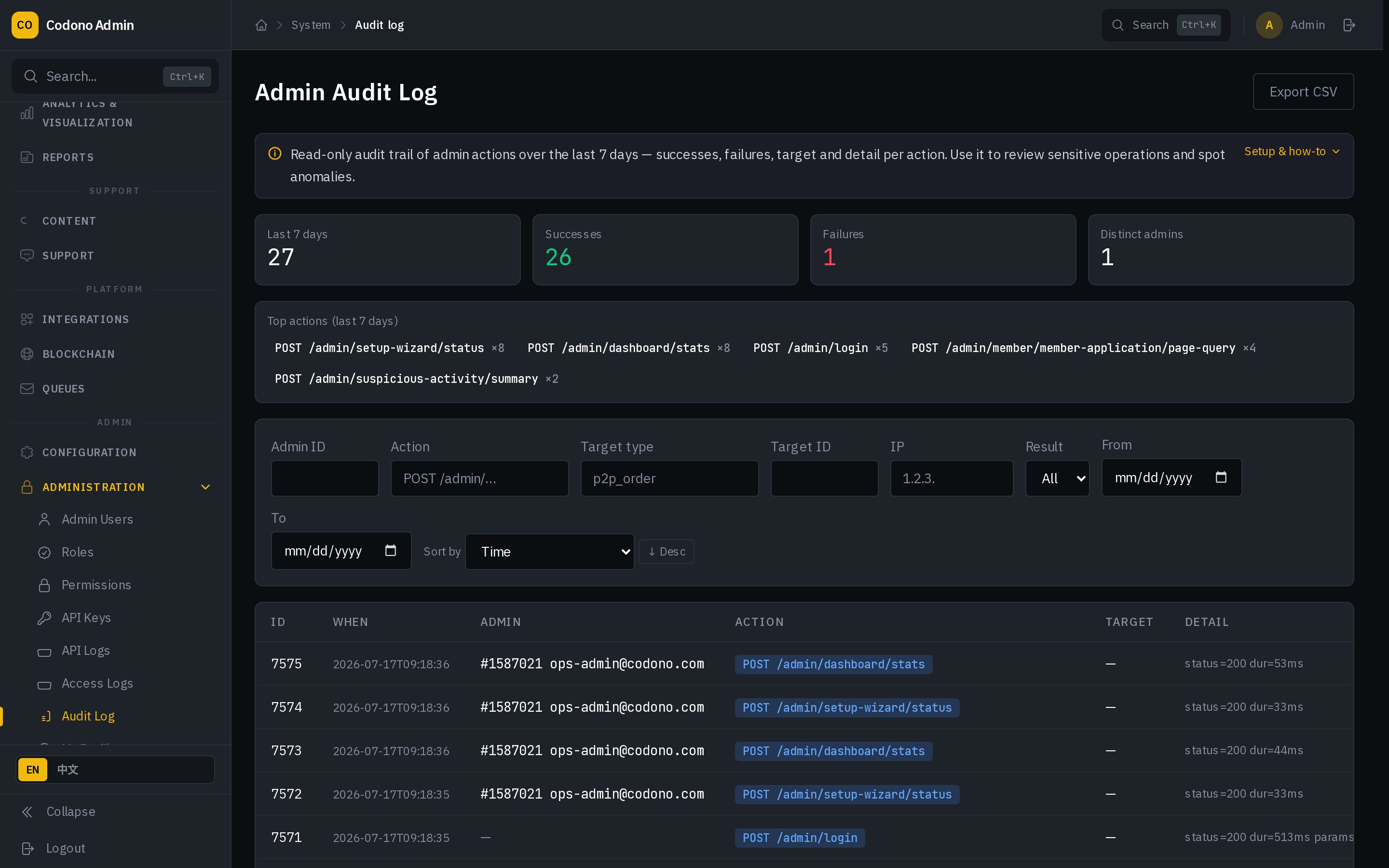
Before an application (or an examiner) arrives, you should be able to tick every line:
The Travel Rule's least-understood obligation isn't sending data — it's knowing who you're sending it to. Before transmitting originator information, an exchange must establish that the receiving VASP is a real, regulated entity capable of protecting the data: is it licensed somewhere credible, is it sanctioned, has it demonstrated Travel Rule capability, does it actually control the address you're sending to? FATF calls this counterparty VASP due diligence, and examiners increasingly ask to see the process, not just the policy.
Operationally this means maintaining a counterparty register with jurisdiction, licensing status, and messaging capability per VASP; a risk tier per counterparty that decides whether transfers flow automatically, with additional data, or not at all; and periodic refresh, because a counterparty that was licensed last year may be sanctioned this year. The platform's jurisdiction rule-packs and evidence logging carry the enforcement side; the register discipline is an operator practice worth building before an examiner asks for it.
Since 2022, "are client assets actually there?" moved from a Twitter question to an examination item. Several regimes now expect exchanges to demonstrate solvency on request: client-asset segregation, reserve attestations, and increasingly Merkle-tree proof-of-reserves that lets individual users verify inclusion of their balances.
Architecture decides how painful this is. Because the platform's MPC-custodied addresses are standard on-chain addresses, reserve attestations work with ordinary block-explorer verification and third-party auditor sampling — no exotic scripts to explain. Internally, the double-entry ledger records every balance mutation, and continuous ledger-versus-chain reconciliation means the number you attest to is a number the system checks against reality all day, not a quarter-end scramble. Liability-side proofs (the harder half of PoR) come down to exportable, complete balance snapshots — which is a query, not a project, when the ledger is the source of truth.
Enforcement actions and examination reports repeat the same handful of findings — worth knowing because they're all preventable with configuration and staffing rather than heroics:
Monitoring generates alerts; nobody disposes them. A backlog of unreviewed alerts is treated as no monitoring at all — worse, it's discoverable evidence that risk was flagged and ignored. Size the review team to alert volume, and tune rules so volume stays reviewable.
The AML program says withdrawals above a threshold need enhanced review; the platform's limits were never updated to match. Examiners diff documents against configuration — keeping them synchronized is the single cheapest finding to avoid, and why versioned policy templates that mirror actual settings matter.
Travel Rule thresholds, KYC tier limits, and velocity rules configured at launch and never revisited as regulations moved. The jurisdiction rule-pack model exists precisely so per-market updates are edits, not releases.
One superuser who configures limits, approves withdrawals, and edits the audit trail. Role separation and maker-checker aren't bureaucracy — they're the control examiners test first, because insider risk outranks hackers in the loss statistics.
An audit trail the admin can modify is not an audit trail. Immutability and export capability turn "trust us" into "verify it" — the difference between a finding and a passed exam.
Licensing regimes are converging on a fourth-and-a-half pillar that most compliance guides skim: the exchange must police its own market. MiCA imports market-abuse prohibitions directly into crypto; mature regimes everywhere expect operators to detect wash trading, spoofing and layering, self-matching, and pump-and-dump coordination — and to be able to show an examiner the detection, not just describe it.
The platform side of that obligation: complete, timestamped, exportable trade and order data (surveillance is impossible over lossy records); self-match prevention at the matching layer; per-account and per-IP rate limits that make manipulation expensive; anomaly flags for wash-trading patterns and coordinated account clusters; and circuit breakers for disorderly markets. The operator side: someone actually reviews the flags, dispositions are recorded, and repeat patterns become account restrictions and, where thresholds are met, suspicious-activity reports.
Two details win examinations here. First, surveillance must cover all venues in the platform — spot, derivatives, and P2P each manipulate differently (P2P adds off-platform payment fraud and triangulation, which is why its escrow and dispute records matter to compliance, not just support). Second, the liquidity operation itself must be clean: if the operator runs market-making accounts, they need documented mandates, separated books, and the same surveillance everyone else gets — internal accounts being exempt from monitoring is a finding waiting to happen.
The enforcement record sets the stakes: Binance settled with US authorities in 2023 for over $4 billion across BSA and sanctions violations; Coinbase paid $100 million in its 2023 NYDFS settlement, half of it earmarked for compliance-program investment; BitMEX's founders paid criminal penalties on top of the exchange's $100 million resolution for operating without an AML program. The consistent pattern in every action: the failures were programmatic — missing controls, unstaffed review queues, absent records — not exotic. Which is precisely what the checklist above exists to prevent.
No platform purchase substitutes for a license, an accountable officer, or judgment. What the platform does is change what kind of problem compliance is: from an engineering project bolted onto your launch plan, to configuration and operation of controls that already exist. Operators who have gone through licensing with Codono consistently report the same thing — the technology-audit portion stopped being the hard part. The hard part is the paperwork, as it should be.
For the regulatory landscape per market, continue with the country guides: MiCA, Dubai VARA, Singapore MAS, Latin America — or the operational guides on KYC program design and how regulators audit exchanges.
Yes. The platform ships with KYC providers and KYT/chain‑monitoring connectors. You can choose providers and configure policies per jurisdiction.
We interoperate with leading Travel Rule providers. The policy engine checks when the rule applies, requests/validates counterparty data, and logs evidence.
Yes. A rules engine enables or disables modules (e.g., margin, perpetuals, staking) based on user country, verification level, and your risk policy.
Suspicious activity reports (drafting + review), exportable audit logs, and configurable data retention with time‑boxed access for auditors.
Four pillars recur across every serious jurisdiction: identity (tiered KYC/KYB with sanctions and PEP screening), monitoring (transaction monitoring with blockchain analytics and suspicious-activity reporting), data-sharing (FATF Travel Rule originator/beneficiary exchange), and governance (a written AML program, a named compliance officer, audit trails, and periodic independent review). Licensing frameworks such as MiCA, FinCEN MSB registration, MAS PSA, and VARA each express these pillars with different thresholds and filings.
They differ in kind, not just amount — and conflating the two is a common compliance error. The US applies a genuine $3,000 trigger under FinCEN's BSA rule: below it, the Travel Rule does not attach. Most other regimes apply the rule to transfers of any size and use a figure only to set how much data must travel — the EU (Transfer of Funds Regulation) and UK require information on every CASP transfer, with a reduced data set permitted below roughly €1,000; Singapore's SGD 1,500 and Dubai VARA's AED 3,500 likewise mark where the fuller data set is required, not an exemption below it; Japan applies the rule with no threshold at all. An exchange serving multiple markets needs per-jurisdiction logic that distinguishes “rule does not apply” from “reduced data applies” — not a single global setting.
Yes — FATF's 2025 supervisory best-practices guidance notes that authorities may make Travel Rule compliance a prerequisite for VASP licensing, and jurisdictions including Singapore and Hong Kong already ask applicants to demonstrate the capability before approval. Having the messaging fields, counterparty checks, and evidence logging built into your platform turns that portion of the technology audit into a demonstration rather than a build project.
VASP (virtual asset service provider) is FATF's umbrella term used by most national frameworks; CASP (crypto-asset service provider) is the EU's MiCA equivalent. In practice an exchange is both: FATF-derived rules (Travel Rule, AML program) apply globally, while CASP authorization adds MiCA-specific requirements such as prudential safeguards and white-paper obligations for listed assets.
No — and treat any vendor who says otherwise with suspicion. Software supplies the enforcement infrastructure: KYC tiers, screening, monitoring, Travel Rule messaging, reporting, and audit evidence. Compliance itself is an operator obligation — licensing, a named responsible officer, written policies, and day-to-day judgment. The realistic goal is that your technology stops being the hard part of the application.
Request the compliance pack with policy templates, mappings, and architecture docs.