 Borsa Yazılımı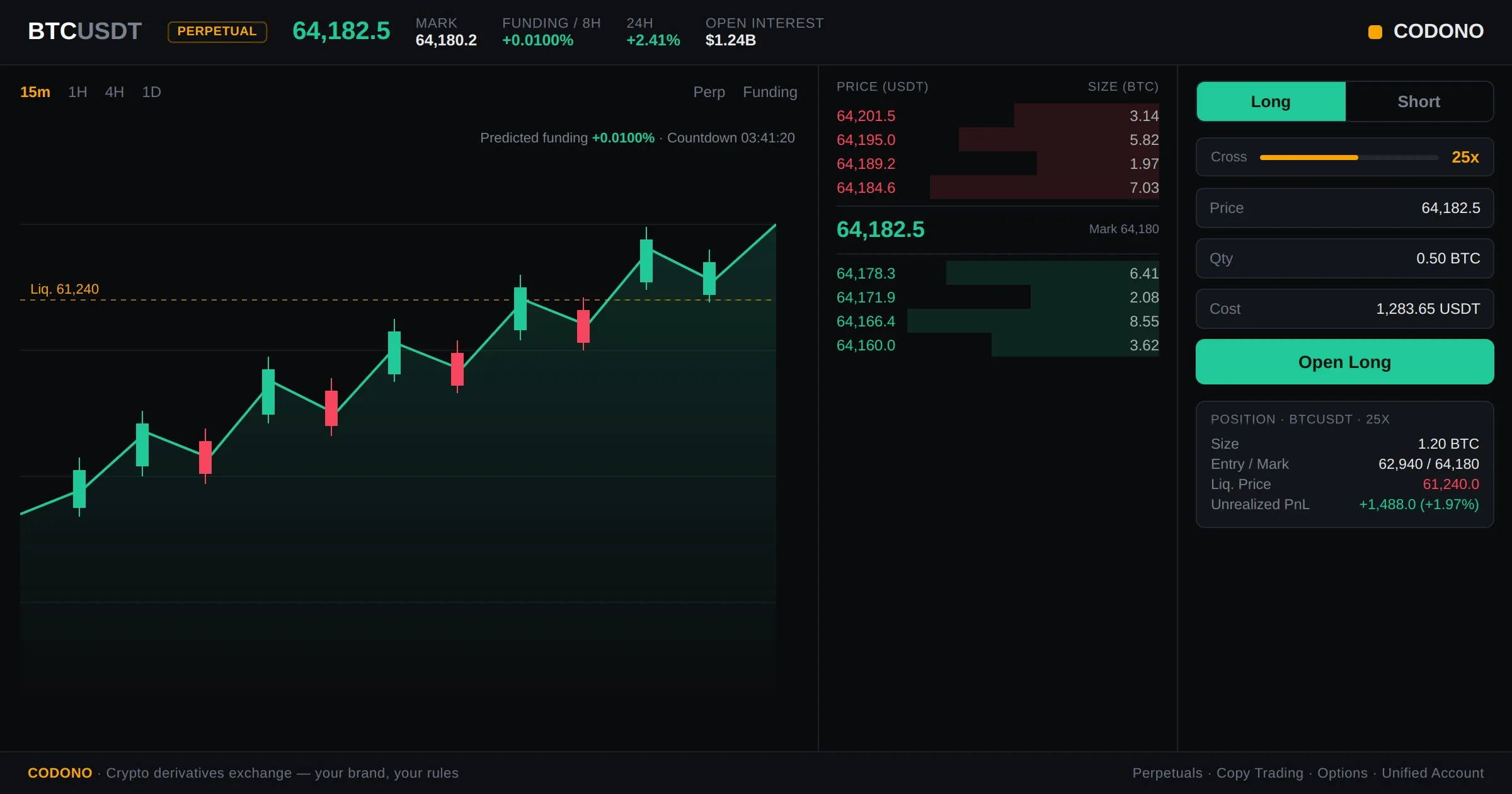
What Is Crypto Derivatives Exchange Software?
Crypto derivatives exchange software runs an exchange whose core product is derivatives — perpetual futures, margin, and options — rather than spot trading. The distinction matters because a derivatives exchange lives or dies on something a spot exchange barely needs: a production risk engine that keeps the house solvent when leveraged positions liquidate en masse.
Codono provides this as a source-available product with a one-time license — you own the codebase and self-host it, rather than renting a platform. This page is the vendor-neutral product category: if you want to model your exchange specifically on Bybit, the Bybit clone is that; if you want the perpetual futures module in feature detail, the futures trading software page covers it. This page is for the operator who has decided their exchange is a derivatives exchange and wants to launch one under their own brand.
Why Derivatives Out-Earn Spot
The reason operators build derivatives-first is economic, and it’s stark: derivatives generate far more volume and fee revenue per user than spot. Leverage multiplies position size, and derivatives traders turn over capital constantly, so a derivatives exchange can reach meaningful fee revenue with a fraction of the active users a spot exchange needs. Futures fees are the highest-margin revenue in the industry, and funding-rate flow keeps volume high in both directions.
The catch — and this page is honest about it — is that derivatives demand two things spot doesn’t: a real risk engine (or your first liquidation cascade bankrupts you) and stronger regulatory footing (derivatives are more tightly controlled than spot). Both are covered below, because a derivatives exchange that ignores either doesn’t survive.
The Derivatives Products You Can Offer
The platform supports the full derivatives stack, so you choose which products to lead with:
- Perpetual futures — USDT-margined and inverse (coin-margined) contracts, with a funding-rate mechanism anchoring the perpetual price to spot. The mainstream, highest-volume derivatives product.
- Isolated & cross margin — leveraged spot positions up to configurable leverage, sharing a unified account with the rest of the platform. See margin trading .
- Options — with perpetual futures and margin production-ready today and options on the roadmap, you can plan a derivatives suite that grows. (For fixed-payout options specifically, see the binary options trading platform .)
Each product ships with the controls that make it viable at scale — not a “futures tab” bolted onto a spot UI, but a derivatives-first trading experience: leverage selection, funding countdown, position PnL and liquidation price on screen, and the professional order types (conditional, TP/SL, post-only, reduce-only) derivatives traders expect.
The Risk Engine Is the Product
This is where most “derivatives software” quietly fails. Adding perpetual futures to a feature list is easy; building a risk engine that survives a liquidation cascade without bankrupting the exchange is the hard part — and it’s the part that determines whether your derivatives exchange lives or dies on its first volatile day.
The engine includes the primitives that keep major derivatives exchanges solvent:
- Mark-price aggregation — liquidations trigger on a manipulation-resistant mark price (a median across venues), not the last trade, so a thin-book wick can’t cascade wrongful liquidations.
- Partial liquidation — positions are reduced incrementally rather than dumped whole, minimizing market impact.
- Insurance fund — absorbs the gap when a liquidation closes below bankruptcy price, protecting winning traders from socialized losses.
- Auto-deleveraging (ADL) — a ranked, last-resort mechanism when the insurance fund is exhausted.
- Configurable risk tiers — maximum leverage steps down as position size grows, capping the exchange’s tail risk.
These aren’t optional extras — they’re the difference between a derivatives exchange and a liability. The same engine has been verified in real deployments processing derivatives volume; you can trade it on the live demo before licensing.
Regulatory Reality for Derivatives
A responsible derivatives page has to say this plainly: crypto derivatives are more heavily regulated than spot, and are restricted or prohibited for retail users in several major markets (the UK’s FCA banned the sale of crypto derivatives to retail consumers , and others have similar limits). Offering leveraged derivatives typically requires specific licensing, and which users you may serve depends on their jurisdiction.
The software gives you the capability; it cannot give you the permission. Before launching derivatives you must confirm your licensing and geo-restrictions for each market you intend to serve — the compliance requirements page and the crypto exchange license guide are the starting points, and a local regulatory advisor is essential. Building the risk controls to enforce geo-restrictions and eligibility is part of the platform; deciding who you may legally serve is your regulatory responsibility.
Spot-First or Derivatives-First?
A strategic question worth deciding early: do you launch as a derivatives exchange from day one, or start with spot and switch on derivatives later? Because both run on the same codebase, the choice is about sequencing and risk, not platforms.
Launch derivatives-first when derivatives revenue is your whole thesis and you have the licensing in place. The upside is that you concentrate immediately on the highest-margin product and build a derivatives-native brand. The demands are real: your risk engine and treasury must be sound before you take a single leveraged position, and your regulatory footing for derivatives has to be secured up front.
Launch spot-first, add derivatives later — a common, lower-risk path. You go live with a spot exchange (lighter regulatory bar, simpler risk), build liquidity, users and operational maturity, and then switch on perpetuals and margin once your compliance and treasury are ready. Because the derivatives engine is already in the platform, “adding derivatives” is enabling and configuring a module, not migrating to a new system. Many operators sequence this way deliberately: earn the operational scar tissue on spot, then layer on the product where a mistake is far more expensive.
The honest guidance: unless derivatives licensing and risk management are already handled, spot-first is the safer on-ramp to a derivatives exchange — you reach the same destination with less chance of a costly early mistake. Either way, you’re building on one platform, so the decision is reversible and incremental rather than a fork in the road.
Core Platform and Tech
A derivatives exchange is still a full exchange, so every deployment includes the complete stack:
- Matching engine — price-time priority, in-memory order books, thousands of orders per second at sub-5ms latency, holding that latency when volume spikes during liquidation events.
- Spot & unified account — spot trading and margin sharing one margin balance, so users hedge and trade across products.
- Multi-chain wallets across 50+ networks with hot/cold security.
- KYC/AML with tiered verification and geo-eligibility controls — which matter more for derivatives.
- Admin risk dashboard & API — liquidation controls, funding configuration, and the REST/WebSocket surface algorithmic derivatives traders require.
- Cross-Platform mobile apps with full derivatives trading and margin/liquidation alerts.
Tech: Java (Spring) microservices with a Node.js matching engine, MySQL double-entry ledger, Redis, Kafka; Next.js web app; cross-platform iOS/Android. Full source-code access under a one-time license.
Revenue Model
A derivatives exchange concentrates revenue on the highest-margin activity in crypto:
- Futures trading fees — on leveraged volume that far exceeds spot turnover.
- Funding-rate flow — the mechanism balancing long/short demand keeps volume high.
- Liquidation flow — the insurance fund captures value from the liquidation process.
- Margin interest — on borrowed funds.
- Spot fees — secondary revenue from the unified account.
Because leverage multiplies volume, a derivatives exchange can reach meaningful revenue with a smaller active-user base than a spot-only platform — the core reason operators choose this model.
Getting Started
- Confirm your licensing — derivatives are a regulatory question first; sort your permitted markets.
- See the engine — explore the live demo , including perpetuals and the risk controls.
- Check the one-time price — pricing is published, with full source-code access.
- Plan your build — contact us to scope deployment, or model it on Bybit if that’s your target UX.
A derivatives exchange is the highest-revenue exchange model in crypto — and the most demanding. Codono gives you the engine and the controls; you bring the license and the market.