 Exchange-Software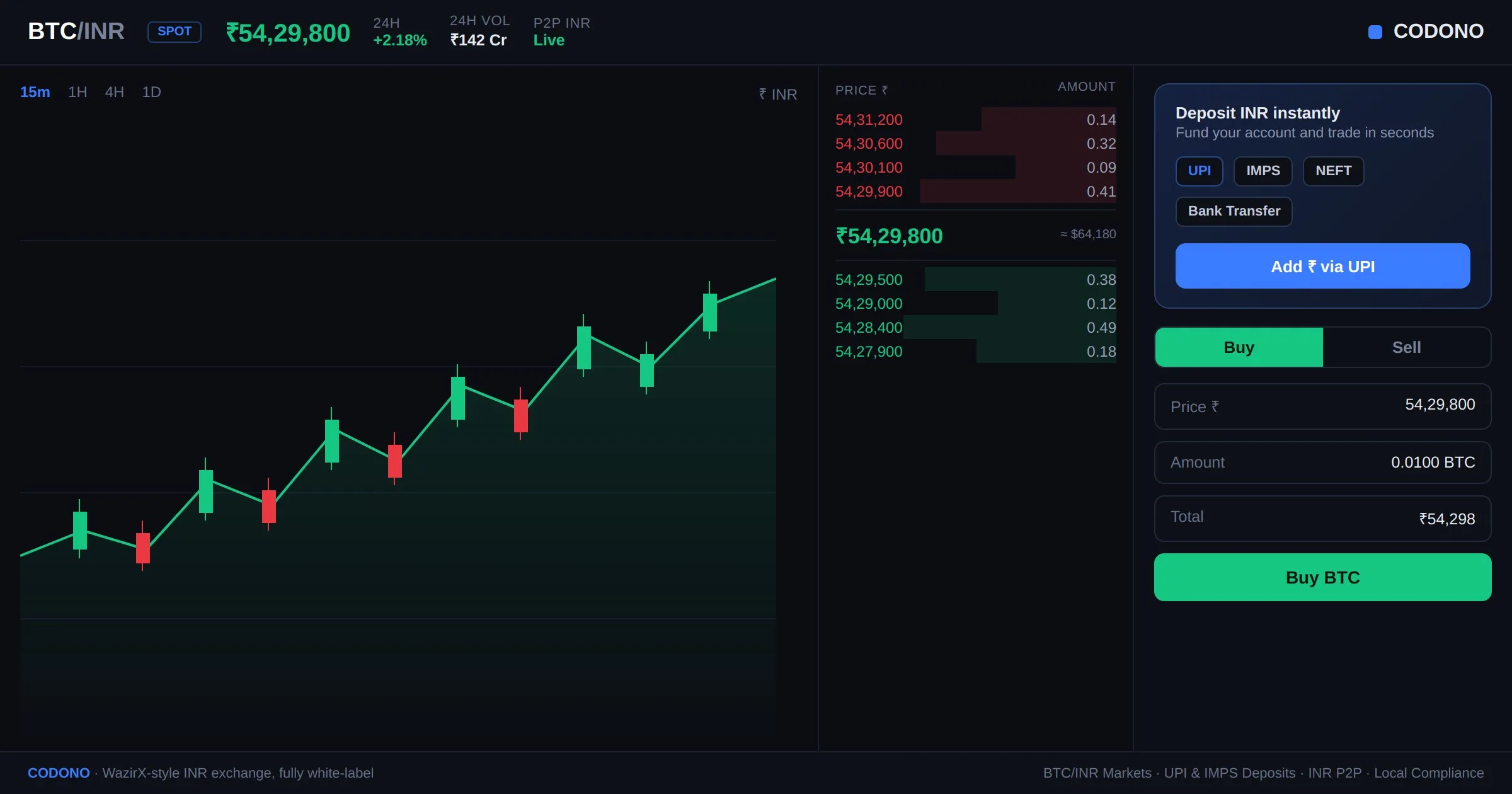
What is a WazirX Clone Script?
A WazirX clone script is exchange software built for the thing that made WazirX India’s household-name crypto exchange: not “an exchange,” but an exchange for India - rupee trading pairs, instant UPI deposits, an INR P2P marketplace, and the local compliance handling the Indian market demands.
Codono is an independently built, unbranded codebase. Configured as a WazirX clone, it gives you an India-ready exchange - launched under your own brand, domain and logo, with full source-code access. This is the model to choose when India is your market, because a generic dollar-denominated exchange simply does not fit how Indians fund accounts, pay taxes, or trade. (For the market-launch side — FIU-IND registration, banking access, costs and the step-by-step — see the India launch guide .)
This page is specific to the WazirX/India model. For a global full-suite exchange see the Binance clone ; for a pure P2P marketplace across emerging markets see the Paxful clone . The clone-script overview compares every model on one engine.
Why Clone WazirX Specifically?
India is one of the largest crypto-user populations on earth, but it is a market with very specific rails and rules. WazirX won it by fitting them exactly - and that fit is what you are replicating.
1. INR rails are non-negotiable. Indian users fund accounts with UPI, IMPS and bank transfers, and they think in rupees, not dollars. An exchange that cannot take an instant UPI deposit and quote BTC/INR is invisible to the Indian mainstream. The WazirX model puts INR funding and INR pairs at the center, exactly where Indian users expect them.
2. P2P is the pressure valve. Indian crypto has repeatedly faced banking friction, and WazirX’s INR P2P marketplace became the way users kept funding accounts when direct bank rails wavered. A resilient Indian exchange needs P2P as a first-class feature, not an afterthought - it is both a growth channel and an insurance policy against banking disruption.
3. Local compliance is table stakes. India taxes crypto specifically (1% TDS, 30% on gains) and requires exchanges to register with FIU-IND. An exchange that does not handle TDS at the transaction level and support the reporting obligations cannot operate credibly in India. The WazirX model bakes this in.
Together they make the WazirX model a India-market-fit play: you win not by having more features than global exchanges, but by fitting India’s rails, language and rules better than they do.
Feature Comparison With WazirX
| Feature | WazirX | Our Clone Script |
|---|---|---|
| INR trading pairs | ✓ | ✓ |
| UPI deposits | ✓ | ✓ |
| IMPS / NEFT / bank | ✓ | ✓ |
| INR P2P marketplace | ✓ | ✓ |
| TDS handling & reports | ✓ | ✓ Configurable |
| Spot trading | ✓ | ✓ |
| Native-token discounts (WRX-style) | ✓ | ✓ Configurable |
| Regional language support | ✓ | ✓ |
| Staking / Earn | ✓ | ✓ |
| Cross-Platform mobile apps | ✓ | ✓ iOS & Android |
The Signature WazirX Features, Replicated
INR Markets & Instant UPI Deposits
The heart of the model. Users add rupees through the payment gateway via UPI, IMPS, NEFT or bank transfer and trade BTC/INR, ETH/INR and other rupee pairs directly. Instant UPI funding is the feature Indian users judge an exchange on first - the clone makes it the front door, not a buried option.
INR P2P Marketplace
An escrow-protected P2P marketplace where Indian users trade INR for crypto directly with one another, with local payment methods (UPI, IMPS, PayTM-style wallets), merchant verification, ratings and dispute resolution. This is the resilience layer that kept WazirX funded through banking uncertainty - and a strong organic growth channel.
TDS Handling
India’s 1% TDS on crypto transfers is an operational requirement, not an optional feature. The platform supports TDS deduction and reporting at the transaction level, with configurable rates and thresholds and record generation for users and authorities. (Rates and rules evolve - configure to the current law and confirm with a local advisor.)
Native-Token Discounts (the WRX Pattern)
WazirX’s WRX token grants trading-fee discounts. The clone’s fee engine supports the same pattern: issue your own token, grant tiered fee discounts for holding it, and drive demand for your token through utility.
Regional Localization
The interface localizes into English and Indian regional languages. In a market as linguistically diverse as India, meeting users in their language is a real conversion lever, not a nicety.
Built for Indian Compliance
For the WazirX model, Indian compliance is a core requirement, and the clone includes the infrastructure to meet it:
- FIU-IND readiness - the platform supports operating as a reporting entity: the KYC/AML pipeline runs verification under PMLA expectations, with transaction monitoring and suspicious-transaction reporting.
- TDS at the transaction level - deduction, record-keeping and reporting for the 1% transfer tax.
- Tiered KYC - PAN/Aadhaar-style identity verification mapped to trading and withdrawal limits.
- Audit-ready logging - complete trails across trades, fund movements and KYC decisions.
See the compliance requirements page for the broader framework. The honest framing: the software gives you a compliance-capable platform; the FIU-IND registration and the program you run are what make you legally operable in India - and Indian rules continue to change, so treat compliance as an ongoing obligation, not a one-time setup.
Operating in the Indian Market
The software fits India; the operating challenges are commercial and regulatory, and worth understanding before you commit to this model.
Banking access is the make-or-break. The recurring theme of Indian crypto has been banking friction — periods where exchanges struggled to maintain the bank and UPI relationships that let users deposit rupees. Securing and keeping those rails is the single hardest part of running an Indian exchange, and it is a trust exercise with your banking partners that depends on your compliance being visibly solid. Plan for it as your primary operational risk.
P2P is your resilience layer, not just a feature. Because direct bank rails can waver, the INR P2P marketplace is what keeps your exchange usable when they do — users fund each other peer-to-peer while direct deposits are disrupted. Operators who treat P2P as core infrastructure, and cultivate a base of trusted INR vendors early, build an exchange that survives banking shocks. Those who bolt it on as an afterthought get caught out.
Tax handling is a user-experience feature. The 1% TDS and 30% gains tax are not just compliance line-items — how cleanly you handle them shapes the user experience. Users want clear TDS deduction, accurate records, and reports they can hand to their accountant. An exchange that makes Indian crypto tax painless has a real edge over one that leaves users to reconstruct their own records.
Regulation is a moving target. India’s crypto framework has shifted repeatedly and will keep shifting. Build a standing relationship with a local compliance and tax advisor, keep the configurable TDS/KYC settings current, and design your operations to adapt — the winners in India are the exchanges that treat regulatory change as normal, not exceptional.
Core Modules Included
Beyond the India-signature features, every deployment includes the full Codono stack:
Spot Engine
A production matching engine for INR and crypto-crypto pairs - price-time priority, in-memory order books, sub-5ms latency.
Payment & Fiat Layer
The payment gateway integrates UPI, IMPS, NEFT and bank rails - the INR plumbing the whole model depends on.
Multi-Chain Wallets
Automated multi-chain wallets across 50+ networks with hot/cold security and multi-signature withdrawals.
Admin Dashboard
Full back office: KYC review queues, withdrawal approvals, TDS and fee configuration, P2P dispute handling, and compliance reporting.
Cross-Platform Mobile Apps
iOS and Android with full INR trading, UPI deposits and P2P - essential, since Indian crypto usage is overwhelmingly mobile.
Revenue Model for Operators
The WazirX model has the standard exchange revenue lines plus India-specific ones:
- Spot trading fees - maker/taker on INR and crypto pairs.
- P2P fees - merchant and transaction fees on the P2P marketplace.
- Fiat on-ramp fees - a margin on UPI/IMPS/bank funding.
- Native-token economics - fee discounts that drive demand for your token.
- Staking / Earn spread - yield products for INR-market users.
- Withdrawal fees - network-fee markup.
The P2P marketplace does double duty: it is a revenue line and the funding resilience that keeps the exchange usable through banking friction.
Who the WazirX Model Is Right For — and Who It Isn’t
The WazirX model is right for you if:
- India is your market - you are building for Indian users who fund with UPI and think in INR.
- You can register with FIU-IND and run compliance under Indian law, including TDS.
- You can secure banking and UPI relationships - the on-ramp is everything, and it is the hardest part in India.
- You see P2P as a core feature and funding-resilience layer, not an add-on.
It’s probably not the right model if:
- Your market is global rather than Indian - a Binance clone or Coinbase clone fits a broad or Western retail audience better.
- Your focus is emerging-market P2P across many countries - the Paxful clone is purpose-built for that.
- Derivatives are your revenue plan - build the Bybit clone .
Because every model shares one codebase, an India-focused exchange can later add more markets, currencies or modules. The clone-script overview compares the options side by side.
Is a WazirX Clone Legal?
The honest answer, with the India-specific points that matter for this model.
What is legal. INR markets, UPI deposits, P2P, staking - these are functional mechanics, not WazirX inventions, and building software that offers them is entirely legal.
What is not legal. You cannot copy WazirX’s actual source code (you are not - Codono is its own codebase). You cannot use the WazirX name, logo or brand, or the WRX mark, on your exchange - those are registered trademarks. You cannot reproduce WazirX’s copyrighted visual assets pixel-for-pixel.
Operating legally in India means registering with FIU-IND as a reporting entity, running KYC/AML under the PMLA framework, and handling TDS and tax reporting. The software provides this infrastructure; you hold the registration and run the program. Indian crypto regulation and taxation continue to evolve, so build the relationship with a local compliance and tax advisor and treat this as ongoing. See the compliance page and the crypto exchange license guide .
The practical rules are otherwise standard: launch under your own brand and domain; do not copy WazirX’s exact colors, copy or trademarked UI; keep “WazirX clone” as an internal description, not public branding.
In short: replicating what WazirX does is legal; impersonating who WazirX is is not - and operating an Indian exchange legally is an FIU-IND-and-TDS question you must answer.
Getting Started
- Consultation - your target regions within India, banking/UPI position, and compliance readiness.
- License selection - choose from our pricing plans based on the modules you need.
- Configuration - branding, UPI/IMPS integration, INR pairs, TDS and KYC setup, and localization.
- Deployment - server provisioning, installation, blockchain nodes and SSL (2-4 weeks).
- Launch - go live with 12 months of updates and technical support.
Contact us for a consultation on the WazirX / India model, or explore the live demo to try the INR trading and UPI deposit flow before you decide.