 Exchange-Software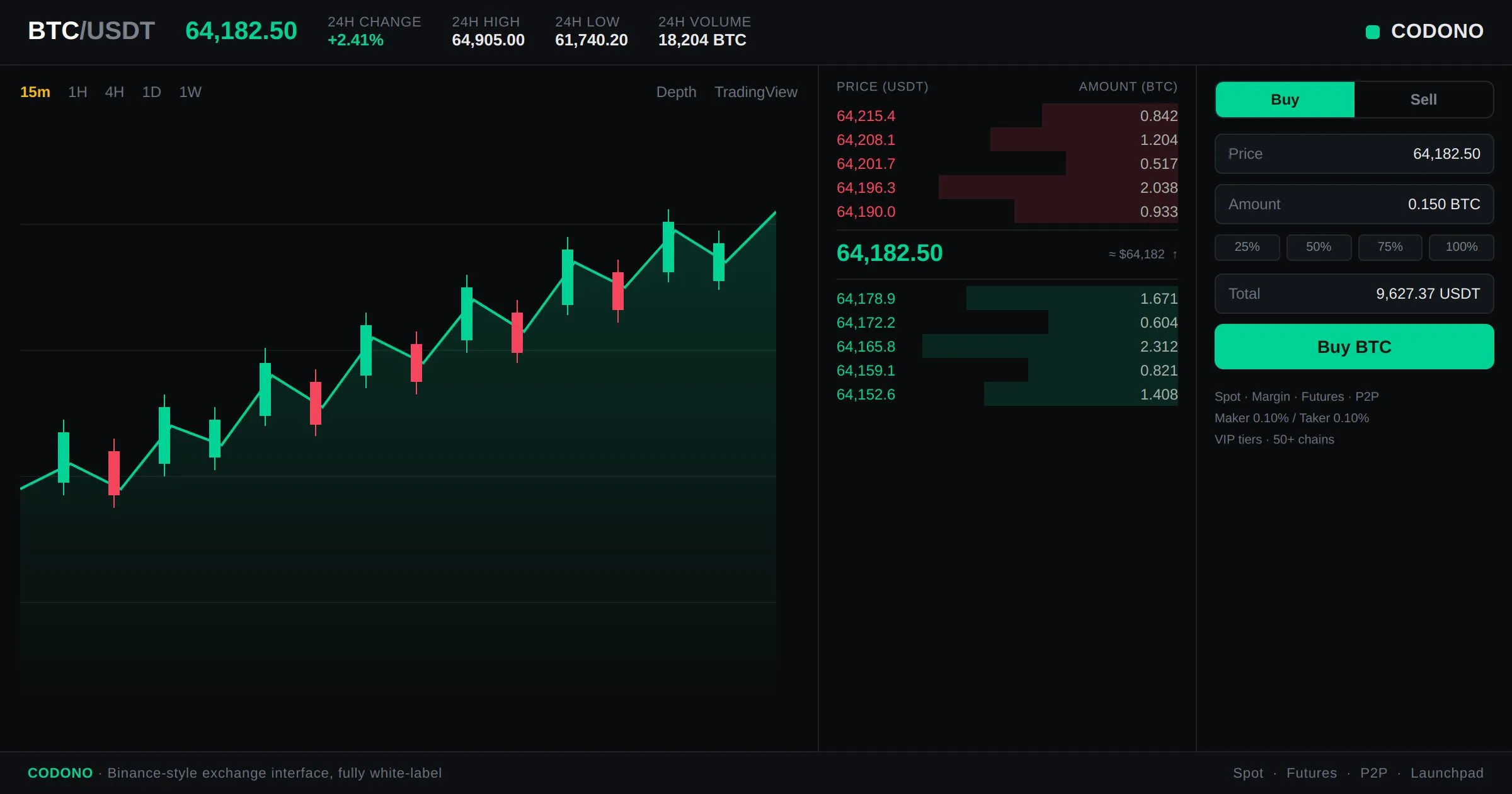
What is a Crypto Exchange Clone Script?
A crypto exchange clone script is production-ready exchange software that replicates the features and trading experience of an established exchange, so you can launch a comparable platform in weeks instead of spending years and millions building one from scratch. The word “clone” refers to matching functionality - the order book, the market types, the fee model, the mobile apps - not to copying a brand or lifting anyone’s source code.
That distinction matters, and we are direct about it throughout this page: Codono is a single, independently built codebase that ships completely unbranded. You point it at the exchange your target market already trusts, configure the modules that matter for your model, and launch under your own name, domain and logo.
The advantage of a clone-script approach is familiarity. Traders adopt platforms that feel like the ones they already use. If your users came from KuCoin, a KuCoin-style interface with trading bots converts better than a novel design they have to learn. If they came from Bybit, they expect perpetuals, a leverage slider and copy trading on day one. A clone script lets you meet that expectation without reinventing the trading experience.
Clone Script vs Building From Scratch
Building a production exchange from zero is a multi-year, multi-million-dollar undertaking: a matching engine that survives volatility, wallet infrastructure across dozens of blockchains, a KYC/AML pipeline that passes a regulator’s audit, a derivatives risk engine that does not bankrupt the house on the first liquidation cascade. Each of those is a specialist project in its own right.
A clone script collapses that timeline because the hard, invisible infrastructure is already built and battle-tested. You are not paying to invent an order-matching algorithm - you are paying to configure, brand and launch one that already works. The visible parts (branding, trading pairs, fees, payment methods, locale) are exactly the parts you should control, and those are fully yours.
| Build From Scratch | Codono Clone Script | |
|---|---|---|
| Time to launch | 12-24 months | 2-4 weeks |
| Upfront cost | $500k - several million | One-time license |
| Matching engine | Build & test yourself | Production-tested, included |
| Multi-chain wallets | Build per chain | 50+ chains included |
| KYC/AML & audit trail | Build & certify | Included, audit-ready |
| Source-code access | You own what you build | Full source-code access, licensed |
| Ongoing maintenance | Your team, indefinitely | 12 months updates + support |
The Clone Directory - Pick Your Model
Every model below runs on the same Codono codebase. The difference is which modules take the spotlight and how the platform is configured - not a different product, a different quality tier or a different security posture.
Binance Clone - the full-suite exchange
The broadest model: spot, margin, perpetual futures, P2P, staking, launchpad and mobile apps in one platform. Choose this when you want to be a one-stop exchange rather than specialize. See the Binance clone script →
KuCoin Clone - the altcoin exchange with trading bots
KuCoin earned “the People’s Exchange” reputation on two things: a deep, fast-moving altcoin listing pipeline and built-in grid/DCA trading bots. Choose this model to compete on breadth of listings and automated-trading features rather than blue-chip depth. See the KuCoin clone script →
Bybit Clone - the derivatives exchange
Derivatives-first: perpetual contracts, high leverage, a unified trading account and copy trading as the primary growth engine. Choose this model when futures fees - which dwarf spot fees - are your core revenue plan. See the Bybit clone script →
Coinbase Clone - the compliance-first retail exchange
A simpler, regulation-forward experience built around fiat on-ramps and beginner-friendly buy/sell flows. Choose this model for a regulated retail exchange in markets where trust and simplicity win over advanced trading tools. See the Coinbase clone script →
WazirX Clone - the INR & P2P exchange
Built for the Indian market: INR rails, instant UPI deposits, a WazirX-style P2P marketplace, and India-specific compliance (TDS, FIU-IND). See the WazirX clone script →
Paxful / LocalBitcoins Clone - the pure P2P marketplace
No central order book - an escrow-protected, offer-driven peer-to-peer marketplace with 300+ payment methods, built for emerging markets where P2P is the primary on-ramp. Powered by our P2P crypto exchange module. See the Paxful clone script →
One Engine Behind Every Model
The reason we can offer this range without cutting corners is that there is no range of codebases - there is one. Every model above is the same platform with different modules enabled:
- Matching engine - price-time priority, in-memory order books, thousands of orders per second with deterministic execution under load.
- Multi-chain wallet infrastructure - automated deposit detection, withdrawal queuing and hot/cold rebalancing across 50+ blockchains.
- KYC/AML pipeline - tiered verification, transaction monitoring and complete audit trails that stand up to a regulator’s inspection.
- Admin back office - user management, financial controls, risk monitoring and reporting.
- Cross-Platform mobile apps - iOS and Android with full trading functionality.
A Bybit-style derivatives launch and a Paxful-style P2P launch are therefore the same audited codebase. Security, quality and update cadence are identical no matter which exchange you model - a point that generic single-purpose clone vendors cannot make.
How to Choose Which Exchange to Model
Match the model to two things: what your target users already trade on, and how you plan to make money.
- Broadest reach → Binance model. Be the one-stop exchange for a market with mixed needs.
- Derivatives revenue → Bybit model. Futures fees are the highest-margin revenue in the industry; lead with perpetuals and copy trading.
- Altcoin & automation edge → KuCoin model. Win on listing speed and built-in trading bots.
- Regulated retail → Coinbase model. Fiat-first, simple, compliance-forward for trust-sensitive markets.
- Indian market → WazirX model. INR rails and P2P are the local default.
- Emerging-market P2P → Paxful model. Where banking is thin, peer-to-peer is the on-ramp.
You are not locked in. Because every model shares one codebase, most operators launch spot plus one specialty and switch on additional modules - futures, bots, P2P - as they grow. If you are still deciding between a branded generic exchange and a specific model, the white-label crypto exchange page covers the flexible-branding case, and the self-hosted crypto exchange page covers deploying on your own infrastructure.
Is Cloning an Exchange Legal?
Every operator asks this first, and it deserves a straight answer. The line runs between functionality and intellectual property.
What is legal. Trading mechanics are not protectable. An order book, spot and futures markets, a P2P marketplace, a staking product, a maker/taker fee schedule - these are functional concepts used across every exchange, not any one company’s invention. Building software that offers the same features is entirely legal.
What is not legal. You cannot copy a target exchange’s actual source code (you are not - Codono is its own codebase). You cannot use that exchange’s name, logo or brand on your platform - those are registered trademarks, and using them implies an affiliation that does not exist. You cannot reproduce its copyrighted visual assets pixel-for-pixel.
The practical rules are the same for every model: launch under your own brand and domain; do not reproduce the target’s exact colors, copy or trademarked UI; keep the “[exchange] clone” phrasing as an internal description of what you are building, never in your public branding. Each specific clone page ( Binance , KuCoin , Bybit ) covers the trademark specifics for that brand.
And the real legal work is licensing. In most jurisdictions what makes your exchange legal to operate is not the software - it is holding the right operating license and running the compliance program underneath it. That is covered in depth on the compliance requirements page and the crypto exchange license guide . In short: replicating what an exchange does is legal; impersonating who it is is not - and Codono ships unbranded so your identity is entirely your own.
What Every Clone Includes
Regardless of the model you choose, every Codono clone ships with:
- Full source-code access - licensed, so you customize every layer, not just the logo.
- The complete trading stack - matching engine, order types, market data over WebSocket, TradingView charts.
- Multi-chain wallets across 50+ blockchains with hot/cold security.
- KYC/AML and compliance with tiered verification and audit-ready logging.
- Admin dashboard for users, finance, risk and reporting.
- Cross-Platform iOS & Android apps.
- Liquidity aggregation so your book has competitive prices from day one.
- One-time license - no monthly SaaS fee, no revenue share; you own your exchange, servers and data.
For the full feature and module breakdown, see the main crypto exchange software page.
Getting Started
- Consultation - tell us your target market and revenue plan; we recommend a model.
- License selection - choose from our pricing plans based on the modules you need.
- Configuration - branding, trading pairs, fees, payment methods and locale.
- Deployment - server provisioning, installation, blockchain nodes and SSL (2-4 weeks).
- Launch - go live with 12 months of updates and technical support.
Contact us to discuss which exchange model fits your market, or explore the live demo to see the platform before you decide.