 Software de Exchange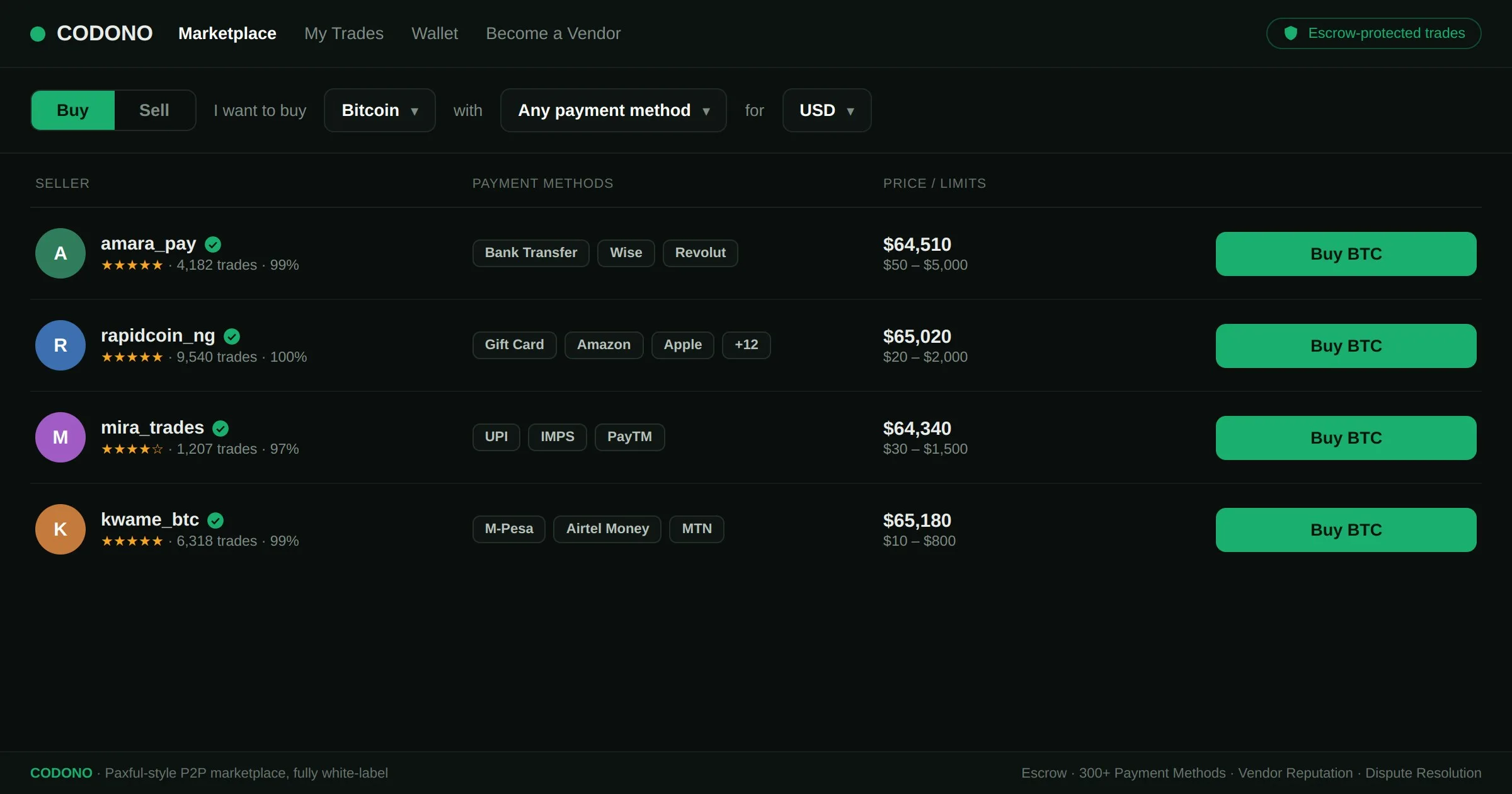
What is a Paxful Clone Script?
A Paxful clone script is software that replicates the peer-to-peer marketplace model that made Paxful and LocalBitcoins the way millions of people in emerging markets buy crypto - not a central exchange, but a marketplace where users trade directly with each other through escrow-protected offers, using whatever payment method works locally.
Codono is an independently built, unbranded codebase. Configured as a Paxful clone, it gives you a full P2P marketplace - launched under your own brand, domain and logo, with full source-code access. This is the model to choose when your users cannot rely on direct bank rails and need to transact person-to-person, with the widest possible range of payment methods.
This page is specific to the pure-P2P model. If you want a central-order-book exchange with P2P as one feature among many, the Binance clone or the WazirX clone fit better. The clone-script overview compares every model on one engine.
Why Clone Paxful Specifically?
Paxful did not compete with Binance on trading - it served a completely different need, and that need is enormous and underserved.
1. It works where banks don’t. In much of Africa, Latin America, South and Southeast Asia, direct crypto-to-bank rails are unreliable, restricted or absent. Paxful’s answer was to let people pay each other however they can - mobile money, bank transfer, gift cards, cash deposits - with escrow making it safe. A P2P marketplace reaches the huge population that a conventional exchange simply cannot onboard. (For a market-specific launch, see how to start a crypto exchange in Nigeria - Africa’s largest, most P2P-driven crypto market.)
2. Payment-method breadth is the moat. There is no single dominant payment rail across emerging markets, so the marketplace with the most methods wins. Paxful’s 300+ payment methods - including gift cards, which almost no one else touched - were its core advantage. The P2P model competes on breadth and local fit, not on order-book depth.
3. The community runs the liquidity. In a P2P marketplace, the vendors are the liquidity. Successful operators cultivate a base of trusted, high-volume vendors whose offers fill the marketplace - which means once you reach critical mass, the community sustains itself.
Together they make the Paxful model a financial-inclusion play: you serve people conventional exchanges leave out, and you do it by enabling person-to-person trade with trust built in.
How a P2P Marketplace Works
This model is structurally different from every other clone on this site, so it is worth being explicit:
- Offers, not an order book. Vendors post buy and sell offers, each with its own price (often a margin over the market rate), limits, and accepted payment methods. Buyers browse and filter offers instead of hitting a single market price.
- Escrow locks the crypto. When a buyer takes an offer, the seller’s crypto is locked in platform escrow - it cannot move until the trade resolves.
- Payment happens off-platform. The buyer pays the seller directly via the agreed method (bank transfer, M-Pesa, gift card, etc.) and marks the trade paid, with a built-in chat for evidence.
- Release or dispute. The seller confirms receipt and escrow releases the crypto; if there is a disagreement, a moderator reviews the evidence and decides.
Escrow plus reputation plus moderation is what lets strangers trade safely - and all three are core to the clone.
The Signature Paxful Features, Replicated
Escrow-Protected Trading
Automatic escrow on every trade: crypto is locked when the trade opens and released only on confirmation (or by moderator decision in a dispute). This is the single feature that makes person-to-person trading with strangers viable, and it is the foundation of the P2P module .
300+ Payment Methods
Bank transfers, mobile money (M-Pesa, Airtel Money, MTN), digital wallets, and gift cards - the breadth that lets users transact however they can locally. Operators configure which methods are enabled and can set per-method rules (for example, restricting higher-risk methods to verified vendors).
Vendor Reputation & Trade History
Every vendor carries a public reputation: completed trades, success rate, ratings, verification badges, and response time. Reputation is how buyers choose whom to trust, and it is how your best vendors earn the volume that fills your marketplace.
Dispute Resolution & Moderation
A structured dispute system with a moderator queue, evidence review (chat logs, payment receipts), and configurable resolution rules. Fair, fast dispute handling is what keeps a P2P marketplace trustworthy as it scales.
Offer Creation & Vendor Tools
Vendors get the tools to run a real business on your platform: create and manage offers, set margins and limits, define payment windows, and track their trade pipeline - the “become a vendor” path that turns power users into your liquidity engine.
Managing Fraud and Trust
The P2P model’s strength - accepting any payment method, including irreversible ones like gift cards - is also its risk, and a Paxful clone lives or dies on how well it manages that. The clone includes the controls that make it viable:
- Escrow removes the biggest risk: the buyer can’t lose crypto they haven’t received, and the seller can’t lose crypto before payment is confirmed.
- Vendor reputation and trade history let good actors build trust and expose bad ones.
- KYC/AML tiers - P2P marketplaces attract money-laundering scrutiny, so identity verification and transaction monitoring are essential, not optional.
- Per-method risk rules - restrict high-risk payment methods (gift cards, irreversible transfers) to verified or high-reputation vendors, cap limits, and require extra evidence.
- Dispute moderation - a trained moderation process that resolves conflicts on evidence.
Running these well is the actual operating skill of a P2P marketplace. The software gives you every control; the trust-and-safety program you run on top is what makes the marketplace safe enough to grow. See the compliance requirements page for the regulatory side.
Bootstrapping Vendor Liquidity
A P2P marketplace has a classic chicken-and-egg problem: buyers won’t come to an empty marketplace, and vendors won’t post offers with no buyers. Solving this cold start is the defining operator challenge of the Paxful model, and it is worth planning before launch — the software is ready on day one, but a marketplace with no offers converts no one.
Seed the vendor side first. Liquidity in a P2P marketplace comes from vendors, so you recruit them before you chase buyers. Successful operators onboard an initial cohort of trusted, high-volume traders — often people already running P2P businesses elsewhere — with incentives: reduced or zero fees for early vendors, promoted placement, or a temporary vendor bonus. A handful of active, well-reputed vendors posting competitive offers is enough to make the marketplace feel alive.
Focus on one corridor at a time. Don’t try to launch every country and payment method at once. Pick a specific corridor — a country and its dominant payment methods (say, Nigeria with bank transfer and mobile money, or a specific gift-card niche) — and get liquidity dense there before expanding. A marketplace that is deep in one corridor beats one that is thin across twenty.
Let reputation compound. Once early vendors build trade history and ratings, their reputation becomes the trust that pulls in buyers, and buyer volume pulls in more vendors. The reputation and vendor-tier tools exist to accelerate this flywheel — surface your best vendors, reward reliability, and the community begins to sustain its own liquidity.
Protect the early experience ruthlessly. In the fragile early phase, a single high-profile scam can kill trust before the marketplace establishes itself. Keep fraud controls tight at launch — conservative limits, strict KYC, fast dispute resolution — even at the cost of some friction. Trust is the marketplace’s only real asset, and it is cheapest to protect before you have scale, not after.
Core Modules Included
The P2P marketplace is the centerpiece, backed by the full Codono stack:
P2P Marketplace Engine
The P2P module provides offers, escrow, reputation, chat with evidence, dispute resolution and vendor tools - the complete marketplace.
Multi-Chain Wallets
Automated multi-chain wallets across 50+ networks with hot/cold security - the custody layer escrow sits on.
KYC/AML & Compliance
Tiered KYC/AML with transaction monitoring - critical for a P2P marketplace’s regulatory standing.
Admin & Moderation Dashboard
Full back office: vendor management, dispute/moderation queues, payment-method configuration, KYC review, and reporting.
Cross-Platform Mobile Apps
iOS and Android with the full marketplace, escrow and chat - vital in emerging markets where users are mobile-first.
Optional Spot Layer
If you want to add a conventional order-book market later, the same codebase includes a full spot engine - P2P and spot on one platform.
Revenue Model for Operators
The P2P model monetizes the marketplace itself:
- Trade / escrow fees - a fee on completed P2P trades, typically charged to the vendor.
- Vendor / merchant fees - premium vendor tiers or listing fees for offers.
- Spread capture - optional platform margin on facilitated trades.
- Advertising / promoted offers - vendors paying for offer visibility.
- Withdrawal fees - network-fee markup on off-platform withdrawals.
- Optional spot fees - if you add an order-book market.
Because vendors bring their own liquidity and customers, a healthy P2P marketplace scales its revenue with community volume rather than with your own market-making.
Who the Paxful Model Is Right For — and Who It Isn’t
The Paxful model is right for you if:
- Your users are in markets where direct bank rails are unreliable and person-to-person trade is the norm.
- You want to compete on payment-method breadth and local fit rather than order-book depth.
- You are prepared to run a real trust-and-safety operation - escrow, moderation, fraud controls - which is the core operating skill here.
- You see the vendor community as your liquidity and want to cultivate it.
It’s probably not the right model if:
- Your users have easy fiat rails and just want to buy crypto simply - the Coinbase clone fits that better.
- You want a central-order-book trading exchange - the Binance clone or KuCoin clone fit.
- Your market is specifically India with UPI rails - the WazirX clone combines an order book with INR P2P.
- Derivatives are your revenue plan - build the Bybit clone .
Because every model shares one codebase, you can run a pure P2P marketplace and add a spot market later without changing platforms. The clone-script overview compares the options side by side.
Is a Paxful Clone Legal?
The honest answer, with the P2P-specific points that matter.
What is legal. A P2P marketplace, escrow, reputation, dispute resolution, many payment methods - these are functional mechanics, not Paxful inventions, and building software that offers them is entirely legal.
What is not legal. You cannot copy Paxful’s or LocalBitcoins’ actual source code (you are not - Codono is its own codebase). You cannot use the Paxful or LocalBitcoins name, logo or brand on your marketplace - those are registered trademarks. You cannot reproduce their copyrighted visual assets pixel-for-pixel.
The P2P-specific compliance reality. Peer-to-peer marketplaces attract heightened money-laundering scrutiny precisely because they accept diverse, sometimes irreversible payment methods. Operating legally requires KYC/AML (identity verification and transaction monitoring), the right registration or license in your market, and genuine fraud controls - especially for gift-card and irreversible methods. The software provides this infrastructure; you run the program. See the compliance page and the crypto exchange license guide .
The practical rules are otherwise standard: launch under your own brand and domain; do not copy Paxful’s exact colors, copy or trademarked UI; keep “Paxful clone” as an internal description, not public branding.
In short: replicating what Paxful does is legal; impersonating who Paxful is - or running a marketplace without KYC and fraud controls - is not.
Getting Started
- Consultation - your target markets, priority payment methods, and compliance position.
- License selection - choose from our pricing plans based on the modules you need.
- Configuration - branding, payment-method and escrow setup, vendor tiers, KYC and moderation rules.
- Deployment - server provisioning, installation, blockchain nodes and SSL (2-4 weeks).
- Launch - go live with 12 months of updates and technical support.
Contact us for a consultation on the Paxful / P2P model, or explore the live demo to try the marketplace, escrow and dispute flow before you decide.