 Software de Exchange
 30-Second Verdict
Binance Cloud rents you the strongest brand-adjacent infrastructure in crypto: Binance’s liquidity, Binance’s uptime, Binance’s custody — behind your logo, under Binance’s terms, at privately negotiated cost. Codono sells you the opposite: a complete exchange codebase you own outright, host yourself, and modify freely, with liquidity aggregated from venues you choose.
If your business case is Binance’s order-book depth and you accept platform dependency as the price, Binance Cloud is the honest pick. If your business case is an asset you control — code, data, fees, roadmap — that’s the structural fit Codono is built for.
At a Glance
| Factor | Binance Cloud | Codono |
|---|---|---|
| Model | Hosted white label on Binance infrastructure | One-time source-code license, self-hosted |
| Source code | Never provided | 100% unencrypted, all components |
| Pricing | Private, invitation-gated; revenue-sharing arrangements reported | Public: $1,899 one-time (Ultra), Enterprise from $12,500 |
| Liquidity | Shared Binance order books (deep, dependent) | Multi-venue aggregation you configure |
| Custody | Binance systems | Your wallets: MPC, hot/cold, your keys |
| Branding | Your brand on Binance’s stack | Fully yours, down to the code |
| Compliance relationship | Structured around Binance’s framework | You hold licenses; software provides the controls |
| Exit | Migration off a closed platform | Nothing to exit — you own the deployment |
Two Different Models
Binance Cloud is a brand extension you rent. Binance provisions the exchange, runs the matching, holds the assets, and clears trades against its own books. Your role is the local operator: market the venue, own the customer relationships, run compliance for your jurisdiction. Everything technical lives on Binance’s side of the wall.
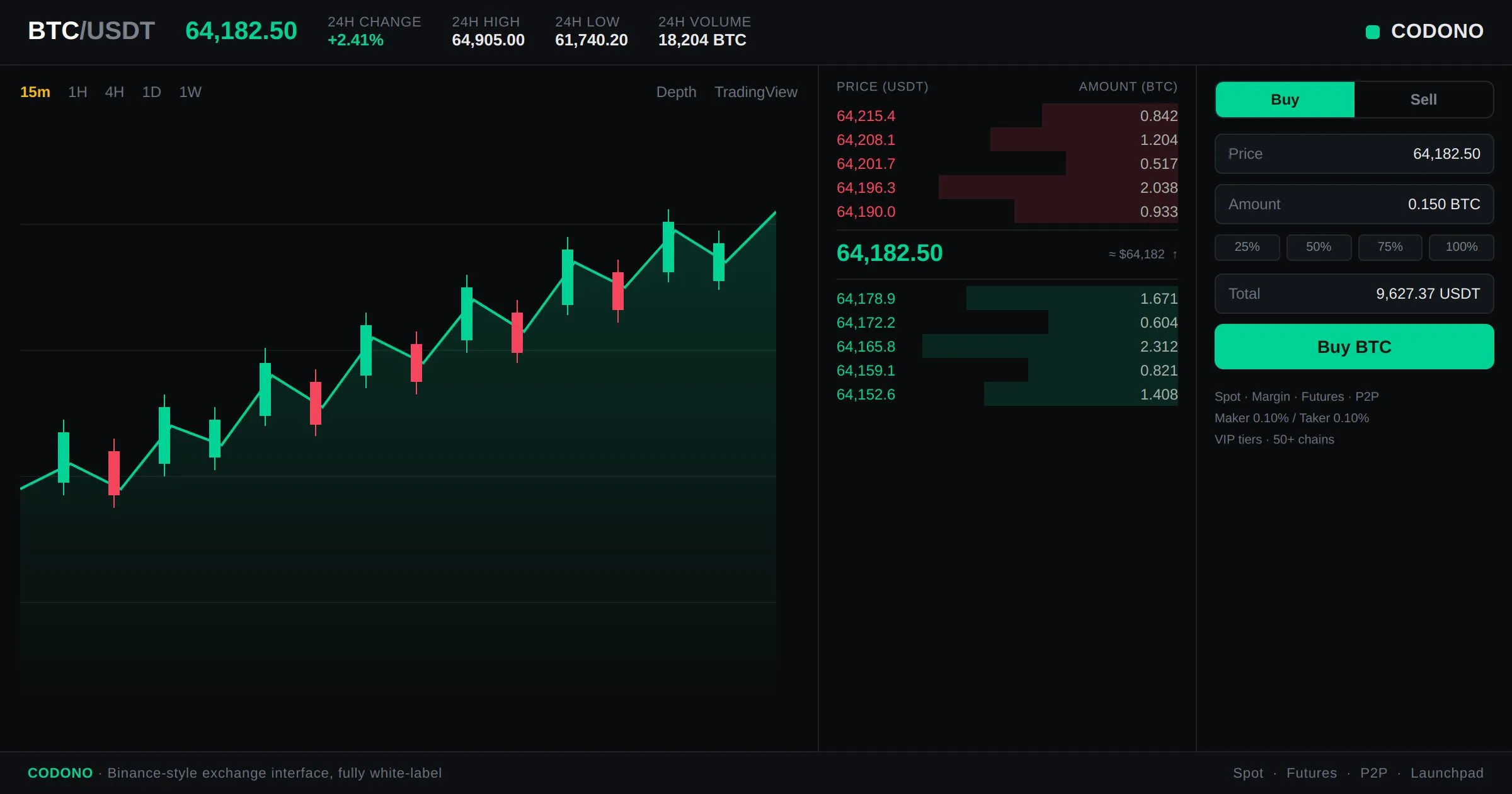
Codono is a product you buy once. The license delivers the complete codebase — matching engine, multi-chain wallets, KYC pipeline, admin panel, iOS/Android apps — deployed on infrastructure you control. Your team (or ours, during assisted deployment) configures markets, connects liquidity, and applies branding. After go-live there is no ongoing platform dependency: no license servers, no callbacks, no revenue share.
Neither model is dishonest about what it is. The mistake operators make is choosing one while wanting the properties of the other.
Cost Structure
Binance Cloud has no public price list — access is invitation-gated and terms are quoted privately, with industry reporting describing substantial setup commitments and ongoing revenue-sharing. That is normal for institutional infrastructure, but it makes five-year budgeting a negotiation rather than a calculation.
Codono’s numbers are public and fixed: $1,899 one-time for Ultra (full source, mobile apps included), Enterprise from $12,500, roughly $200–$800/month for hosting you control. Over five years a mid-size operator’s total cost stays in the tens of thousands — versus SaaS and revenue-share arrangements where costs scale with your own success. Our pricing page has the full breakdown, and how to start a crypto exchange covers the surrounding launch budget.
Liquidity — Where Binance Cloud Genuinely Wins
Let’s concede the real advantage: shared Binance order books mean your users see depth from the world’s largest venue on day one. No aggregation setup, no market-maker negotiations, no thin books at launch. If tight spreads on major pairs are your make-or-break requirement and you accept the dependency, this is the strongest argument for the rented model.
Codono answers the cold-start problem differently: the liquidity engine aggregates external venues (with smart order routing and configurable failover), so your books are full from launch while remaining yours — you choose the sources, the pairs, and the day you switch a market to internal flow. Deep, but by configuration rather than by inheritance.
Branding & Control
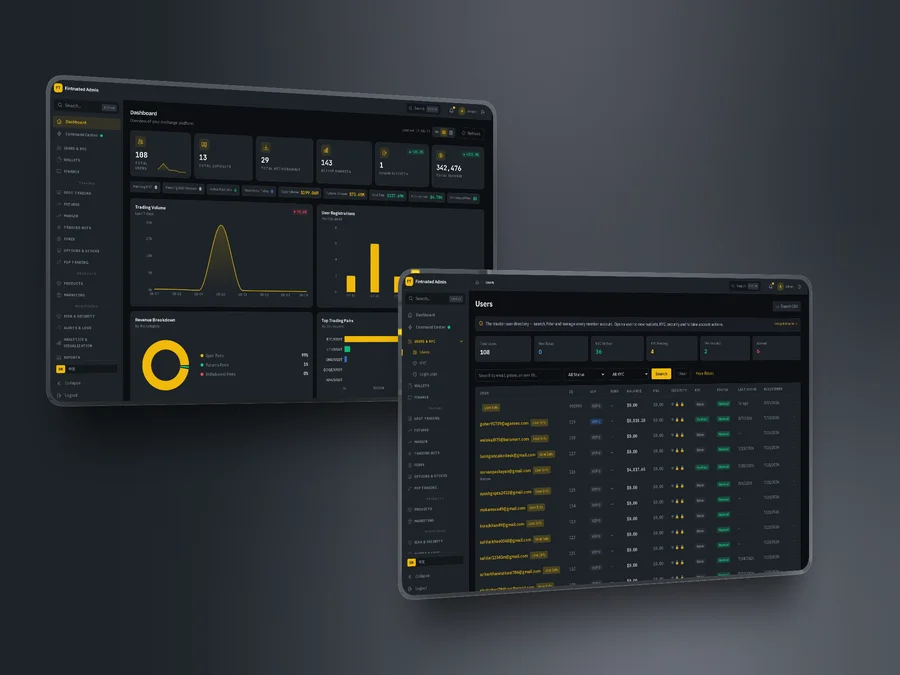
On Binance Cloud your brand fronts Binance’s stack: UI customization within the platform’s boundaries, listings and features within Binance’s catalog and cadence. On Codono the question doesn’t arise — you have the source. Rename anything, restyle everything, add a module, delete one, integrate a regional payment provider Binance never heard of. Control is not a tier; it’s the product.
Compliance Ownership
Under either model, you hold the operating license in your jurisdiction — no white-label arrangement outsources regulatory accountability. The difference is the machinery: Binance Cloud operators work within Binance’s compliance framework and data systems; Codono operators run their own KYC/AML stack with pluggable providers, on infrastructure where they can answer a regulator’s data-residency and audit-trail questions directly. For licensing strategy itself, see the jurisdiction-by-jurisdiction guide .
Exit Risk
The uncomfortable question for any rented platform: what happens when the landlord’s priorities change? Terms can be renegotiated, product lines can be deprioritized, and Binance has a documented history of winding down adjacent services when strategy shifts. Migrating an exchange off a closed platform means rebuilding — new stack, user migration, liquidity re-negotiation — under time pressure.
A source-code deployment has no equivalent failure mode. If Codono disappeared tomorrow, your exchange would keep running unchanged; the code is on your servers and it is yours. That asymmetry is the deepest difference between the two models, and it’s the one that only matters on the worst day.
When Binance Cloud Wins
- Your pitch to users is Binance-grade depth on majors, and nothing else closes that gap fast enough
- You have the institutional profile to get invited and negotiate terms
- You prefer operating a franchise to owning infrastructure, and accept platform dependency as the cost
When Codono Wins
- You want the exchange as an owned asset: code, data, fees, roadmap
- Your budget needs public, fixed, one-time pricing — not a negotiation with revenue share
- You need modifications a hosted platform will never prioritize (regional payments, custom modules, unusual pairs)
- Exit risk is unacceptable: no dependency that can turn your platform off
Evaluate it live: open the demo , compare license tiers , or see the wider field on the Binance Cloud alternatives page.