 Software de Exchange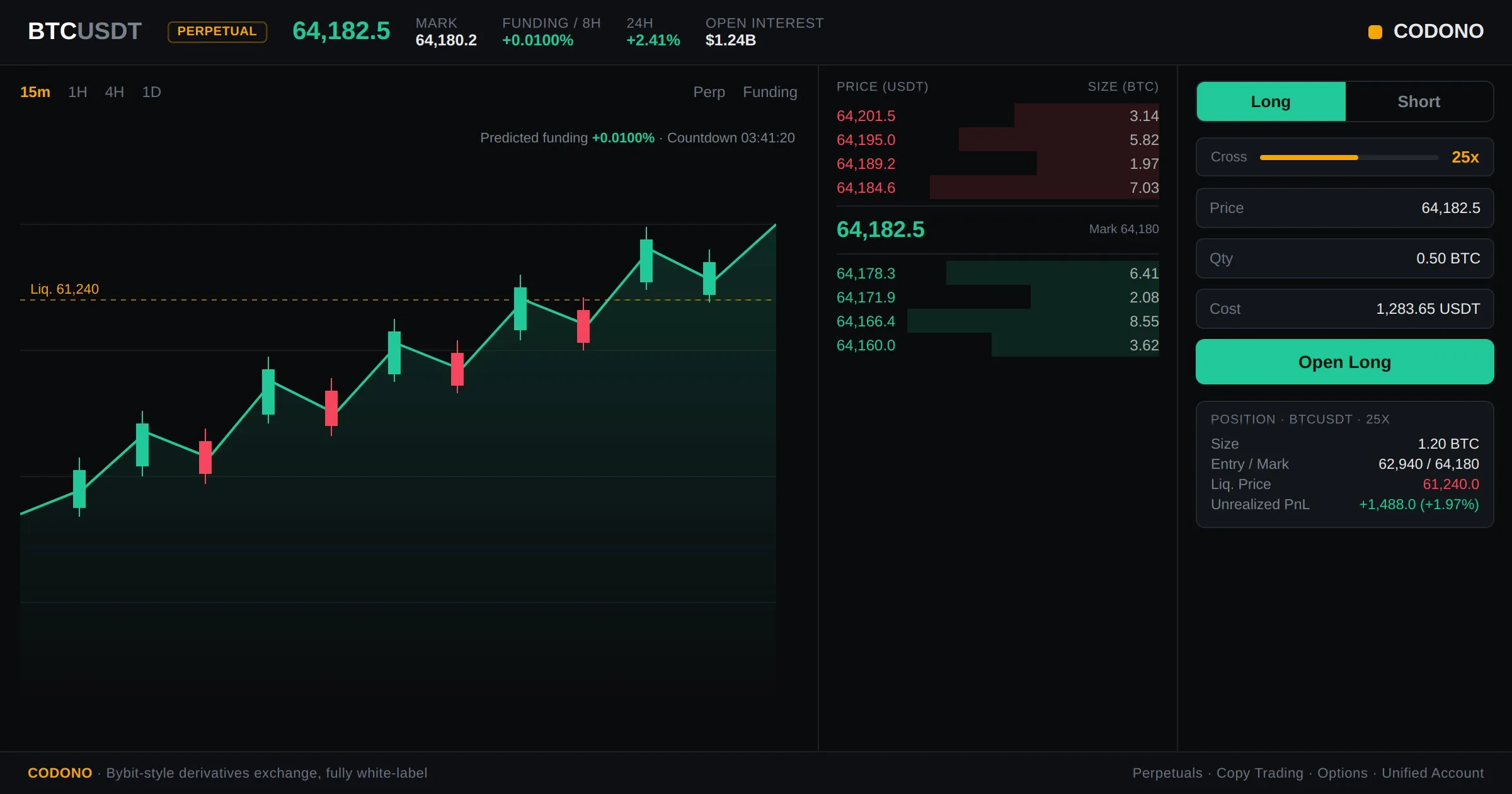
If you’re searching for a Bybit clone alternative, you’ve probably noticed that most “clone scripts” advertise perpetual futures and copy trading — then turn out to be rebranded shells without a real risk engine or source code. This page compares Codono as a source-owned, one-time alternative to those typical Bybit clone scripts , and is honest about when a low-cost clone is the right call.
What Is a Bybit Clone Script?
A Bybit clone script is ready-made exchange software built to replicate the derivatives-first experience that made Bybit a top exchange: perpetual futures , high leverage, a unified trading account, and copy trading as a growth engine.
Configured as a Bybit-style exchange, Codono delivers the same derivatives outcome — branded as your business, with full source-code access. The clone-script label describes the model, not the quality; what matters is whether the underlying software can actually operate a live derivatives exchange with real leverage and real liquidations.
Why Operators Look for a Bybit Clone Alternative
Most operators start by comparing clone scripts on price, then discover the same recurring problems:
- No real source-code ownership. Many clone scripts are encrypted, ionCube-protected, or delivered as a black-box deployment. You cannot audit the risk engine, extend the matching logic, or self-host the stack — and you are locked into the vendor’s license server.
- A “futures” tab without a futures engine. The Bybit model lives or dies on its risk engine. Generic clone scripts often add a perpetuals UI without mark-price liquidations, an insurance fund, or auto-deleveraging — which means the exchange can become insolvent on its first volatile day.
- Copy trading that doesn’t copy. Copy trading is Bybit’s signature growth loop, but many clone scripts ship a leaderboard without real position mirroring, profit-share splits, or follower-risk controls.
- Hidden recurring costs. A low headline price is often followed by annual renewal fees, per-domain licenses, feature unlock fees, or revenue shares that make the platform more expensive than a one-time license over a few years.
- No compliance depth for derivatives. Regulators look at leverage limits, margin transparency, liquidation fairness, and KYC/AML first. Clone scripts that treat compliance as a checkbox put the operator, not the vendor, at risk.
A real Bybit clone alternative solves those structural issues: full source code, a production perpetual-futures engine, working copy trading, transparent one-time pricing, and derivatives-ready compliance infrastructure.
Typical Clone Script vs Codono
| Dimension | Typical Bybit Clone Script | Codono |
|---|---|---|
| Source code | Encrypted, partial, or none | Full codebase to every licensee |
| Commercial model | Recurring license, per-domain, or revenue share | One-time license plus your own hosting |
| Perpetual futures | Often UI-only or basic | Production engine: USDT & inverse, funding, mark price |
| Risk engine | Missing or incomplete | Mark price, partial liquidation, insurance fund, ADL |
| Copy trading | Often leaderboard-only | Real mirroring with profit share and risk caps |
| Unified account | Rarely supported | Spot, margin, and futures share one margin balance |
| Leverage | Fixed or unrealistic | Configurable per contract and risk tier |
| Mobile apps | Often generic or not included | Native iOS and Android with derivatives trading |
| Compliance posture | Checkbox marketing | Designed for derivatives licensing review |
| Long-term cost | Compounds with fees | Predictable one-time cost |
The gap is not just features — it’s whether the platform can survive real derivatives volume and become an owned asset rather than a rented shell.
What Codono Adds
Codono is not a slightly better clone script; it is a source-owned exchange product that can be configured for the Bybit derivatives model. Beyond the table above, the differences show up in day-to-day operations:
- Production perpetual-futures engine. USDT-margined and inverse contracts, funding-rate mechanism, mark-price and index-price systems, and the same risk primitives used by live derivatives exchanges. See futures trading software for the full specification.
- Risk engine that keeps you solvent. Mark-price aggregation, partial liquidation, insurance fund, auto-deleveraging, and configurable risk tiers — the difference between a derivatives exchange that survives volatility and one that doesn’t.
- Working copy trading. Lead-trader approval, profit-share splits, proportional position mirroring, follower allocation caps, and verified performance history so the program can actually compound.
- Unified trading account. One margin balance across spot, margin , and derivatives — the capital-efficiency model Bybit users expect.
- Real source ownership. You host the stack, modify the code, and control the data. There is no license server to fail or vendor to outgrow.
- Transparent pricing. Published pricing tiers with no recurring platform fee — a structural difference that usually wins on multi-year cost.
- Derivatives-ready compliance. Tiered KYC/AML, transaction monitoring, audit logging, and jurisdiction mapping via the compliance framework.
If your plan is to run a derivatives exchange as a real business, those additions move the project from “demo that might launch” to “platform that can handle leverage.”
When a Cheap Clone Script Still Fits
It would be dishonest to say Codono is the right choice for every project. A low-cost Bybit clone script can be the right tool when:
- You need a non-trading demo or MVP to show investors or partners before committing to a full derivatives license and risk-engine review.
- You’re building an internal prototype or training environment where live trading, liquidations, and source ownership do not matter.
- You’re operating in a jurisdiction with minimal compliance requirements and your users do not actually trade derivatives, so the futures UI is decorative.
- Speed matters more than longevity — for example, a short-term marketing experiment or a one-off event.
In those cases, a cheap clone script is a reasonable disposable starting point. For a live derivatives exchange handling leveraged positions, a source-owned platform with a real risk engine is the safer long-term choice.
Migration Path
If you already launched on a generic Bybit clone script and are hitting its limits, migration to Codono follows a standard reconciliation pattern:
- Data export — users, balances, open positions, order history, funding records, and KYC data from the old system.
- Staging import — load the export into a Codono staging environment and validate data integrity.
- Position and balance reconciliation — reconcile user balances, margin, pending orders, and in-flight funding payments before cutover.
- Configuration — map branding, contracts, leverage tiers, copy-trading rules, funding parameters, fees, and payment methods.
- Cutover — brief maintenance window, DNS switch, and post-launch monitoring.
The technical migration is straightforward; the regulatory continuity — keeping your derivatives licensing, banking relationships, and compliance program valid — is what needs planning. Contact us to scope a migration from your current clone script.
Getting Started
- Compare the models — read the full Bybit clone script page to see the derivatives feature set.
- Explore the platform — try the live demo for perpetuals, leverage, and copy trading.
- Check transparent pricing — published pricing tiers with full source-code access.
- Review compliance — see the compliance , margin trading , and futures trading pages to map the regulatory path.
- Talk it through — contact us to scope a new derivatives exchange or a migration from an existing clone script.
The choice between a typical Bybit clone script and Codono comes down to ownership: rent a rebranded derivatives shell, or launch a source-owned exchange with a real risk engine you can grow.