 Exchange-Software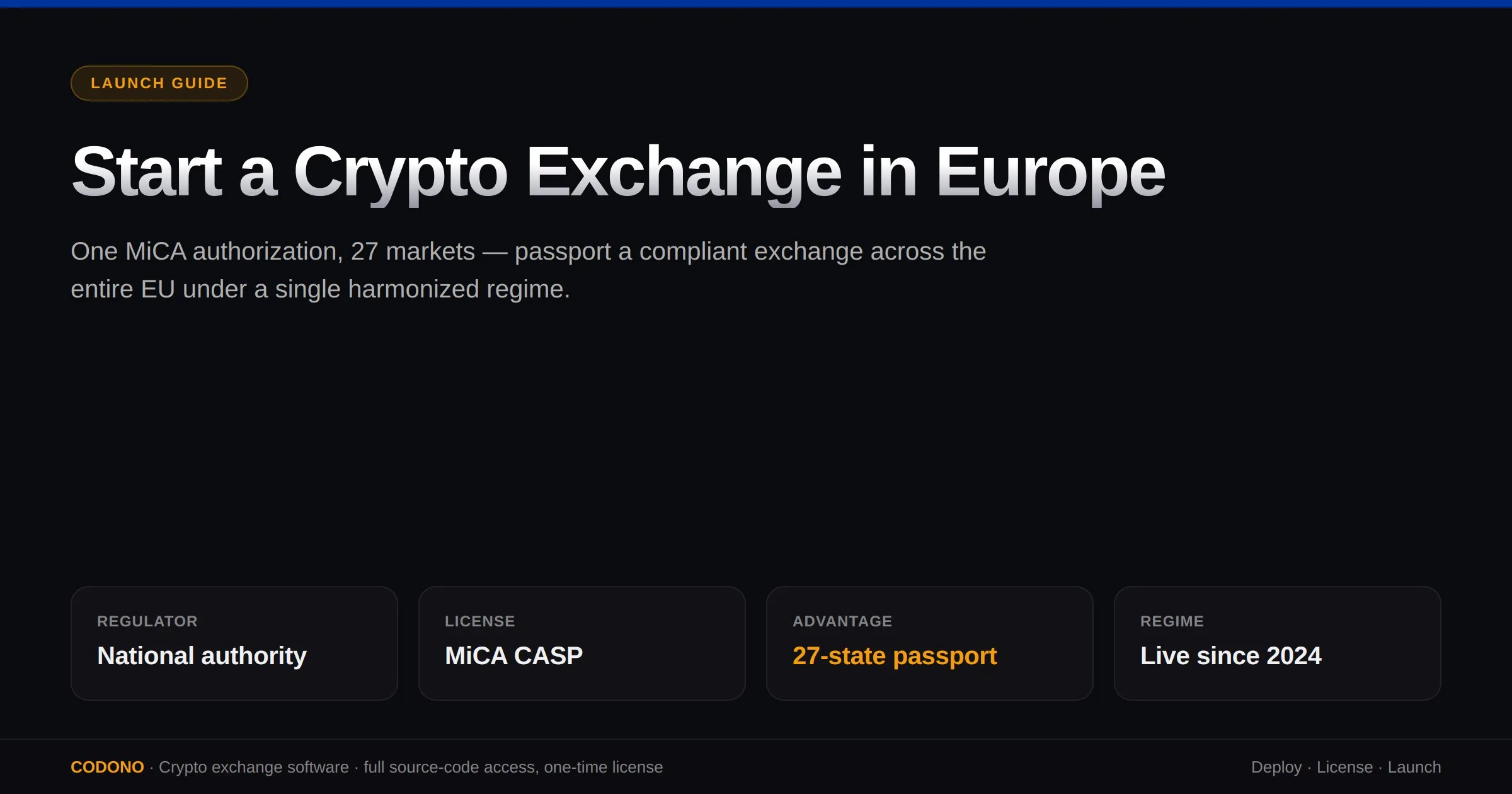
Europe changed the game for crypto exchanges with MiCA — the Markets in Crypto-Assets regulation, coordinated at EU level by ESMA — which replaced a fragmented patchwork of national rules with one harmonized regime across the entire EU. The payoff is unique: a single CASP authorization can passport your exchange across all 27 member states. This guide walks the practical path to launching there.
Why Launch a Crypto Exchange in Europe?
The EU is one of the largest, wealthiest, most crypto-active markets in the world — and MiCA turned it from a regulatory maze into a single, addressable market.
- Regulatory certainty. Before MiCA, serving the EU meant navigating 27 different national approaches. MiCA provides one clear, crypto-specific rulebook — demanding, but predictable.
- A single market via passporting. Authorize once, serve everywhere in the EU. No other major region offers a 27-country market on a single authorization.
- Credibility. A MiCA-authorized CASP carries real regulatory standing, which matters for institutional partners, banking relationships and user trust.
The trade-off is that MiCA’s requirements are substantial — capital, governance, compliance and safeguarding obligations are serious. But for operators willing to meet the bar, the passport makes the EU one of the most valuable regulated markets to hold.
The MiCA Licensing Path
The key thing to understand: the CASP authorization is the hard part, not the software. Under MiCA you must be authorized as a Crypto-Asset Service Provider by a national competent authority in an EU member state before offering services.
At a high level, CASP authorization involves establishing an EU entity with genuine substance and governance, meeting regulatory capital requirements (which scale with the services you offer), demonstrating fit-and-proper management, and standing up a full compliance program — KYC/AML, transaction monitoring, custody and safeguarding, complaints handling and risk controls — that the regulator examines in detail.
This page is orientation, not legal advice. For the detailed treatment see the MiCA compliance guide , and engage an EU regulatory advisor early — CASP authorization is not a do-it-yourself process.
MiCA’s Key Obligations for Exchanges
MiCA is demanding precisely because it is comprehensive. While your advisor will map the specifics to your services, the obligations that most shape an exchange operator’s build and budget include:
- Regulatory capital and prudential safeguards. CASPs must hold minimum capital that scales with the services provided, plus meet ongoing prudential requirements. This is often the largest single number in the plan.
- Client-asset safeguarding. Client crypto and funds must be segregated and protected, with clear custody arrangements — hot/cold segregation, controls over keys, and safeguarding of client money. The platform’s custody infrastructure is built around exactly this.
- Governance and fit-and-proper management. Real substance, qualified management, a compliance function, risk management and conflict-of-interest controls.
- AML/CFT. Full KYC/AML under the EU framework, transaction monitoring and reporting — see the KYC/AML system .
- Transparency and conduct rules. Fair treatment of clients, clear disclosures, complaints handling, and market-abuse controls.
- Stablecoin rules. MiCA treats asset-referenced and e-money tokens (ART/EMT) under specific regimes; if you list or support stablecoins, there are additional requirements around which tokens qualify and how they’re handled.
None of these are the software’s job to decide — but the software must make them operable, which is why an audit-ready, compliance-capable platform matters. The compliance requirements page maps these controls in more detail.
The Passport Advantage
This is what makes the EU strategically special. Once a national competent authority authorizes you as a CASP, you can passport those services across all 27 EU member states — offering your exchange EU-wide without a separate authorization in each country.
The practical implications:
- You choose your home state. Operators weigh regulator responsiveness, cost, language and business environment to pick where to authorize — then serve the whole EU from there. The choice affects your speed and cost, not your market access, which is EU-wide regardless.
- One compliance program, one supervisor. You build and maintain a single MiCA compliance program under your home regulator, rather than 27 parallel ones.
No license-by-country jurisdiction can match this. It is the core reason the EU is worth MiCA’s demands.
Choosing Your Home Member State
Because authorization passports EU-wide, one of your earliest and most consequential decisions is which member state to authorize in. Market access is identical either way — you serve all 27 states — so the choice is about speed, cost and fit, not reach. Operators typically weigh:
- Regulator responsiveness and crypto experience. Some national competent authorities have processed more crypto authorizations and move faster or with more predictability than others. Regulator familiarity with your model can materially shorten your timeline.
- Cost of establishment. Company formation, office, local staffing and professional fees vary significantly across member states.
- Language and operating environment. Working in a jurisdiction whose language and business culture you can operate in day-to-day reduces friction across the whole lifecycle, not just authorization.
- Talent and banking. Access to compliance talent and crypto-friendly banking differs by country and affects both your application and your ongoing operations.
There is no single “best” member state — the right choice depends on your model, budget and timeline, and it is a decision to make with your EU regulatory advisor. The key mental shift: you are choosing an operational home, not a market, because MiCA already gave you the whole market.
What It Costs
| Cost component | Character |
|---|---|
| CASP authorization process | Regulatory; multi-month |
| Regulatory capital | Scales with service scope; often the largest requirement |
| EU entity & substance | Local company, governance, office |
| Compliance staffing | Compliance function, MLRO, governance |
| Exchange software | One-time license, full source-code access — fixed, comparatively small |
As with other license-based jurisdictions, the regulatory and capital components dominate and vary by service scope — confirm current figures with an EU advisor. The software is a fixed one-time cost — see pricing .
How to Launch, Step by Step
- Scope your services — the CASP services you’ll offer drive your capital and requirements.
- Choose your home member state with an EU regulatory advisor.
- Establish the EU entity with substance and governance.
- Prepare and file the CASP application — capital, management, and a documented compliance program.
- Build in parallel — deploy and configure the exchange software (branding, KYC, custody, pairs) inside the authorization window (2–4 weeks).
- Work through regulatory review and meet authorization conditions.
- Launch and passport — go live in your home state and extend across the EU.
The Software That Runs Underneath
Once authorized, you need a platform that meets MiCA’s expectations. Codono provides the infrastructure a CASP relies on:
- KYC/AML pipeline — tiered verification, integrated identity providers, transaction monitoring and reporting.
- Custody & safeguarding — hot/cold segregation and multi-signature withdrawals across 50+ chains, aligned with client-asset protection expectations.
- Audit-ready logging — complete trails across trades, fund movements and admin/KYC decisions.
- Full source-code access — a one-time license, so you own and control the platform.
Which model you launch is your choice — the clone-script overview helps you match a spot, derivatives, retail or full-suite model to your strategy, and the compliance requirements page maps the controls MiCA expects.
MiCA vs Launching Elsewhere
Is the EU the right base for you? It helps to weigh MiCA against the alternatives:
- MiCA vs Dubai. Dubai offers tax efficiency and a business-friendly setup, but serves its market and region. MiCA offers no tax advantage and heavier requirements, but hands you a 27-state single market on one authorization. If your ambition is broad European reach, nothing matches the passport; if tax efficiency and a Gulf/global base matter more, Dubai competes strongly.
- MiCA vs offshore. Offshore jurisdictions can be faster and cheaper, but a MiCA authorization carries regulatory standing that offshore status cannot — which increasingly determines banking access, institutional partnerships and user trust in Europe. For serving EU users credibly and durably, MiCA is the path; offshore is a shrinking option as MiCA enforcement matures.
- MiCA vs pre-MiCA national licenses. MiCA replaced the old patchwork of national registrations. Operating under a single harmonized regime with EU-wide passporting is structurally simpler and more valuable than assembling country-by-country permissions — the fragmentation MiCA was designed to end.
The honest summary: MiCA is the most demanding but most rewarding way to serve Europe. The requirements are real, but the single-market passport and the credibility of authorization make it the right choice for operators serious about the EU — and the reason many are choosing it despite the bar.
Realistic Timeline
- Software deployment: 2–4 weeks.
- EU entity setup: weeks to a couple of months.
- CASP authorization: a multi-month regulatory process, dependent on member state, service scope, capital and application quality.
Plan around the authorization timeline, and use the window to get the platform fully built and tested so you can launch — and passport — the moment authorization lands.
Getting Started
- Consultation — your services, target member state, and licensing position.
- Software — choose from our pricing plans and configure while authorization proceeds.
- Deploy & test — a fully-branded, MiCA-ready platform inside the authorization window.
- Launch & passport — go live with 12 months of updates and technical support.
Contact us to plan your EU launch, or explore the live demo to see the platform you’ll be deploying.