 取引所ソフトウェア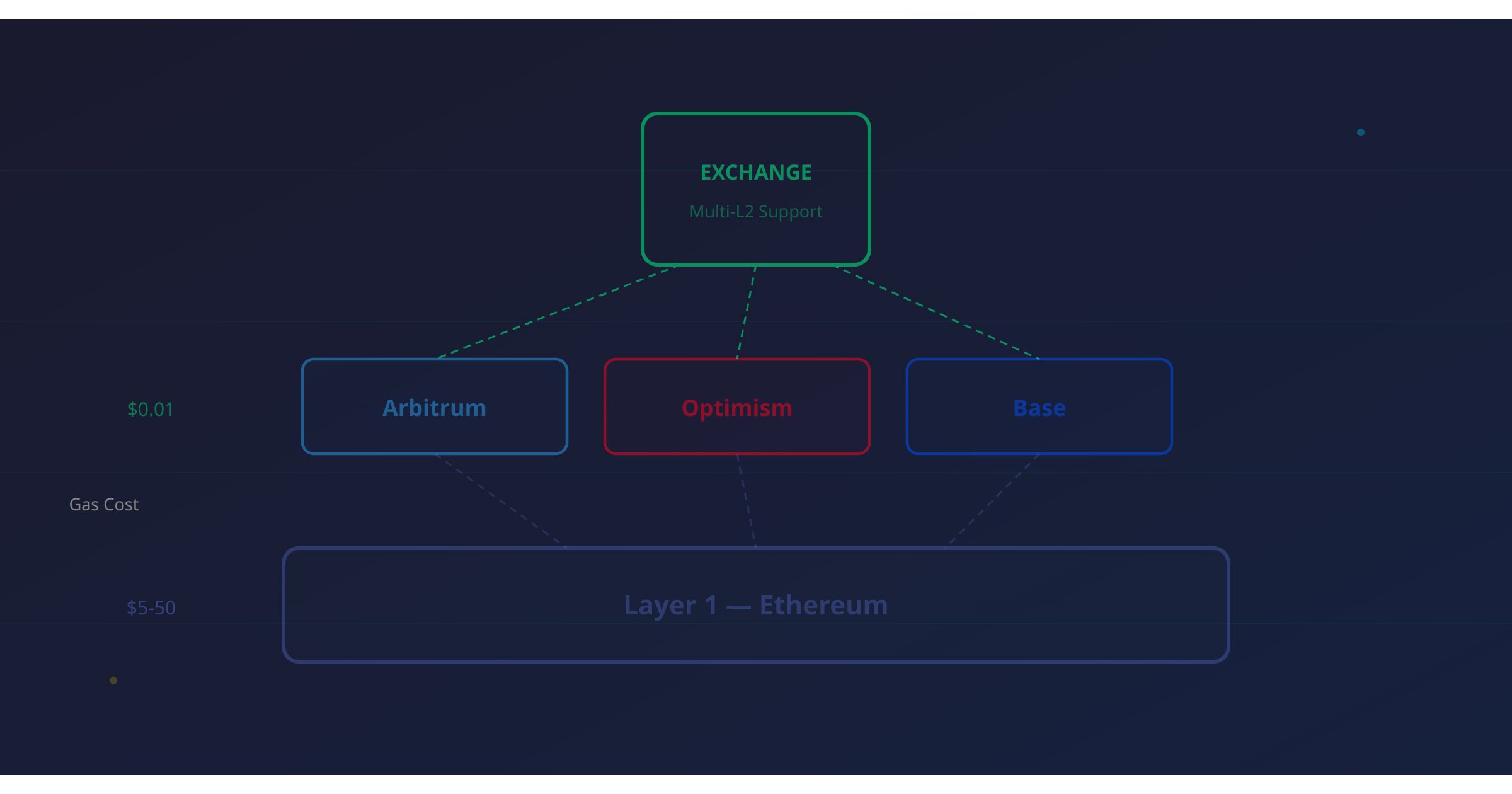
Layer 2 Integration for Crypto Exchanges: The Complete Implementation Guide
Table of Contents
- The Gas Fee Problem That L2 Networks Solve
- The Layer 2 Landscape in 2026
- Rollup Types Explained: Optimistic vs ZK
- Which L2 Networks to Prioritize
- Technical Integration: Node Infrastructure and Deposit Detection
- Multi-L2 Deposit Support: Architecture Decisions
- Withdrawal Routing: Cost, Speed, and User Choice
- L2-Native Token Listings
- Cost Savings for Exchange Operations
- Security Considerations and Finality
- Bridge Risks and Mitigation
- Implementation Priority Roadmap
- The Competitive Advantage of L2 Support
The Gas Fee Problem That L2 Networks Solve
If you are running a crypto exchange that only supports Ethereum mainnet deposits and withdrawals, you are losing users every day. Here is the math: during moderate network congestion, a simple ERC-20 token transfer on Ethereum L1 costs $5 to $15 in gas fees. During peak activity, that figure climbs to $30 or more. For a retail user depositing $100 worth of USDC, paying $10 in gas just to move funds onto your exchange is unacceptable. They will use a competitor that accepts deposits on Arbitrum or Base, where the same transfer costs a few cents.
This is not a theoretical concern. DeFi-native users — the most active and highest-value traders — already hold the majority of their assets on Layer 2 networks. According to L2Beat data, the combined TVL across Ethereum Layer 2 networks exceeded $45 billion in early 2026. Arbitrum alone holds over $18 billion. These users are not going to bridge back to L1, pay the gas fee, and then deposit to your exchange. They will find an exchange that meets them where their funds already are.
The shift is structural, not temporary. As the Ethereum ecosystem matures, L2 networks are becoming the default execution layer. L1 is settling into its role as the security and data availability layer. Exchanges that do not adapt to this reality will increasingly feel like exchanges that never added ERC-20 support back in 2018 — technically functional, but missing where the users actually are.
The Layer 2 Landscape in 2026
Before diving into integration specifics, here is a quick overview of the L2 networks that matter for exchange operators. Each network has different characteristics that affect your integration approach.
Arbitrum One is the largest L2 by TVL and transaction volume. It is an optimistic rollup built by Offchain Labs. The DeFi ecosystem is deep: GMX, Aave, Uniswap, Camelot, and hundreds of other protocols operate here. If you integrate only one L2, this is the one.
Base is built by Coinbase using the OP Stack (same technology as Optimism). It has seen explosive growth through 2025 and into 2026, driven by retail user onboarding from the Coinbase ecosystem. Base has become a hub for social applications, memecoins, and newer DeFi protocols.
Optimism is the original optimistic rollup and the foundation of the OP Stack, which Base and several other L2s use. It has a strong governance ecosystem and solid DeFi presence, though its TVL is smaller than Arbitrum.
zkSync Era is a ZK rollup built by Matter Labs. It uses zero-knowledge proofs for transaction validation, which gives it different finality characteristics than optimistic rollups. The ecosystem is growing but still smaller than Arbitrum or Base.
Polygon zkEVM is Polygon’s ZK rollup solution, separate from the Polygon PoS chain. If you already support Polygon, adding zkEVM is a natural extension. The architecture is designed for EVM equivalence, which simplifies integration.
Starknet uses STARK proofs and has its own VM (not EVM-compatible), which makes integration more complex. It has a dedicated developer community and some unique DeFi protocols, but the integration effort is significantly higher than EVM-compatible L2s.
Linea is built by Consensys (the team behind MetaMask and Infura). It is a zkEVM rollup with growing adoption, partly driven by the MetaMask integration that makes it easy for users to bridge funds.
Rollup Types Explained: Optimistic vs ZK
Understanding the two rollup architectures is critical for exchange operators because they directly affect deposit confirmation times, withdrawal processing, and security assumptions. If you have read our technology stack guide, you know that infrastructure choices cascade through your entire operation. L2 rollup types are no different.
Optimistic Rollups
Optimistic rollups (Arbitrum, Optimism, Base) assume that all transactions posted to the rollup are valid. They batch transactions together, compress them, and post the data to Ethereum L1. If someone believes a batch contains an invalid transaction, they can submit a fraud proof during a challenge window — typically 7 days.
What this means for exchanges:
- Deposits on the L2 itself confirm in seconds (block time is roughly 250ms on Arbitrum).
- However, true L1 finality takes about 7 days because of the challenge period.
- In practice, exchanges treat optimistic rollup deposits as confirmed after a much shorter period (typically 10-30 minutes), accepting the minimal risk that a fraud proof could theoretically invalidate the batch.
- Withdrawals from the L2 to L1 via the native bridge take the full 7 days unless you use a fast bridge or liquidity pool approach.
ZK Rollups
ZK rollups (zkSync, Polygon zkEVM, Starknet, Linea) generate cryptographic proofs that mathematically verify the correctness of every transaction batch. There is no challenge period because the proof itself guarantees validity.
What this means for exchanges:
- Once a ZK proof is posted and verified on L1, the transactions have full L1 finality. This typically takes 1-3 hours depending on the network’s proof generation and posting cadence.
- Withdrawals to L1 via the native bridge are faster than optimistic rollups — hours instead of days.
- The trade-off is that ZK proof generation is computationally expensive, which historically made ZK rollups slightly more expensive per transaction. This gap has narrowed significantly.
The Practical Exchange Perspective
For day-to-day exchange operations, optimistic rollups and ZK rollups feel similar for deposits: both confirm quickly on the L2 itself, and most exchanges credit deposits after a reasonable number of L2 block confirmations rather than waiting for full L1 finality. The real difference shows up in withdrawals to L1 and in how you think about worst-case security scenarios.
Which L2 Networks to Prioritize
Not all L2s deserve the same integration priority. Here is how to think about it based on concrete metrics rather than hype.
Tier 1: Integrate First
Arbitrum One — $18B+ TVL, highest transaction volume among L2s, deepest DeFi ecosystem. This is where the money is. Most DeFi-native users who want to deposit to a centralized exchange hold significant assets on Arbitrum.
Base — Fastest-growing L2 by user count, strong retail presence, direct Coinbase ecosystem pipeline. The growth trajectory makes Base a priority even though its TVL is smaller than Arbitrum. The user base skews toward newer crypto participants who expect L2 support as default.
Tier 2: Integrate Next
Optimism — Solid TVL, strong ecosystem, and shares the OP Stack with Base. If you have already integrated Base, Optimism integration is architecturally very similar, reducing the marginal effort.
Polygon zkEVM — If you already support Polygon PoS (and you should, given its established ecosystem), adding zkEVM is a natural extension. The user overlap is significant.
Tier 3: Evaluate Based on Your Market
zkSync Era — Growing ecosystem, technically interesting, but smaller user base. Integrate if your target market includes Eastern European or developer-heavy communities where zkSync has strong adoption.
Starknet — Unique ecosystem but non-EVM architecture means significantly higher integration cost. Only prioritize if specific high-demand tokens are Starknet-native.
Linea — Growing but still early. Monitor and integrate when TVL and user metrics justify the effort.
Technical Integration: Node Infrastructure and Deposit Detection
Integrating an L2 network into your exchange shares many patterns with Ethereum mainnet integration, but there are important differences. Here is what the technical work actually looks like.
Node Infrastructure
Each L2 you support requires its own node infrastructure. For EVM-compatible L2s (Arbitrum, Base, Optimism, zkSync Era, Polygon zkEVM, Linea), you are running nodes that expose a standard Ethereum JSON-RPC interface. This is good news: your existing Ethereum deposit detection and withdrawal processing code can largely be reused.
Arbitrum runs Nitro nodes. You need an Arbitrum full node that syncs with the network and an L1 Ethereum node for verification. Disk requirements are moderate compared to Ethereum mainnet — around 500GB to 1TB for a full node as of early 2026.
Base and Optimism run op-node plus op-geth. Since they share the OP Stack, the node software is nearly identical. You need an L1 Ethereum node as well.
zkSync Era runs its own node software. Disk requirements are currently smaller than Arbitrum but growing.
For production exchange infrastructure, you need at least two nodes per chain: one primary and one failover. You should also consider using a node provider (Alchemy, Infura, QuickNode) as a secondary data source for cross-verification, even if you run your own nodes.
Deposit Detection
The deposit detection flow on L2s follows the same pattern as L1:
- Generate a unique deposit address for each user (or use a shared hot wallet with memo/tag system).
- Monitor incoming transactions to deposit addresses by scanning new blocks.
- Wait for a sufficient number of block confirmations before crediting the user’s exchange balance.
- Move deposited funds from individual deposit addresses to the exchange’s hot wallet (the sweep transaction).
The key difference is confirmation requirements. On Ethereum L1, most exchanges wait for 12-35 block confirmations (roughly 2.5 to 7 minutes). On L2s, block times are much faster (sub-second on some chains), so you need to think about confirmations differently.
A practical approach: wait for the L2 transaction to be included in a batch that has been posted to L1. For optimistic rollups, this typically happens within 10-20 minutes. For ZK rollups, wait until the proof is posted, which can take 1-3 hours. Some exchanges accept the risk of crediting sooner (after 50-100 L2 block confirmations) for smaller deposits and use longer confirmation windows for large deposits.
Withdrawal Processing
Withdrawal processing on L2 is straightforward: you send a transaction from your hot wallet on the L2 to the user’s withdrawal address on the same L2. The transaction confirms in seconds and costs a fraction of an L1 transaction.
The complexity comes when a user wants to withdraw to L1 (Ethereum mainnet) while your funds are on L2. We cover this in the withdrawal routing section below.
Multi-L2 Deposit Support: Architecture Decisions
When your exchange supports multiple L2 networks, you face a key architecture decision: how do you present deposit options to users?
Unified Address Approach
Since most L2s are EVM-compatible, the same Ethereum address (derived from the same private key) is valid across all of them. This means you can show users a single deposit address and let them choose which network to send on.
Advantages:
- Simpler user experience — one address, multiple network options.
- Simpler key management — one key pair covers all EVM L2s.
- Less infrastructure for address generation.
Risks:
- If a user sends funds on a network you do not support, the funds are recoverable (you control the private key) but require manual intervention.
- You must clearly communicate which networks are supported to avoid user confusion.
Chain-Specific Presentation
Even with unified addresses, the deposit UI should make the network selection explicit and prominent. Best practices:
- Show the deposit address with a dropdown or tab selector for the network (Ethereum, Arbitrum, Base, Optimism, etc.).
- Display the estimated confirmation time and fee for each network option.
- Show a warning if the user selects a high-fee option (L1) when cheaper L2 options are available.
- Remember the user’s last-used network as a default.
This is a wallet infrastructure concern as much as a UI concern. Your wallet service needs to track balances and process transactions independently on each chain, even though the addresses are shared.
Withdrawal Routing: Cost, Speed, and User Choice
Withdrawal routing is where multi-L2 support gets genuinely complex. Users want to withdraw to a specific network, but your exchange’s funds might be distributed across multiple chains.
The Three Routing Strategies
Cheapest path: Route the withdrawal through whichever network has the lowest fees at the moment. If a user wants ETH on Arbitrum and you have ETH on Arbitrum, send directly. If you are low on Arbitrum ETH, you could bridge from Base or Optimism — but this adds latency and bridge fees that may exceed the savings.
Fastest path: Always process from the same chain the user requested. This requires maintaining sufficient liquidity on each supported L2, which has capital efficiency implications.
User choice: Let the user explicitly select which network they want to receive funds on. Show the fee and estimated time for each option. This is the most transparent approach and the one most exchanges adopt.
Liquidity Management Across Chains
The practical challenge of multi-L2 withdrawals is liquidity management. If 80% of your withdrawal requests go to Arbitrum but only 40% of your deposits come from Arbitrum, you need to constantly rebalance funds across chains.
Rebalancing options:
- Native bridges: Cheapest but slowest. Optimistic rollup bridges take 7 days from L2 to L1. L1 to L2 deposits are faster (10-20 minutes).
- Third-party bridges: Services like Across, Stargate, or Synapse can move funds between L2s in minutes for a small fee (typically 0.05-0.15%).
- Centralized exchange liquidity: If you hold funds on multiple centralized exchanges, you can use them as intermediary liquidity pools.
- Scheduled rebalancing: Rather than rebalancing on every withdrawal, batch rebalancing on a schedule (every few hours) to minimize bridge costs.
L2-Native Token Listings
As the L2 ecosystem matures, an increasing number of tokens exist only on specific L2 networks. GMX is native to Arbitrum (and Avalanche). Many newer tokens launch exclusively on Base. Some DeFi protocol tokens are deployed on one or two L2s and may never exist on Ethereum mainnet.
Handling L2-Native Tokens
When listing an L2-native token, your exchange needs to account for several factors:
Contract verification: Verify the token contract on the specific L2. Do not assume that because a token is popular on Arbitrum, the same contract address on other chains is the legitimate version. Cross-chain token impersonation is a real attack vector.
Deposit and withdrawal networks: For L2-native tokens, deposits and withdrawals are only possible on the chains where the token exists. Make this clear in the UI. A user cannot withdraw an Arbitrum-native token to Ethereum mainnet unless there is a bridged version on mainnet.
Wrapped asset handling: Some L2-native tokens have wrapped versions on other chains via bridges. Decide whether your exchange treats the native version and bridged versions as the same asset (unified balance) or separate assets. The unified approach is better for user experience but requires your backend to manage cross-chain fungibility.
Price feeds: L2-native tokens may have primary liquidity on L2 DEXs. Your price oracle infrastructure needs to pull data from L2 DEX sources (Uniswap on Arbitrum, Aerodrome on Base) alongside centralized exchange feeds. This matters for your overall exchange architecture.
Cost Savings for Exchange Operations
One of the most compelling reasons to support L2 networks is the direct cost savings on exchange operations. This goes beyond user-facing fees.
Withdrawal Fee Comparison
| Operation | Ethereum L1 | Arbitrum | Base |
|---|---|---|---|
| ETH transfer | $2-10 | $0.01-0.05 | $0.005-0.03 |
| ERC-20 transfer | $5-15 | $0.02-0.10 | $0.01-0.05 |
| Batch (10 transfers) | $50-150 | $0.20-1.00 | $0.10-0.50 |
For an exchange processing 5,000 withdrawals per day, the difference between L1 and L2 processing is dramatic. At L1 average costs, that is $25,000-$75,000 per day in gas. On Arbitrum, it is $100-$500 per day. The annual savings can reach millions of dollars.
Batch Withdrawal Optimization
L2 networks make batch withdrawal processing even more attractive. Because L2 gas costs are so low, you can process withdrawals more frequently (every 5 minutes instead of every 30 minutes) without significant cost impact. This improves the user experience — faster withdrawals — while keeping costs minimal.
Some exchanges also implement smart batching: during low-congestion periods, they process through L1 for users who specifically requested it; during high-congestion periods, they nudge users toward L2 withdrawal options with fee comparisons shown at withdrawal time.
Sweep Transaction Savings
Sweep transactions — moving funds from individual deposit addresses to your hot wallet — are a major operational cost for exchanges. On L1, each sweep costs gas. If you have 10,000 deposit addresses with small balances, sweeping them all can cost more than the deposited amounts.
On L2, sweep costs are negligible. You can sweep more frequently and with lower minimum thresholds, improving your capital efficiency. Dust balances that would be uneconomical to sweep on L1 become worth collecting on L2.
Security Considerations and Finality
L2 integration introduces security considerations that differ from L1 chains. Your security infrastructure needs to account for these differences.
Finality Times by Network Type
Optimistic rollups (Arbitrum, Optimism, Base):
- L2 block confirmation: near-instant (sub-second to 2 seconds).
- Batch posted to L1: 10-20 minutes typically.
- Full L1 finality (challenge period expires): ~7 days.
- Practical exchange confirmation: 10-30 minutes for most deposits; longer for large amounts.
ZK rollups (zkSync, Polygon zkEVM, Linea):
- L2 block confirmation: near-instant.
- Proof generated and posted to L1: 1-3 hours typically.
- Full L1 finality (proof verified): same as proof posting.
- Practical exchange confirmation: 1-3 hours for full security; shorter periods acceptable for smaller amounts.
Handling Reorgs
L2 reorgs (reorganizations where the chain reverts recent blocks) are rare but possible, especially on newer L2 networks. Your deposit detection system should handle this the same way it handles L1 reorgs: maintain a confirmation threshold and only credit deposits after that threshold is met.
On optimistic rollups, a more serious concern is a sequencer failure. If the L2 sequencer goes down, users can still force transactions through L1, but this is slow and expensive. Your monitoring infrastructure should track sequencer health for each supported L2 and pause deposits/withdrawals if the sequencer is unresponsive.
Sequencer Centralization Risk
Most L2 networks currently operate with a single sequencer (the entity that orders transactions and produces blocks). This is a centralization risk: the sequencer can theoretically censor transactions or go offline. Major L2 teams are working on decentralized sequencer solutions, but as of 2026, most L2s still have centralized sequencers with escape hatch mechanisms.
For exchange operators, this means:
- Monitor sequencer uptime and latency for each supported L2.
- Have automated circuit breakers that pause L2 deposits/withdrawals if the sequencer is unresponsive.
- Understand the escape hatch mechanism for each L2 so you can recover funds in worst-case scenarios.
Bridge Risks and Mitigation
Cross-chain bridges are one of the highest-risk components in crypto infrastructure. Over $2.5 billion has been lost to bridge exploits historically (Ronin, Wormhole, Nomad, Harmony). When your exchange interacts with bridges for liquidity rebalancing, you are taking on bridge risk.
Mitigating Bridge Risk
Use native bridges when possible. The native rollup bridges (Arbitrum’s bridge, the OP Stack bridge) inherit the security of the rollup itself and of Ethereum L1. They are the safest option, though they are slower for optimistic rollups.
Limit exposure to third-party bridges. If you use third-party bridges (Across, Stargate, etc.) for fast rebalancing, cap the amount in transit at any given time. Do not route your entire treasury through a third-party bridge.
Diversify bridge providers. If you need fast bridging, spread the volume across multiple bridge protocols. A single bridge exploit should not expose a critical portion of your exchange’s funds.
Never require users to bridge. Your exchange should handle all bridging internally. Users should deposit on whichever L2 they already have funds on. The exchange manages cross-chain liquidity behind the scenes.
Implementation Priority Roadmap
Here is a practical roadmap for adding L2 support to your exchange, whether you are building from scratch or adding L2 to an existing platform.
Phase 1: Foundation (Weeks 1-4)
- Deploy Arbitrum and Base nodes (full nodes with L1 verification).
- Extend your deposit detection service to scan both L2 chains.
- Implement L2 deposit crediting with appropriate confirmation thresholds.
- Enable L2 withdrawals for ETH and major stablecoins (USDC, USDT).
- Update the deposit UI with network selection.
Phase 2: Expansion (Weeks 5-8)
- Add Optimism support (minimal effort if Base is already integrated due to shared OP Stack).
- Implement batch withdrawal processing on L2 networks.
- Add L2-native token listings (start with top tokens by volume on each L2).
- Build liquidity monitoring dashboards to track balances across chains.
- Implement automated rebalancing between L2s using native bridges.
Phase 3: Optimization (Weeks 9-12)
- Add Polygon zkEVM and evaluate zkSync Era based on market demand.
- Implement smart withdrawal routing with fee comparison for users.
- Optimize sweep transaction schedules on L2 (more frequent, lower thresholds).
- Add third-party bridge integration for fast rebalancing (with exposure limits).
- Build monitoring and alerting for sequencer health across all supported L2s.
Phase 4: Advanced (Ongoing)
- Evaluate Starknet and other non-EVM L2s based on user demand.
- Implement cross-chain withdrawal netting (if a deposit comes in on Arbitrum and a withdrawal is pending on Arbitrum, net them internally).
- Explore L2-native order book deployment for reduced trading latency.
- Monitor the decentralized sequencer landscape and update your risk models accordingly.
The Competitive Advantage of L2 Support
Exchanges that support L2 deposits and withdrawals have a measurable competitive advantage. DeFi-native users — who represent the most active trading segment — choose exchanges based on which networks are supported. If a trader has $50,000 in USDC on Arbitrum and your exchange requires an L1 deposit, they need to bridge to L1 (7-day wait or bridge fee), then pay L1 gas to deposit. A competitor that accepts Arbitrum deposits directly gets that user’s business every time.
The data supports this. Exchanges that added L2 support in 2025 reported 15-30% increases in deposit volume within the first quarter of launch. The users who deposit via L2 also tend to be more active traders, contributing disproportionately to trading volume and fee revenue.
Beyond user acquisition, L2 support is increasingly a compliance and partnership signal. Institutional counterparties and liquidity providers expect modern infrastructure. Supporting only L1 in 2026 signals outdated technology, which affects partnership discussions regardless of your actual platform quality.
If you are evaluating crypto exchange software and L2 support is not on the roadmap, that is a red flag. The Ethereum ecosystem has structurally moved to L2, and exchanges need to follow.
Building an exchange with L2 support from day one? Codono’s exchange platform includes multi-chain wallet infrastructure that extends to Layer 2 networks. Explore the full feature set or check the blockchain integration guide to see which chains are supported out of the box.
Codono Team
Codono builds enterprise-grade crypto exchange software deployed by 250+ operators across 30+ countries. Our team writes from production experience running spot, derivatives, custody, and compliance at scale.
View all posts by Codono Team →